Hand symptoms associated with rheumatoid arthritis: A clinical guide to patterns, progression, and function
Typical locations and inflammatory pattern
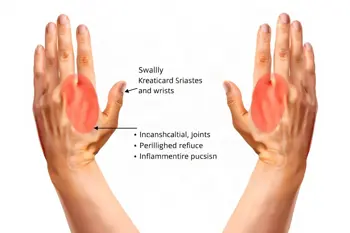
Rheumatoid arthritis most often affects the small joints of the hands and wrists, particularly the metacarpophalangeal joints at the knuckles and the proximal interphalangeal joints in the fingers. These joints can become painful, swollen, warm, and tender as the immune system inflames the synovial lining. The wrist is also a characteristic peripheral site of disease involvement. 1
A notable pattern is symmetry. Symptoms may develop in corresponding joints on both hands, although the disease does not always begin or progress identically on each side. Symmetrical pain, tenderness, and swelling can help distinguish rheumatoid arthritis from some other causes of hand discomfort, but symptoms alone cannot establish a diagnosis. Osteoarthritis, tendon disorders, nerve compression, and other inflammatory conditions can produce overlapping complaints. 2
Early symptoms in the fingers and wrists
Early hand symptoms commonly include aching or sharp joint pain, puffiness around the knuckles or finger joints, and stiffness after sleep or inactivity. Morning stiffness lasting more than 60 minutes is described in consumer and professional references as a characteristic inflammatory feature, while some clinical summaries identify stiffness lasting more than 30 minutes as an important warning pattern. The duration, recurrence, and effect on daily activities are all relevant details for a clinical assessment. 3 4
Inflammation can make ordinary hand movements difficult. A person may struggle to make a fist, turn a handle, grip an object, button clothing, or perform other tasks requiring finger coordination. Pain and stiffness can be most noticeable after rest, while swelling may make rings, gloves, or tools feel unusually tight. These symptoms can fluctuate, with periods of greater activity and periods of relative improvement. 3
Effects on strength, movement, and tendons
Hand weakness and reduced grip strength are frequent functional consequences of rheumatoid arthritis. Pain can inhibit forceful movement, while persistent inflammation and joint damage can reduce the mechanical efficiency of the fingers and wrist. A cross-sectional study of 55 patients at Royal Prima Hospital Medan found that functional impairment was especially prominent among respondents older than 40, with women showing greater functional limitation than men in that study population. 8
Rheumatoid arthritis can also affect tendons and the fluid-filled sheaths surrounding them. Tenosynovitis may cause pain, swelling, restricted finger movement, and difficulty sliding a tendon smoothly during flexion or extension. Tendon involvement can contribute to weakness and may complicate the relationship between joint pain and hand function. Radiology references describe rheumatoid arthritis as a disease that primarily involves synovial joints, tendons, and bursae, rather than only cartilage and bone. 7 10
Structural changes and visible deformities
Persistent inflammation can damage cartilage, bone, tendons, and supporting ligaments. Over time, this may alter finger alignment and reduce the range of motion. Two recognized patterns are boutonniere deformity, in which a finger becomes bent at the middle joint, and swan-neck deformity, in which the finger develops an abnormal combination of joint positions. These changes are associated with damage to the structures that guide and stabilize the fingers. 4 5
Ulnar deviation is another classic structural change. In this pattern, the fingers drift toward the little-finger side of the hand, particularly at the knuckle joints. Rheumatoid nodules may also appear as firm lumps under the skin near affected joints or over pressure points, although their presence and size vary. Deformities generally indicate more established structural involvement and can interfere with grasping, pinching, writing, and other precise movements. 9 11
Associated symptoms beyond the hand
Rheumatoid arthritis is a systemic autoimmune disease, so hand symptoms may occur alongside problems elsewhere in the body. General symptoms can include fatigue, weakness, and fever, while inflammation may also affect the eyes, skin, nerves, blood, heart, or lungs. These broader effects help explain why rheumatoid arthritis is evaluated as a whole-body condition rather than as an isolated hand disorder. 1 2
Nerve compression can accompany rheumatoid arthritis in the wrist and hand. Carpal tunnel syndrome is one example of nerve-related symptoms reported in people with rheumatoid arthritis, potentially causing numbness, tingling, pain, or weakness in the hand. Numbness is not a typical substitute for joint inflammation, so persistent sensory symptoms require separate clinical consideration. The combination of swollen wrists, altered sensation, and declining grip should not be attributed automatically to one cause. 12
How clinicians evaluate hand symptoms
Diagnosis is based on the overall clinical picture, including the distribution of swelling, tenderness, stiffness, and functional limitation. Blood tests may include rheumatoid factor, anti-cyclic citrullinated peptide antibodies, erythrocyte sedimentation rate, and C-reactive protein. These tests provide supporting evidence, but none should be interpreted in isolation because abnormal results can occur in other diseases and normal results do not alone exclude rheumatoid arthritis. 6
Imaging can help identify inflammation and structural damage. Early rheumatoid changes may be non-osseous, making ultrasound or magnetic resonance imaging useful for detecting synovitis or tendon involvement, while X-rays can document later erosions, alignment changes, and joint destruction. Clinical assessment also considers whether symptoms are symmetrical, how long morning stiffness lasts, whether other joints or organs are involved, and how daily hand function has changed. 7
Why progression and function require attention
Untreated or inadequately controlled inflammation can progressively damage articular structures and reduce hand function. Early treatment with disease-modifying antirheumatic drugs, together with physical measures and, in selected cases, surgery, can reduce symptoms and slow disease progression. Splinting, exercises, and physical or occupational therapy may be incorporated to preserve movement and support daily activities, with choices determined by disease activity and structural findings. 1 4
Hand pain, swelling, or prolonged stiffness does not prove rheumatoid arthritis, and self-diagnosis can delay assessment of other conditions. Conversely, persistent symmetrical symptoms should not be dismissed as ordinary aging. A healthcare professional can assess inflammatory signs, order appropriate laboratory and imaging tests, and consider systemic symptoms. Treatment requires ongoing medical oversight because rheumatoid arthritis can affect multiple organs and because disease activity and hand function may change over time. 2 6
Sources
- Merck Manual Professional Edition, Rheumatoid Arthritis
- MedlinePlus, Rheumatoid Arthritis
- Pacific Arthritis Care, Rheumatoid Arthritis Symptoms in Hands
- MSD Manual Consumer Version, Rheumatoid Arthritis
- Cleveland Clinic, Arthritis in Hands
- Arthritis Foundation, Testing for Rheumatoid Arthritis
- Radiopaedia, Rheumatoid Arthritis Musculoskeletal Manifestations
- International Journal of Science and Environment, Clinical Functional Profile of the Hands of Patients with Rheumatoid Arthritis
- Mayo Clinic, Rheumatoid Arthritis Symptoms and Causes
- American Academy of Orthopaedic Surgeons, Rheumatoid Arthritis of the Hand and Wrist
- Johns Hopkins Medicine, Rheumatoid Arthritis
- UpToDate, Clinical Manifestations of Rheumatoid Arthritis
Authored by MyTrendSpot team