Acquiring Commercial Assets: A Practical Analysis of Impound Flatbed Trailers on Sale
Navigating the secondary market for industrial hauling equipment often leads operators to investigate municipal and private liquidations. Sourcing impound flatbed trailers on sale represents a practical method for acquiring heavy-duty transport assets at a reduced cost structure. These public sales, conducted by law enforcement agencies, municipal authorities, and contracted towing companies, serve to dispose of unclaimed or seized transportation equipment. Because these entities prioritize clearing restricted inventory over securing standard retail profit margins, the resulting marketplace offers unique opportunities for prepared buyers.
The Logistics of Impound and Police Auctions for Flatbed Trailers
Municipalities and law enforcement agencies manage seized and abandoned property through scheduled public liquidations. When flatbed trailers are impounded due to registration lapses or road violations, they are held for a legally mandated period. If owners fail to claim the equipment, ownership is forfeited, allowing the hosting agency to liquidate the assets. Government surplus sites and public bidding platforms are utilized to facilitate these sales, serving as the official clearinghouse for various equipment types 2.
Private towing companies also play a significant role in this market. Working under municipal contracts, these operators clear roadways of abandoned flatbeds 5. Because storage space in metropolitan yards is limited, operators are incentivized to initiate lien sales and public auctions as quickly as local statutes permit. This continuous flow of forfeited equipment creates a highly active secondary market, although acquiring units requires consistent monitoring of regional auction schedules 1.
Commercial and Heavy-Duty Configurations in the Salvage Market
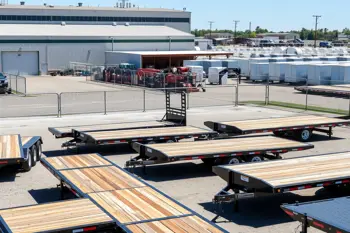
The diversity of flatbed trailers circulating through the impound and salvage auction ecosystem is extensive, spanning from light utility platforms to heavy-duty industrial haulers. Industrial salvage auctions, including major national networks, routinely list trailers categorized by model year, damage profile, and structural configuration 3. In major commercial states like Texas and Ohio, auctions regularly feature flatbeds from prominent manufacturers such as Big Tex, Great Dane, and Utility Trailer Manufacturer 4.
These assets typically fall into several distinct structural classes. Heavy equipment flatbeds, designed for carrying massive payloads like construction excavators, often feature robust 16-inch pierced I-beam mainframes with gross vehicle weight ratings exceeding 53,000 pounds. At the same time, logistics firms can find aluminum spread-axle semi-trailers with 80,000-pound GVWR capacities. For agricultural and local hauling, light-to-medium bumper pull flatbeds with capacities ranging from 14,000 to 25,900 pounds represent a highly accessible category of auctioned assets.
Navigating Regulatory, Legal, and Title Challenges
Acquiring equipment through impound channels requires a thorough understanding of the legal frameworks governing vehicle titles and registration. Unlike retail purchases, where a dealer handles title transfers, auction buyers must navigate the paperwork independently. Municipal sales may issue a government bill of sale or a certificate of repossession, which must be presented to the state Department of Motor Vehicles to secure a clean title. Conversely, salvage auctions often issue salvage titles indicating that the trailer was previously deemed a total loss 3.
Operating an auctioned flatbed trailer legally on public highways demands strict adherence to state-level inspection protocols. If a trailer carries a salvage title, it must undergo a comprehensive rebuilt-vehicle inspection to verify that all structural and safety systems meet highway regulations. Buyers should also verify that there are no active liens associated with the trailer's serial number, as some jurisdictions may require these liabilities to be settled before registration is approved.
Critical Inspection Checklists for Auctioned Flatbeds
Because impounded and seized flatbeds are sold strictly in an as-is, where-is condition, detailed inspection is paramount to preventing costly acquisition mistakes 1. The primary focus of any physical inspection must be the structural integrity of the main frame rails. Inspectors should look closely for warped steel, stress fractures along welds, or deep-scale rust that could compromise the load-bearing capacity of the I-beams. Aluminum trailers require a careful search for hairline cracks near joint stress points.
In addition to frame evaluation, the trailer's running gear and mechanical subsystems require checking. Buyers should evaluate the condition of the axles, suspensions, and braking infrastructure, whether it utilizes standard electric brakes or heavy-duty air brakes. Replacing entire axle assemblies or installing new braking systems can quickly erase any initial cost advantages. Finally, the decking material, whether treated yellow pine, oak, or aluminum flooring, must be evaluated to determine if immediate replacement is necessary to safely secure heavy machinery.
Comparative Market Metrics and Value Expectations
Understanding the standard specifications of available flatbed configurations helps buyers evaluate whether an auctioned asset represents a viable investment relative to its rehabilitation cost. The table below outlines typical specifications for flatbed trailers frequently encountered in commercial and salvage auction environments.
| Trailer Classification | Standard GVWR Range | Main Frame Construction | Common Braking Systems |
|---|---|---|---|
| Heavy Equipment Pintle | 50,000 to 55,000 lbs | 16-inch Pierced I-Beam | Full Air Brake Systems |
| Aluminum Semi-Flatbed | 70,000 to 80,000 lbs | Lightweight Aluminum Beam | Air Ride Spread Axle Drum |
| Heavy Gooseneck Flatbed | 25,000 to 40,000 lbs | Engineered Steel I-Beam | Electric-Over-Hydraulic |
| Medium Bumper Pull | 14,000 to 25,900 lbs | Standard Channel or I-Beam | Dual Electric Spring Axles |
While standard commercial trailers command premium prices when purchased new, units sold through municipal repossession or salvage auctions are typically priced based on immediate demand, physical condition, and local buyer turnout 13. Buyers must balance the auction acquisition price against the projected capital required for replacement tires, electrical rewiring, and deck rebuilding to ensure the total investment remains below the fair market value of an equivalent pre-owned unit.
Risk Mitigation and Post-Acquisition Realities
The operational phase of acquiring an impounded flatbed trailer begins immediately after the winning bid is confirmed. Reputable auction platforms generally mandate strict pickup windows, requiring buyers to remove the equipment from the storage yard within a designated timeframe, often five to ten business days 1. Because many impounded trailers have sat idle, they are rarely roadworthy. Buyers must arrange for professional flatbed towing to safely move the acquired trailer to a repair facility.
Successful integration of an auctioned trailer into a commercial fleet requires budgeting for immediate maintenance. Electrical systems, including LED lighting and wiring harnesses, are highly susceptible to weather damage during prolonged impound storage. Securing new safety chains, inspecting the coupler or pintle eye for wear, and replacing tires are mandatory steps before the equipment can be legally deployed. By accounting for these post-acquisition realities, operators can successfully leverage the auction market to expand their hauling capabilities.
Sources
- Search Labz
- GovDeals
- Insurance Auto Auctions (IAAI)
- SCA Auctions
- ABC Towing
Authored by MyTrendSpot team