Understand plantar fasciitis treatment options: Evidence, timelines, and clinical considerations
Understanding plantar fasciitis treatment options involves comparing conservative care, supportive devices, procedures, and surgery according to symptom severity and duration. Most people recover within a few months without surgery, although persistent or unusual heel pain requires clinical assessment to rule out other conditions. 1
How plantar fasciitis is identified
Diagnosis is usually based on medical history and a physical examination rather than routine imaging. Clinicians typically assess the location of tenderness, foot movement, ankle flexibility, walking pattern, footwear, and activities that may have increased strain. Pain at the bottom of the heel, particularly during the first steps after sleep or rest, is a common presentation. 1
An X-ray or MRI may be considered when another problem is suspected, such as a stress fracture, or when symptoms do not follow the usual pattern. A heel spur can appear on an X-ray, but spurs do not necessarily cause pain, so removing one is typically unnecessary. Constant night pain, swelling, numbness, tingling, or an inability to bear weight after an injury also warrants professional evaluation. 17
First-line self-care and activity changes
Initial treatment generally aims to reduce irritating loads while maintaining appropriate movement. Icing the heel, avoiding activities that clearly increase pain, changing footwear, and performing regular calf, Achilles tendon, and plantar-fascia stretches are commonly recommended. Shoes with suitable support and some heel elevation may reduce strain associated with tight calf muscles or the Achilles tendon. 13
Activity modification does not necessarily mean prolonged complete rest. The practical issue is adjusting walking, running, standing, or other loading to a level that does not repeatedly aggravate symptoms. People whose routines involve hard surfaces, prolonged standing, running, or dancing may need a gradual change in workload. Maintaining a healthy weight is also described as a long-term strategy because body weight contributes to repetitive mechanical stress on the fascia. 38
Medication and symptom relief
Nonprescription pain relievers such as ibuprofen and naproxen sodium may help ease pain and inflammation. These medicines are not appropriate for everyone, and their use should account for medical history, other medicines, and clinician or pharmacist guidance. Medication can reduce symptoms, but it does not replace stretching, load management, footwear changes, or rehabilitation aimed at improving foot and lower-leg function. 1
Ice and cushioning devices can provide short-term comfort, especially when heel pain interferes with walking or standing. However, symptom relief should not be interpreted as proof that the underlying problem has resolved. The condition is often described as involving repeated strain, small tears, and degeneration rather than inflammation alone, which helps explain why a broader rehabilitation plan may be needed. 34
Physical therapy, orthotics, and night splints
Physical therapy may include plantar-fascia and Achilles-tendon stretches, lower-leg strengthening, and instruction in athletic taping. The purpose is to improve flexibility, support the foot arch, and build tolerance for daily loading. Orthotics, including store-bought arch supports or custom-made devices, can distribute pressure more evenly across the feet. A walking boot, cane, or crutches may be recommended for a short period when reducing pressure is clinically necessary. 1
Night splints hold the foot in a stretched position during sleep and are intended to reduce morning pain. Taping and splints may help some individuals, but a 2026 rapid review found that physiotherapy and assistive devices may provide little or no pain reduction compared with control, reflecting uncertainty and variation across studies. These options are therefore best viewed as components of an individualized plan rather than guaranteed solutions. 2
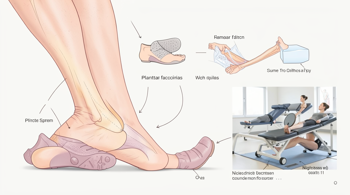
Shockwave therapy and injection procedures
Extracorporeal shockwave therapy, or ESWT, is generally considered for persistent cases that have not improved with initial conservative care. The 2026 rapid review concluded that ESWT probably reduces pain somewhat compared with control. A separate network meta-analysis covering 63 randomized controlled trials and 4,170 participants reported broad effects across short-, middle-, and long-term outcomes, although treatment results varied by intervention and therapeutic goal. 25
Injection options include corticosteroids, platelet-rich plasma, botulinum toxin A, prolotherapy, autologous blood, and local anesthetics. Evidence for pharmacological treatments, including botulinum toxin and steroid injections, remains uncertain in the rapid review. The network meta-analysis associated corticosteroids with the largest short-term functional gains, platelet-rich plasma with longer-term improvements in function and fascia thickness, and prolotherapy with sustained pain relief. Corticosteroids are generally used sparingly because repeated injections may weaken tissue. 257
Surgery, recovery, and treatment decisions
Surgery, such as partial plantar-fascia release, is generally reserved for chronic heel pain that remains disabling after approximately 6 to 12 months of structured nonsurgical treatment. Surgical procedures can carry risks and do not eliminate the need to evaluate footwear, muscle tightness, activity load, or other contributors. The evidence for surgical procedures remains uncertain for both pain and physical function, according to the rapid review. 26
Recovery is often gradual rather than immediate. Mayo Clinic reports that most people recover within a few months using simple nonsurgical measures, while a 2026 review describes favorable resolution in 80% to 90% of cases within 6 to 12 months. Persistent symptoms, worsening pain, neurological symptoms, fever, marked swelling, or pain following significant injury should prompt medical review because plantar heel pain can have causes other than plantar fasciitis. 17
What to weigh before choosing an option
Clinical decisions should consider symptom duration, pain severity, functional limitation, activity demands, foot structure, calf and Achilles flexibility, and previous treatments. Conservative care usually has the lowest procedural burden, but it requires consistent stretching, appropriate activity modification, and footwear changes over time. Devices may improve pressure distribution without resolving every contributing factor, while procedures involve uncertainty about durability and potential adverse effects. 12
- Use examination findings to distinguish plantar fasciitis from fracture, nerve problems, inflammatory disease, or other heel conditions.
- Consider imaging when symptoms are unusual, follow an injury, or fail to improve with a well-delivered plan.
- Discuss medication safety, injection risks, and expected duration of benefit with a qualified clinician.
- Reserve surgery for persistent, function-limiting symptoms after an appropriate nonsurgical period.
The central treatment principle is staged care: begin with load reduction, stretching, ice, supportive footwear, and suitable pain management; add rehabilitation or devices when needed; and discuss ESWT, injections, or surgery when symptoms persist. Evidence does not identify one universally superior treatment, so the balance between expected benefit, uncertainty, risks, and ongoing maintenance should guide decisions. 25
Sources
- Mayo Clinic, Plantar fasciitis: Diagnosis and treatment
- Norwegian Institute of Public Health, Treatment of Plantar Fasciitis: A rapid review for patient decision aid
- MSD Manual Professional Edition, Plantar Fasciitis
- Merck Manual Consumer Version, Plantar Fasciitis
- Scientific Reports, Comparative effectiveness of minimally invasive therapies for plantar fasciitis
- Penn Medicine, Plantar fasciitis treatment information
- Acibadem International, Plantar fasciitis symptoms, causes, and treatment options
- Mount Sinai, Plantar fasciitis health information
Authored by MyTrendSpot team