How to find state-owned heavy duty cargo vans: A Researcher's Guide to Government Surplus Markets
Researchers and fleet operators actively seeking state-owned heavy duty cargo vans often encounter a well-documented but underutilized procurement ecosystem. Federal agencies, state departments of transportation, correctional facilities, and municipal fleets routinely retire commercial cargo vans once vehicles reach mileage thresholds or age benchmarks, releasing a steady stream of government-surplus stock into structured public auction channels. Understanding how these systems are organized is essential for anyone looking to locate, evaluate, and track these vehicles accurately.
The Government Surplus Ecosystem: How State-Owned Vans Enter the Market
State and local governments dispose of surplus fleet vehicles, including heavy duty cargo vans, through centralized asset-liquidation programs governed by procurement regulations. Vehicles are typically decommissioned due to mileage milestones or age, with state-owned cargo vans commonly reaching retirement between 80,000 and 150,000 miles depending on agency policy. 1 Once a vehicle is declared excess, it enters a formal surplus pipeline managed either by a state-level property office or a contracted third-party auction administrator. At the federal level, the U.S. General Services Administration (GSA) manages the disposal of excess federal personal property, including heavy duty cargo and transport vehicles, through its dedicated surplus channels. 2
Real-world government procurement data illustrates the variety of specifications involved. A U.S. Department of State solicitation documented requirements for a cargo van with a V6 engine producing at least 250 horsepower, a minimum payload capacity of 3,700 pounds, approximately 452 cubic feet of cargo volume, a 145-inch wheelbase, and 72-inch interior cargo height. 3 A separate federal solicitation sought a high-roof extra-long cargo van with a 17 cubic meter cargo class, Euro 6D-Final compliant diesel engine, and a firm-fixed-price award structure. 4 These specifications, once vehicles complete their service life, define the categories of heavy duty vans that periodically enter the surplus market.
Primary Federal Channels for Locating Government-Surplus Heavy Duty Vans
GSA Auctions serves as the official U.S. federal government platform for selling surplus federal personal property to the public, with cargo and transport vehicles representing a consistent category of available assets. 2 The platform aggregates listings from multiple federal departments and uses a competitive online bidding format. Separately, GSA Advantage functions as the procurement-side counterpart, where approved contract suppliers offer products to government agencies, though it is less relevant for individual buyers seeking surplus stock. 5
Beyond GSA Auctions, the federal government's broader surplus property program outlines how excess federal assets transition from agency custody to public availability. 6 Buyers should note that federal surplus vans listed through GSA are typically sold on an as-is, where-is basis, meaning winning bidders are responsible for all logistics, including towing or transporting the van from the designated storage facility. 7 This logistical cost should be factored into any acquisition assessment.
State and Municipal Auction Platforms: Key Marketplaces to Monitor
GovDeals is one of the leading marketplaces used by state and local government agencies to conduct competitive online auctions for surplus assets, including heavy duty cargo vans such as Ford E-Series and Chevrolet Express models. 8 The platform allows searches by vehicle type, location, and condition category. Public Surplus operates as a parallel hub specifically oriented toward government fleet liquidation, enabling agencies to manage competitive bidding for vehicles that have reached their operational service limits. 9
Additional platforms relevant to this search include Purple Wave, which maintains searchable auction listings that can include government and public-agency vehicle inventory. 10 BidSpotter similarly aggregates auction events where government agencies list surplus vehicles, with filtering options for cargo vans and trucks drawn from public-sector fleets. 11 PropertyRoom.com partners with law enforcement agencies and government bodies to auction seized and surplus vehicles, including commercial cargo vans. 12 Many individual states also maintain proprietary surplus property websites operated either directly by state agencies or through contracted administrators, which list vehicles exclusively from that jurisdiction's DOT, correctional, or municipal fleet inventory. 13
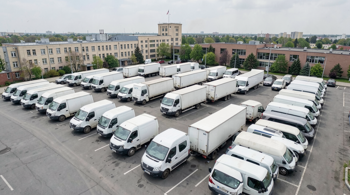
Technical Specifications Commonly Found in State-Surplus Heavy Duty Cargo Vans
Understanding the specification landscape helps prospective researchers identify which vehicles qualify as heavy duty within the government fleet context. The table below summarizes specification data drawn from documented government procurement records for cargo vans at or near retirement-eligible configurations.
| Specification Category | Documented Government Standard |
|---|---|
| Payload Capacity | Minimum 3,700 lb (documented in U.S. Dept. of State solicitation) |
| Cargo Volume | Approximately 452 cu ft (full-size class) or 17 m3 (European high-roof class) |
| Engine Output | V6 minimum 250 HP (gas) or diesel, Euro 6D-Final compliant variants |
| Wheelbase | 145 inches (standard) to extended configurations |
| Interior Cargo Height | 72 inches minimum (high-roof variants exceed this) |
| Transmission | Automatic or 6+ speed automatic documented across multiple solicitations |
| Drive Configuration | Rear-wheel drive, front-wheel drive, or all-wheel drive depending on agency need |
Government solicitations also document auxiliary equipment that is often present on decommissioned vans, including heavy duty slip-resistant cargo flooring, internal partitions, rear-view cameras, and blind spot monitoring systems. 3 Chevrolet Express 2500 RWD configurations with 135-inch wheelbases and 6.6-liter V8 engines producing 401 horsepower and 464 lb-ft of torque have appeared in documented government procurement records, representing the kind of powertrain found in state-owned heavy duty cargo stock. 14
Cooperative Purchasing Programs as an Alternative Research Channel
Beyond the surplus auction route, cooperative purchasing contracts provide a secondary channel for understanding what categories of heavy duty cargo vans have been acquired by government agencies. The Florida Sheriffs Association's Cooperative Purchasing Program, operating under contract FSA25-VEL33.0, covers a wide range of cargo and passenger vans including Ram ProMaster 3500 Super High Roof and Cargo Van High Roof configurations with 159-inch extended wheelbases, Mercedes-Benz Sprinter 2500 170 WB diesel high-roof cargo vans, and Ford Transit T-350 and T-250 high-roof cargo vans. 15 Reviewing active cooperative contracts in a given state reveals which van models are currently being procured, which in turn signals what categories will eventually enter the surplus market.
At the county level, procurement records such as Cape May County's solicitation for a Ford Transit turnkey refrigerated cargo van and California's Riverside County solicitation for a full-size low-height extended cargo van illustrate the breadth of state and local government van acquisition activity. 16 Tracking these active procurement events through SAM.gov, BidNet Direct, and state e-procurement portals provides a forward-looking picture of future surplus inventory categories.
Inspection Protocols, Eligibility Considerations, and Market Friction Points
Government surplus auctions for heavy duty cargo vans carry specific procedural and risk dimensions that any serious researcher must understand. Inspection periods are standard practice, allowing potential bidders to examine the van's mechanical condition before an auction closes. 7 However, government agencies do not warrant the mechanical fitness of surplus vehicles, and the as-is condition can mean deferred maintenance issues, missing documentation, or operational deficiencies that are not immediately visible during a visual inspection. Mileage in the 80,000 to 150,000 range on heavy duty commercial vans may reflect fleet-intensive duty cycles involving frequent idling, urban stop-and-go routes, or heavy payload operations that accelerate wear beyond what odometer readings alone suggest. 1
Registration and eligibility requirements vary by platform. Federal surplus through GSA is generally open to the public, while some state surplus programs limit first-priority access to nonprofit organizations or other governmental bodies before opening unsold inventory to private buyers. Successful bidders must also account for title transfer timelines, which can extend several weeks depending on the administering agency. Transport logistics, since vehicles are sold where they sit, represent an additional planning requirement. Conducting independent mechanical inspections, verifying VIN history, and confirming title status before bidding are standard precautions that experienced buyers in this market apply consistently.
Sources
- General LLM Research Data - State vehicle decommissioning mileage thresholds (80,000-150,000 miles)
- GSA Auctions - gsaauctions.gov
- Starbridge.ai - U.S. Department of State Cargo Van RFP (San Salvador, El Salvador delivery)
- CLEATUS - U.S. Embassy Ankara 17 m3 High-Roof Cargo Van Solicitation 19TU1526Q3721SOL
- GSA Advantage - gsaadvantage.gov
- GSA Federal Surplus Property Program - gsa.gov
- General LLM Research Data - Buyer logistics and inspection period standards for government auctions
- GovDeals - govdeals.com
- Public Surplus - publicsurplus.com
- Purple Wave - purplewave.com
- BidSpotter - bidspotter.com
- PropertyRoom - propertyroom.com
- General LLM Research Data - State proprietary surplus websites
- TenderImpulse / SAM.gov - Solicitation 19NP4025Q5408 for Chevrolet Express Cargo Van
- Florida Sheriffs Association Cooperative Purchasing Program - FSA25-VEL33.0 - flsheriffs.org
- Starbridge.ai - Cape May County Ford Transit Refrigerated Cargo Van RFP; CLEATUS - California Riverside County Full-Size Cargo Van
Authored by MyTrendSpot team