Used Military generators: Technical Evaluation and Sourcing Guide
To secure dependable backup energy during utility grid failures, many facilities are turning to military-grade power systems as a robust and highly cost-effective alternative to standard consumer units. Used military generators present a unique value proposition, often possessing low operating hours and heavy-duty designs built to survive extreme environmental conditions. This technical assessment examines the operational characteristics, procurement pathways, and standard maintenance profiles of retired and surplus military power units currently entering the secondary market.
Market Overview and Financial Dynamics of Surplus Equipment
The global market for military-grade generators has witnessed notable growth in recent years. Statistical assessments indicate that the market size was valued at 1.3 billion USD in 2021 and is projected to expand to approximately 2 billion USD by 2031, representing a compound annual growth rate (CAGR) of 4.7% over the forecast period 1. This growth is driven by both governmental demand and commercial operators seeking highly resilient backup power solutions that can operate independently of fragile municipal grids.
A key distinction exists between standard used machinery and military surplus inventory. Surplus generators are often brand-new units that remained unsold in government storage due to changes in logistical requirements or procurement lifecycle shifts 1. Consequently, these systems frequently feature minimal operating hours on their meters, offering commercial buyers near-new operational readiness at a fraction of the original capital expenditure 1. These surplus assets are frequently distributed via specialized liquidation channels, including federal auctions and secondary equipment platforms 2.
Technical Classifications and the Tactical Quiet Generator Series
The Military Tactical Quiet Generator (TQG) series represents some of the most sought-after machinery on the secondary market. Engineered for noise reduction and stealth in tactical environments, these generators feature specialized sound-attenuated enclosures. For example, the MEP-806A model is a 60 kW standby/prime capable diesel generator set 3. It is designed for multi-voltage operation, offering selectable three-phase outputs of 120/208V and 240/416V to support diverse field equipment 3.
For smaller localized operations, the MEP-804A model offers a 15 kW power output at a 0.8 power factor 4. This tactical quiet generator is powered by an Isuzu C240 water-cooled four-cylinder diesel engine coupled to a brushless generator head 4. Its technical specifications include a 14-gallon fuel capacity that allows for eight hours of continuous run time, producing a relatively low sound footprint of 70 dBA at a distance of 23 feet 4.
Industrial-Scale Power and High-Capacity Auxiliary Systems
When facilities require massive industrial power reserves, larger dual-use and military-spec systems are utilized. For intermediate demands, portable diesel generators like the Cummins C150D2RE 150 kW unit provide multi-voltage, three-phase outputs managed by digital controllers like the PowerCommand 3.3 5. These systems incorporate sound-attenuating enclosures and large on-board fuel tanks, often exceeding 250 gallons, to ensure extended runtime during emergency outages without requiring immediate refueling infrastructure in the field 5.
For critical infrastructure protection, such as data centers and municipal water stations, mega-watt class systems are deployed. The Cummins DQKAB generator set, rated at 2,000 kW, represents the upper tier of available secondary power assets 6. These massive units, equipped with heavy-duty QSK60-GE engines, feature double-walled base fuel tanks with capacities up to 8,000 gallons, allowing for prolonged standby operation under heavy load profiles, making them highly suitable for robust facility defense 6.
Maintenance Realities and Professional Refurbishment Programs
Operating legacy or surplus military generators requires a clear understanding of specialized maintenance criteria. Because these units are engineered for military defense standards, they feature complex electrical wiring and unique diagnostic interfaces. Professional generator mechanics with specialized training in the US Marine Corps or Army National Guard are typically required to perform complex overhauls and electronic troubleshooting on the TQG series 7. Experienced technical staff are frequently tasked with the maintenance and logistical management of these units 8.
Since many used units are acquired through government auctions in "as-is" condition, secondary procurement often involves specialized refurbishment. Organizations like Green Mountain Generators establish dedicated supply chains for obsolete parts and offer refurbished generators backed by limited 90-day or 100-hour parts warranties 9. These initiatives guarantee that critical components, such as fuel injection systems and voltage regulators, are fully verified before the machinery is integrated into civilian applications.
Tactical Mobility and Remote Microgrid Integration
Modern military power strategy has evolved from relying purely on stand-alone diesel units to integrating containerized hybrid microgrids. Known in tactical circles as "Field Power Containers," these systems package solar photovoltaic arrays, lithium-ion battery banks, and diesel generators inside a standard 20-foot shipping container for rapid deployment in remote locations 10. This integration ensures both mobility and high operational resilience in the field, allowing remote bases to maintain continuous energy security even when conventional logistics lines are disrupted or entirely severed 10.
Academic research modeling remote military outposts shows that the optimal configuration, consisting of a 15 kW solar array, a 30 kVA diesel generator, and an 80 kWh battery storage bank, can cover more than 93% of annual energy demand from renewable solar resources 10. Compared to a traditional diesel-only generator setup, the hybrid microgrid achieves a drastic reduction in annual fuel consumption, falling from 29,600 liters down to just 788 liters 10.
Acquisition Protocols and Compliance Checklists for Operators
Prospective operators looking to purchase military surplus generators must navigate specific regulatory and logistics requirements. High-specification tactical generators engineered by companies like Fischer Panda are built to meet rigorous military standards for electromagnetic interference (EMI) levels, infrared (IR) signatures, and exhaust emissions 11. Sourcing and exporting these units may require approvals from federal bodies like the U.S. Bureau of Industry and Security to prevent unauthorized technical transfers to restricted overseas entities 9.
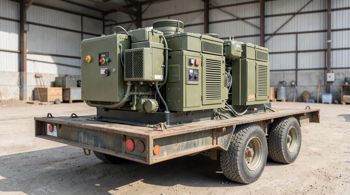
Furthermore, buyers must plan for transport logistics, as these machines are heavy and typically mounted on heavy-duty skids or multi-axle trailers 3 4. Standard single-unit weights can exceed 2,000 pounds for a modest 15 kW unit, rising to over 30,000 pounds for high-capacity 500 kW models 4 5. Utilizing community forums like Steel Soldiers can assist operators in finding legacy technical manuals and troubleshooting procedures 12.
Sources
- Central States Diesel Generators
- GovPlanet
- Electrical Trader
- Police and Tactical Supply
- Woodstock Power
- Ninexpower
- LinkedIn - Marine Corps and Army National Guard Professional Profiles
- LinkedIn - United States Army Technical Staff
- Green Mountain Generators
- IEEE Xplore - Tunisian Naval Academy
- Fischer Panda Generators
- Steel Soldiers Forum
Authored by MyTrendSpot team