Best radiation therapy for prostate cancer: Evidence, treatment choices, and clinical trade-offs
The question of the best radiation therapy for prostate cancer has no single answer for every patient. Treatment selection is generally based on the cancer's risk category, stage, life expectancy, baseline urinary and bowel function, previous treatment, imaging, and preferences. A multidisciplinary review involving radiation oncology, urology, and medical oncology can help match the radiation method to the clinical situation. 1
How risk category determines radiation choice
Localized prostate cancer is commonly divided into low-, intermediate-, and high-risk groups using PSA, clinical stage, and Grade Group or Gleason findings. Active surveillance may be considered for some lower-risk cancers, while definitive radiation is one established option when treatment is needed. For unfavorable intermediate-risk and high-risk disease, radiation is often combined with androgen-deprivation therapy, because randomized evidence has shown improved disease control compared with radiation alone. 2
Locally advanced disease includes clinical T3 to T4 tumors and regional lymph-node involvement without distant metastases. The contemporary standard remains external-beam radiation therapy combined with androgen-deprivation therapy, with abiraterone recommended for selected high-risk cases. Surgery may be considered in carefully selected patients as part of multimodal care, but randomized trial support is less established than for combined radiation and hormone treatment. 11
External-beam radiation: IMRT and image guidance
Modern external-beam treatment usually uses intensity-modulated radiation therapy, or IMRT, with image guidance. IMRT shapes radiation intensity around the prostate, while image guidance helps account for daily changes in anatomy and positioning. These methods are designed to reduce exposure to nearby organs, including the rectum, bladder, bowel, and penile bulb, although they do not eliminate side effects. 5
Conventional fractionation historically delivered 78 Gy in 39 treatments, while moderate hypofractionation uses larger doses per treatment over fewer visits. In the HYPRO randomized trial, 64.4 Gy in 19 fractions was compared with 78 Gy in 39 fractions among patients with intermediate- to high-risk localized cancer. At 10 years, relapse-free survival was 64.5% with hypofractionation and 60.1% with conventional treatment, but earlier reports did not establish noninferiority for acute and late toxicity. 12
SBRT and brachytherapy in localized disease
Stereotactic body radiation therapy, also called ultrahypofractionated radiation therapy, delivers the prostate dose in approximately five treatments. It is an evidence-supported option for many men with low- or intermediate-risk localized disease when anatomy, urinary function, and treatment planning are suitable. SBRT reduces the number of treatment visits, but its appropriateness depends on careful patient selection and the experience of the treating center. 3
Results from the NRG-GU005 study comparing SBRT with moderately hypofractionated IMRT in localized intermediate-risk disease found a bowel health-related quality-of-life benefit for SBRT, but no significant improvement in urinary quality of life or disease-free survival. The trial's disease-free survival analysis was reported for futility of superiority because of higher PSA-defined biochemical failure in the SBRT arm, while longer follow-up remains relevant. 17
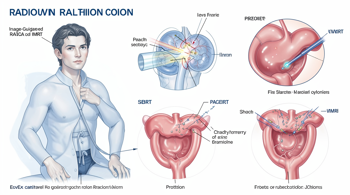
Low-dose-rate brachytherapy permanently implants radioactive seeds in the prostate and is commonly considered for appropriately selected low-risk or favorable intermediate-risk patients. High-dose-rate brachytherapy temporarily places radioactive sources and may be used alone in selected cases or as a boost with external-beam radiation, particularly for higher-risk disease. Prostate size, urinary symptoms, anatomy, and disease extent influence eligibility. 2
Proton therapy compared with photon treatment
Proton therapy uses the Bragg peak, a physical property that can concentrate dose at a selected depth and reduce exit dose. Dosimetric studies report lower low- to intermediate-dose exposure to the bladder and rectum with proton plans. However, dosimetric improvement does not automatically translate into better cancer control, fewer clinically important complications, or superior quality of life. 14
Comparative clinical evidence has not established proton therapy as superior to modern photon IMRT or VMAT for routine localized prostate cancer. The literature includes many observational studies, heterogeneous treatment schedules, inconsistent toxicity definitions, and limited standardized patient-reported outcomes. Preliminary PARTIQoL randomized results did not demonstrate a significant quality-of-life difference, and proton treatment is generally less available and more costly. 9
Hormone therapy and treatment intensification
Androgen-deprivation therapy is a central part of radiation treatment for selected unfavorable intermediate-risk and high-risk cancers. In a cited GETUG 14 analysis, adding four months of hormone therapy to 80 Gy radiation improved five-year disease-free survival from 76% to 85% and biochemical control from 79% to 90%. The treatment can also produce systemic effects, so duration and drug selection require individualized discussion. 16
For locally advanced disease, combined external-beam radiation and androgen deprivation remains the established foundation. The 2026 expert review describes abiraterone as an added option for selected high-risk patients, while broader neoadjuvant and adjuvant intensification with androgen-receptor pathway inhibitors or chemotherapy remains under investigation. PSMA-PET/CT may also refine staging and influence whether pelvic nodes or other sites should be addressed. 11
Side effects, salvage treatment, and decision factors
Radiation can affect urinary, bowel, sexual, and fatigue-related health. Symptoms may occur during treatment or later, and severity varies with baseline function, dose, technique, anatomy, and hormone therapy. Urinary irritation, bowel changes, erectile dysfunction, and incontinence-related concerns should be discussed before treatment. Advanced planning systems can reduce normal-tissue exposure, but no technique guarantees the absence of complications. 7
For cancer that returns after prostatectomy only through a rising PSA, early salvage radiation to the prostate bed can provide better disease control than waiting for a higher PSA in appropriate patients. The final decision should account for pathology, PSA trend, Grade Group, imaging, life expectancy, prior surgery, urinary function, bowel health, and the potential effects of hormone therapy. A second clinical opinion may be appropriate when treatment choices are closely balanced. 4
Sources
- National Cancer Institute, Prostate Cancer Treatment
- American Cancer Society, Radiation Therapy for Prostate Cancer
- American Society for Radiation Oncology, Evidence-Based Guidance on Prostate Radiation
- American Urological Association and ASTRO, Clinically Localized Prostate Cancer Guideline
- RadiologyInfo.org, Prostate Cancer Radiation Treatment
- Mayo Clinic, Prostate Cancer Treatment
- Cleveland Clinic, Prostate Cancer Radiation Therapy
- Johns Hopkins Medicine, Radiation Therapy for Prostate Cancer
- American Society of Clinical Oncology, Proton Therapy
- Khalil et al., Modern Proton Therapy in Prostate Cancer, Frontiers in Oncology
- Contemporary Management of Locally Advanced Prostate Cancer, World Journal of Urology, 2026
- HYPRO Trial Long-Term Results, Hypofractionated Versus Conventionally Fractionated Radiation Therapy
- Tilbæk et al., Proton Versus Photon Whole-Pelvic Radiotherapy
- Proton Beam Therapy in Prostate Cancer: Clinical Evidence, Controversies and Future Directions
- Niska, Androgen Deprivation Therapy and Definitive Radiotherapy in the Modern Era
- NRG-GU005, SBRT Versus Moderately Hypofractionated IMRT
Authored by MyTrendSpot team