Understand spinal stenosis treatment options: A clinical overview of nonsurgical and surgical care
This guide to understand spinal stenosis treatment options examines the stepped approach used for narrowing in the spinal canal or nerve passageways. Treatment depends on symptoms, neurologic examination findings, imaging, overall health, and personal goals rather than an MRI result alone. Many people manage symptoms without surgery, while persistent disability or worsening neurologic problems can justify specialist discussion of an operation. 1
How spinal stenosis is evaluated
Evaluation begins with a medical history and physical examination focused on pain, walking tolerance, strength, sensation, reflexes, balance, and coordination. Lumbar stenosis may cause leg pain, heaviness, numbness, or weakness that worsens with standing and walking and improves with sitting or bending forward. Cervical stenosis may affect the arms and hands and can cause balance or coordination problems when the spinal cord is involved. 2
- X-rays can show bone changes that reduce available space.
- MRI provides detailed images of discs, ligaments, nerves, and possible tumors.
- CT, or CT myelography when MRI is unsuitable, can help identify bone spurs, herniated discs, and other structural causes. 1
Activity changes and physical therapy
Initial care commonly emphasizes maintaining movement while reducing activities that reliably trigger symptoms. Guided physical therapy may address trunk strength, lower-limb function, posture, flexibility, and walking strategies. For lumbar stenosis, symptoms often ease in a flexed position, so exercises and activity pacing may be adapted to that pattern. The practical objective is improved function, such as greater standing or walking tolerance, rather than changing the underlying shape of the spinal canal. 3
- Activity modification can reduce repeated aggravating positions or distances.
- Supervised strengthening and aerobic exercise may support mobility and conditioning.
- Weight management and smoking cessation may support general function and recovery, but neither reverses structural narrowing. 5
Medicines and symptom control
Medication selection depends on the type of pain, other health conditions, and potential interactions. Mayo Clinic lists nonsteroidal anti-inflammatory drugs, tricyclic antidepressants for chronic pain, anti-seizure medicines for nerve-related pain, and opioids among possible medical treatments. These options require individualized risk review, particularly because anti-inflammatory medicines and opioids can be unsuitable or hazardous for some patients. Medication generally manages symptoms and does not enlarge the narrowed canal. 1
- Anti-inflammatory medicines may be considered when medically appropriate.
- Neuropathic-pain medicines may be discussed for radiating pain, although routine use of gabapentin or pregabalin is not supported by the high-quality evidence summarized in the supplied research. 8
- Opioids involve dependence and other safety concerns and are not a structural treatment.
Injections and minimally invasive procedures
Epidural steroid injections may provide temporary relief for radiating leg pain, but they do not widen the spinal canal or permanently correct stenosis. The U.S. Food and Drug Administration has warned of rare but serious neurologic complications associated with epidural corticosteroid injections, and the supplied evidence notes that this use is not FDA-approved. Risks, expected duration of relief, and alternatives therefore require a clinician-led discussion. 7
- Injections are generally considered symptom-management tools rather than cures.
- Minimally invasive lumbar decompression may suit selected patients whose anatomy and ligament changes match the procedure.
- Interspinous or motion-preserving devices have eligibility limits and may be inappropriate when instability is present. 8
When surgery enters the discussion
Surgery is generally considered when pain, leg symptoms, or walking limitations remain substantially disabling despite an appropriate course of nonsurgical care, or when neurologic deficits progress. The decision also reflects the location of stenosis, physical findings, imaging correlation, general health, and the patient’s goals. Surgery is not automatically required because narrowing appears on an MRI, since some people have visible stenosis with few or no symptoms. 4
| Procedure | Typical purpose | Important consideration |
|---|---|---|
| Decompression or laminectomy | Removes bone and soft tissue pressing on nerves | May be considered for persistent functional limitation |
| Fusion | Adds stability when needed | Usually depends on instability, deformity, or spondylolisthesis |
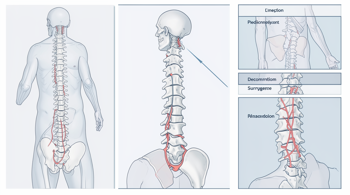
Decompression targets pressure on the spinal nerves, while fusion may be added when the spine is unstable or alignment requires stabilization. The benefits must be weighed against operative risks, recovery demands, coexisting conditions, and the possibility that symptoms may have more than one cause. Evidence comparing surgical and nonsurgical care does not support a single choice for every patient, so shared decision-making is central. 9
Cervical stenosis and spinal-cord symptoms
Cervical spinal stenosis deserves particular attention because narrowing can compress the spinal cord, producing myelopathy. Relevant symptoms include worsening balance, hand clumsiness, reduced coordination, weakness, and difficulty controlling the arms or legs. These findings differ from isolated neck pain and may indicate a need for timely specialist evaluation. Treatment decisions depend on the severity and cause of symptoms, examination results, and whether spinal-cord function appears threatened. 6
- New or worsening balance problems should be reported during medical assessment.
- Hand coordination changes can be clinically important even when neck pain is modest.
- Bladder or bowel dysfunction in the setting of cervical symptoms requires prompt evaluation. 2
Risks, expectations, and decision factors
Spinal stenosis treatment involves tradeoffs rather than a guaranteed sequence of escalating interventions. Nonsurgical care may improve comfort and function without correcting the narrowing, while injections may be temporary and carry uncommon but serious risks. Surgery can relieve nerve pressure in appropriately selected patients but involves procedural risks, recovery, and possible need for ongoing management. The treatment plan should account for symptom severity, neurologic deficits, response to prior care, anatomy, health status, and functional priorities. 5
- Ask how closely imaging findings match the symptoms and examination.
- Clarify the expected goal: pain reduction, walking improvement, protection of neurologic function, or stabilization.
- Review medication risks, injection risks, surgical alternatives, recovery requirements, and signs of deterioration.
Warning signs requiring urgent assessment
New loss of bladder or bowel control, saddle numbness, or rapidly worsening leg weakness can indicate severe nerve compression and warrants urgent medical evaluation. Significant balance loss, coordination decline, or progressive weakness also merits prompt clinical attention, particularly with cervical stenosis. These symptoms should not be managed solely through self-directed exercise or medication changes. A clinician can determine whether emergency assessment, advanced imaging, or specialist care is required. 10
- Seek urgent assessment for new bladder or bowel dysfunction.
- Report rapidly worsening weakness, foot-control problems, or inability to walk safely.
- Discuss progressive numbness, balance changes, or hand clumsiness without waiting for routine symptom review. 6
Sources
- Mayo Clinic, Spinal stenosis: Diagnosis and treatment
- ColumbiaDoctors, Spinal Stenosis
- The Well by Northwell, Spinal Stenosis Treatment
- American Association of Neurological Surgeons, Spinal Stenosis
- American Academy of Orthopaedic Surgeons, Spinal Stenosis
- Cleveland Clinic, Cervical Spinal Stenosis
- U.S. Food and Drug Administration, Epidural Corticosteroid Injection Safety Communication
- North American Spine Society, Lumbar Spinal Stenosis Guideline
- Cochrane, Surgical versus non-surgical treatment for lumbar spinal stenosis
- National Health Service, Spinal stenosis
Authored by MyTrendSpot team