State-by-state breakdown of registered nurse salaries in America
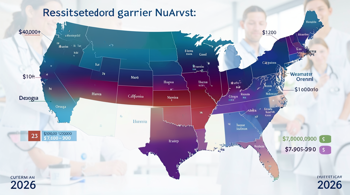
Registered nurse salaries in America vary dramatically depending on location, with compensation differences of more than $70,000 per year between the highest and lowest-paying states. Understanding these state-by-state variations is essential for nurses evaluating career opportunities, considering relocation, or negotiating employment offers. The data presented here reflects the most current Bureau of Labor Statistics information available, enabling a detailed examination of how geographic location shapes nursing compensation across the country.
National Salary Baseline and Overall Trends
The national median annual wage for registered nurses in the United States stands at $97,550 per year, equivalent to approximately $46.90 per hour 1. The mean (average) annual wage is $101,420 2, pulled higher by concentrated earnings in high-cost states. This median figure represents a significant increase from historical levels, with BLS data showing growth from $73,300 in 2019 to $97,550 in 2025, reflecting a compound annual growth rate of approximately 5.31 percent 1. Employment in registered nursing remains robust, with approximately 3.38 million registered nurses employed nationwide 2, and the profession is projected to grow 5 to 6 percent from 2024 to 2034, generating approximately 189,100 job openings per year 3.
The distribution of earnings across the profession reveals substantial variation. At the 10th percentile, registered nurses earn $68,940 annually, while those at the 90th percentile earn $137,470, representing a $68,530 gap driven primarily by location, experience, and specialty 4. The middle 50 percent of registered nurses earn between $78,610 and $107,960 annually 5, illustrating that geographic and employment factors create meaningful income spreads even among nurses with comparable credentials and experience.
Top 10 Highest-Paying States for Registered Nurses
California leads the nation with the highest median registered nurse salary, reported between $140,270 and $150,280 annually depending on the data source 12. Hawaii ranks second with a median salary of $136,320 1, while Oregon places third at approximately $123,140 2. Washington state follows with a median of approximately $121,540 2, and Massachusetts ranks fifth at $117,960 2. Alaska, New York, New Jersey, District of Columbia, and Connecticut round out the top ten, with salaries ranging from $102,540 to $114,870 annually 12. These top-paying states share common characteristics: higher cost of living, stronger union representation, stricter nurse-to-patient ratio laws, and concentrated healthcare infrastructure in major metropolitan areas.
| Rank | State | Median Annual Salary | Hourly Rate (approx.) |
|---|---|---|---|
| 1 | California | $140,270 - $150,280 | $67.43 - $72.25 |
| 2 | Hawaii | $136,320 | $65.54 |
| 3 | Oregon | $123,140 | $59.20 |
| 4 | Washington | $121,540 | $58.43 |
| 5 | Massachusetts | $117,960 | $56.71 |
| 6 | Alaska | $109,480 - $114,870 | $52.64 - $55.23 |
| 7 | New York | $100,130 - $109,440 | $48.14 - $52.62 |
| 8 | New Jersey | $106,500 | $51.20 |
| 9 | District of Columbia | $102,540 | $49.30 |
| 10 | Connecticut | $102,740 | $49.39 |
Lowest-Paying States and Regional Patterns
The bottom tier of registered nurse salaries reflects a distinct geographic pattern, with Southern and rural-majority states reporting substantially lower compensation. Alabama reports the lowest median salary at $77,080 annually 1, followed closely by Arkansas at $78,940 1 and Iowa at $78,630 1. Kansas, Louisiana, Kentucky, and Mississippi also fall below $80,000 annually 1. The gap between the highest-paying state (California at $150,280) and the lowest-paying state (Alabama at $77,080) exceeds $73,000 per year, representing approximately a 2:1 ratio in nominal compensation 1. These lower-paying states typically have lower overall costs of living, less union density in healthcare sectors, and populations with lower acuity healthcare needs compared to densely populated urban centers.
Regional analysis reveals that Southeastern states consistently report below-average salaries, with the exception of parts of Florida. Midwestern and Great Plains states fall near the national median, while Pacific and Northeast states dominate the upper salary tier. West Virginia, South Dakota, and Mississippi report some of the lowest compensation, each falling below $75,000 annually in certain data releases 6. However, nurses in these lower-wage states often experience greater purchasing power due to reduced cost of living, lower tax burdens in some jurisdictions, and lower housing costs, offsetting nominal salary differences.
Cost of Living Adjustments and Real Purchasing Power
Nominal salary figures do not tell the complete financial story, as cost of living varies dramatically across states. When adjusted for regional cost of living, the salary rankings shift substantially. Oregon, despite ranking third in nominal wages at $123,140, demonstrates exceptional real purchasing power after cost-of-living adjustment 7. Minnesota similarly shows strong adjusted value, while California's nominal advantage diminishes considerably when housing costs, state income taxes averaging 9.3 percent, and overall expense ratios are factored into take-home earnings 8. A nurse earning $137,000 in California after accounting for 9.3 percent state income tax, federal taxes, and rent averaging $3,200 monthly may retain less spending power than a Texas nurse earning $95,000 with zero state income tax and rent near $1,600 monthly 8.
Research demonstrates that after adjusting for local cost of living and tax burden, states like Texas, Washington, and Tennessee offer nurses superior real value despite lower nominal salaries 9. Nurses in zero-income-tax states such as Florida, Nevada, Tennessee, and Washington retain substantially higher percentages of gross earnings. The practical implication is that career decisions based solely on headline salary figures may lead to suboptimal financial outcomes when total compensation, taxes, and living expenses are evaluated holistically.
Factors Driving State-by-State Salary Variations
Multiple structural and economic factors explain registered nurse salary differences across states. Nurse-to-patient ratio mandates, particularly in California requiring no more than 1:5 ratios in most settings, create staffing pressures that force employers to offer higher wages to attract and retain qualified nurses 10. States without such mandates can operate with less staffing pressure, moderating wage growth. Union density and collective bargaining agreements correlate strongly with higher compensation, particularly in Northeast and Pacific states where healthcare unions maintain substantial membership. Massachusetts, Connecticut, and New York benefit from both robust union presence and aging population demographics driving sustained healthcare demand 10.
Cost of living in major metropolitan centers-where most high-paying states concentrate their healthcare infrastructure-necessitates higher nominal wages to maintain economic viability. California's $3,200 monthly rent in major metros, Hawaii's geographic isolation increasing operational costs, and Massachusetts' premium real estate market all contribute to upward wage pressure 10. Additionally, states with aging populations experience higher hospital admission rates and acuity levels, driving demand for experienced nurses. Massachusetts, with 17.8 percent of residents over age 65 compared to the national average of 17.2 percent, exemplifies this demographic dynamic 10. Employment setting matters significantly as well, with hospital-based registered nurses earning more than those in physician offices or nursing care facilities, and major academic medical centers offering premium compensation compared to community hospitals.
Specialty and Advanced Practice Earnings Within State Context
Registered nurse salaries form the foundation of compensation within the broader nursing field, but advanced practice credentials command substantially higher earnings across all states. Nurse anesthetists (CRNAs) earn a mean annual wage of $248,320 nationally, approximately 2.4 times the staff registered nurse mean 11, while nurse practitioners earn a mean of $137,300 11, representing a 35 percent premium over staff RN compensation 11. Certified nurse midwives earn approximately $136,980 annually 11. These advanced practice roles experience similar state-by-state variation as staff RNs, with highest compensation concentrated in California, Hawaii, Oregon, and the Northeast corridor.
Within registered nursing itself, specialty certification and shift differentials affect total compensation. Critical care and intensive care unit nurses, emergency department nurses, and operating room nurses typically earn premium pay relative to medical-surgical and home health nurses 12. Night and weekend differentials add $8,000 to $20,000 annually at major hospitals, and overtime availability in understaffed facilities can push experienced nurses earning $80,000 to $90,000 base salaries above $100,000 total annual compensation. Travel nurses, accepting temporary 13-week contracts, earn 20 to 50 percent premium compensation, often ranging from $90,000 to $150,000 annually depending on specialty and location demand 13.
Education Level and Credential Impact on Earnings
The distinction between Associate Degree in Nursing (ADN) and Bachelor of Science in Nursing (BSN) credentials produces measurable salary differences across all states. Nurses with BSN preparation typically earn $6,000 to $10,000 more annually than ADN-prepared nurses 14, a gap that compounds significantly over a career spanning decades. New graduate registered nurses entering the field earn substantially less than experienced nurses, typically ranging from $58,000 to $68,000 annually regardless of state 15, with salary progression occurring as experience accumulates. Most hospitals implement clinical ladder systems providing incremental raises based on years of service, specialty certification, and demonstrated competency. The progression from entry-level to experienced registered nurse often produces $20,000 to $30,000 salary increases over 5 to 10 years of clinical practice.
Regulatory requirements increasingly favor BSN preparation for advancement into leadership and specialty roles. States with more stringent BSN-for-licensure movements or strong BSN-preferring employer markets tend to support slightly higher median salaries, reflecting increased credentialing as a hiring preference. Licensed practical nurses (LPNs) earn substantially less, with a national median of approximately $64,400 1, while certified nursing assistants earn around $42,700 nationally 11. The nursing career ladder demonstrates that education and credential advancement represent powerful mechanisms for increasing earning potential, with the most significant gains available through pursuit of advanced practice credentials such as nurse practitioner or nurse anesthetist preparation.
Employment Setting and Employer Type Considerations
Registered nurses employed in hospital settings earn more on average than those in alternative care environments, with this differential appearing consistently across all states. Approximately 56 percent of registered nurses work in general medical and surgical hospitals, where average pay exceeds that in physicians' offices and home health care services, the second and third largest employment sectors 16. Academic medical centers and major teaching hospitals typically offer higher compensation than community hospitals, reflecting patient acuity, research involvement, and institutional resources. Federal employment through the Veterans Health Administration or other government agencies offers stable compensation often aligned with state medians plus benefits including defined pension plans.
Home health nursing provides scheduling flexibility but typically compensates at the lower end of the registered nurse spectrum, often $8,000 to $15,000 below hospital averages within a given state. Outpatient clinics and physician offices offer predictable schedules and typically Monday-through-Friday work weeks, trading premium compensation for lifestyle benefits. School nursing and occupational health nursing similarly emphasize schedule consistency over maximum earnings. Travel nursing, conversely, maximizes short-term earnings through premium pay, tax-free housing stipends, and reduced travel taxes, though it sacrifices job security, benefits continuity, and work-life stability. Nurses evaluating employment opportunities must weigh nominal salary against benefits, shift requirements, weekend obligations, and lifestyle preferences when comparing across settings and locations.
Sources
- RenewRN - Registered Nurse Salary by State (2025 BLS Data)
- The Nursing Directory - Nursing by the Numbers (2026)
- Bureau of Labor Statistics - Occupational Outlook Handbook
- Qualora - Registered Nurse Salary 2026: State Wages and Outlook
- SalaryTruth - How Much Do Registered Nurses Make? 2025 Median Salary
- World Population Review - Nurse Salary by State 2026
- Mappr - Registered Nurse Salary by State (2025)
- RelocateRight - Top 10 Best States for Nurses in 2026
- NurseZee - RN Salary by State: Where Nurses Earn the Most
- Nurse Salary Data - Why Northeast States Dominate Nurse Salaries
- The Nursing Directory - Nursing Specialty Salaries and Career Progression
- Nurse Salary Data - Nursing Salary Statistics 2026
- Salario.io - Nurse Salary by State 2026
- NurseSalaryIntel - Nurse Salary Data 2026: All 50 States and Specialties
- Jobs Near Me - Registered Nurse Salary 2026 By State, City and Experience Level
- Nurse One Stop - Your Nursing Salary Just Got Updated (New BLS Data)
Authored by MyTrendSpot team