Surplus Maritime Patrol Vessels: A Global Intelligence Report on Fleet Transfers, Disposal Mechanisms, and Strategic Reuse
Surplus maritime patrol vessels represent one of the most consequential and underreported instruments of contemporary naval diplomacy. As fleets in Western Europe and North America accelerate replacement cycles, decommissioned offshore patrol vessels (OPVs), cutters, and mine countermeasures ships are finding second operational lives across Southeast Asia, the Caribbean, the Bay of Bengal, and the Black Sea. The volume and geographic scope of these transfers, documented extensively between 2023 and 2026, illustrate a systematic, policy-driven effort to project maritime security capacity to partner nations at a fraction of new-build costs.
The U.S. Excess Defense Articles Program and Coast Guard Transfers
The United States manages surplus maritime assets primarily through the Excess Defense Articles (EDA) program, administered by the Defense Security Cooperation Agency (DSCA). Under this framework, equipment declared excess to U.S. military requirements is made available to eligible foreign governments at reduced cost or as a grant, contingent on a validated operational requirement by the recipient nation. 1 The program has become a cornerstone of U.S. maritime security cooperation, enabling capacity-building without the multi-year timelines of new construction.
The U.S. Coast Guard Office of International Acquisition has delivered more than $1 billion in assets and services to partner nations in support of national security objectives through its Foreign Military Sales channels. 2 In June 2025, former Coast Guard cutters Liberty, Mustang, and Naushon were transferred to Colombia, with operational and maintenance training completed by June 27, 2025. 2 Separately, the United States selected Malaysia to receive a second decommissioned USCG vessel alongside a USD 7 million allocation under Foreign Military Financing, reinforcing maritime domain awareness in Southeast Asia. 3
Indo-Pacific Transfers: Philippines and the Reliance-Class Deployment
The strategic calculus driving surplus vessel transfers is most visible in the Indo-Pacific. U.S. Secretary of Defense Pete Hegseth confirmed during the Shangri-La Dialogue on May 30, 2026, that the United States would transfer a 210-foot Reliance-class cutter to the Philippine Coast Guard. 4 Designed for long-duration offshore operations, the Reliance-class is capable of remaining at sea for extended periods while conducting surveillance, law enforcement, search-and-rescue, and maritime security missions. Its endurance, aviation capability, and relatively low crew requirements make it well-suited for sustaining a continuous presence across contested and remote maritime areas in the West Philippine Sea. 4
The Philippines also received U.S. Marine Protector-class patrol boats, described as signaling more than routine military aid in the context of escalating South China Sea tensions. 5 Bangladesh previously acquired the Hamilton-class cutter USCGC Rush under the Excess Defense Articles program in May 2015, subsequently reclassifying the 3,250-tonne, 378-foot vessel as BNS Somudra Avijan, a patrol frigate with a 45-day endurance and a range of 16,000 nautical miles. 6
European Divestments: UK, Portugal, and the OPV Secondary Market
Portugal approved the sale of four Tejo-class coastal patrol vessels to the Dominican Republic Navy on February 17, 2026, for a total of EUR 24 million, setting an individual price of EUR 6 million per ship. 7 The transferred vessels, NRP Tejo, NRP Douro, NRP Mondego, and NRP Guadiana, received approval from the Portuguese Council of Chiefs of Staff as part of bilateral defense cooperation. The agreement, valued at up to EUR 24.37 million, includes modernization, training, and logistics support, with delivery occurring in phases over approximately 40 months. 8 The ships are intended to strengthen surveillance and law enforcement across the Dominican Republic's Exclusive Economic Zone and support counter-narcotics operations in the Caribbean.
The Royal Navy is concurrently in negotiations to sell three River-class Batch I OPVs, HMS Tyne, HMS Mersey, and HMS Severn, to Uruguay when the vessels leave service in 2026. Each ship carries a reported price of approximately $20 million (GBP 15 million), compared with roughly $60 million for a brand-new equivalent OPV. 9 The sale follows Uruguay's October 2025 termination of a contract with Spanish shipyard Cardama for two 1,500-tonne OPVs, cancelled due to reported contractual irregularities. 9 River-class Batch I vessels, introduced in 2001, carry one 20mm cannon, two machine guns, and a flight deck for light helicopters, making them operationally adequate for patrol and fishery-protection roles despite lacking high-intensity combat capability.
Black Sea, South Asia, and the UK Defence Equipment Sales Authority
The UK's Defence Equipment Sales Authority (DESA), an agency mandated to dispose of surplus military equipment, sold two Sandown-class mine countermeasures vessels to Romania. The former HMS Pembroke was commissioned as Capitan Constantin Dumitrescu in a ceremony at Rosyth, Scotland, in August 2025, following refurbishment by Babcock. 10 Its sister ship, the former HMS Blyth, had been commissioned into Romanian service in September 2023. The 52.5-metre Sandown-class vessels use high-definition sonar to locate mines, which are then neutralized by diving teams or remote disposal systems, addressing the direct threat posed by drifting mines from the war in Ukraine in the Black Sea. 10
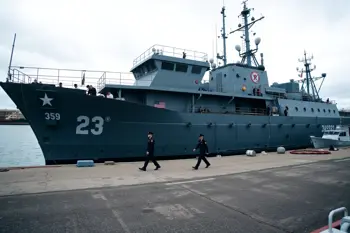
The UK also signed a government-to-government defence sales agreement with Bangladesh on February 8, 2026, transferring the former Royal Navy hydrographic survey vessel HMS Enterprise (H88) to the Bangladesh Navy. 11 Decommissioned by the Royal Navy in March 2023, the Echo-class vessel measures approximately 91 meters and accommodates around 70 sailors. It carries advanced sensors capable of scanning both the surface and the seabed, supporting hydrographic, oceanographic, and submarine-related missions in the Bay of Bengal. 11
Pricing Architecture, Acquisition Pathways, and Institutional Frameworks
Surplus maritime patrol vessel transactions follow several distinct institutional pathways. The U.S. government coordinates transfers through the DSCA's Foreign Military Sales program, a formal government-to-government mechanism, alongside the EDA grant pathway for lower-income partners. The U.S. General Services Administration manages broader federal surplus property disposal, including boats and marine equipment listed through platforms such as GSA Auctions. 12 The U.S. Marshals Service and Treasury-linked auction mechanisms handle vessels forfeited through judicial processes separately from military-origin surplus.
Pricing data from documented transactions illustrates the range of values in the secondary patrol vessel market. Portugal's Tejo-class units transferred at EUR 6 million per hull with support packages included. 7 UK River-class OPVs are reportedly priced at approximately GBP 15 million per vessel for Uruguay, one-third the cost of a new-build equivalent. 9 Greece's acquisition of Carlo Bergamini-class FREMM frigates from Italy, approved in May 2026, involves an initial two-vessel purchase at approximately EUR 700 million including primary weapons systems, with CAPTAS-4 towed sonar systems adding roughly EUR 110 million ($128 million) in additional upgrades. 13 These transactions confirm a wide price spectrum governed by hull size, mission capability, and inclusion of support, training, and refit packages.
Risks, Maintenance Realities, and Regulatory Considerations
Acquiring surplus maritime patrol vessels carries documented operational and financial risks that recipient navies must weigh carefully. The Royal Canadian Navy's experience with its Kingston-class Maritime Coastal Defence Vessels illustrates structural fragility in aging fleet design: HMCS Saskatoon, Whitehorse, Brandon, and five additional Kingston-class ships were formally paid off in ceremonies held in Esquimalt and Halifax in late September and October 2025, with internal documents indicating the fleet would be withdrawn from service sooner than originally expected due to structural pressures from an expanded security mandate. 14 Canada's parallel experience with the MV Asterix resupply vessel, converted for naval service at $659 million and delivered on time and on budget in 2018, demonstrates that converted and interim platforms can provide genuine capability but face political and financial uncertainty at contract renewal. 15
The MV Matthew case from Ireland illustrates the extreme end of surplus maritime disposal complexity. The vessel, seized following Ireland's largest-ever narcotics seizure, remained docked in Cork Harbour for nearly three years after its detention, accumulating maintenance, repair, and storage costs totaling EUR 16,841,193, approximately EUR 114,000 per week, before ultimately being sold for $1 to an international shipping company in July 2026. 16 Legal complications tied to its involvement in international drug trafficking, combined with evidentiary requirements that delayed disposal until December 2024, exemplify the non-military frictions that can dominate surplus vessel management. Recipient navies considering surplus acquisitions must independently assess structural condition, remaining service life, parts availability, crew training requirements, and the compatibility of legacy systems with existing fleet logistics chains before advancing any bilateral agreement.
Sources
- Defense Security Cooperation Agency - dsca.mil/programs/excess-defense-articles-eda
- U.S. Coast Guard Acquisition Newsroom - dcms.uscg.mil
- GBP Defence & Security - gbp.com.sg
- Army Recognition Naval News - armyrecognition.com (Reliance-class Philippines transfer)
- Indo-Pacific Report via Facebook/Naval Institute - USNI News
- Wikipedia - BNS Somudra Avijan
- Army Recognition Naval News - armyrecognition.com (Tejo-class Portugal-Dominican Republic)
- The Defense Watch - thedefensewatch.com
- Navy Lookout - navylookout.com
- Baird Maritime - bairdmaritime.com
- Army Recognition Naval News - armyrecognition.com (HMS Enterprise Bangladesh)
- USAGov - usa.gov/boat-aircraft-auctions
- The National Interest - nationalinterest.org
- Royal Canadian Navy / Canada.ca - canada.ca
- Esprit de Corps - espritdecorps.ca
- Irish Mirror - irishmirror.ie
Authored by MyTrendSpot team