Must-see mountain rail journeys in the US
Mountain rail journeys in the US represent a distinct category of travel where the mode of transport is inseparable from the destination itself. Whether it is a narrow-gauge steam engine built in 1882 still hauling passengers through roadless canyons, or a purpose-built cog railway locking into a toothed rack rail to scale a 14,115-foot summit, these routes concentrate geography, engineering history, and landscape into experiences that road travel structurally cannot replicate. The routes surveyed below span Colorado, New Mexico, New Hampshire, and Alaska, covering heritage railroads, luxury daylight corridors, and long-distance Amtrak segments alike.
Durango and Silverton Narrow Gauge Railroad: Colorado's Roadless Canyon Route
The Durango and Silverton Narrow Gauge Railroad operates a 45.2-mile route through the Animas Canyon that has run continuously since July 1882, making it one of the oldest uninterrupted rail operations in the American West. 1 The line was constructed in nine months and five days by approximately 500 laborers, mostly Chinese and Irish immigrants, who blasted ledges into sheer granite walls to create a path where no road has ever been built. 2 Over its working life, the route moved an estimated $300 million in precious metals out of the San Juan Mountains, a figure that underscores how completely the railroad's original purpose was industrial rather than scenic. 2
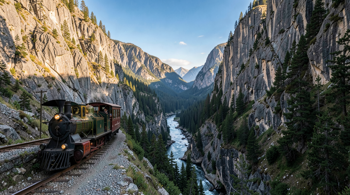
The route's most dramatic feature is the High Line, where tracks are carved into a sheer rock face with the Animas River dropping hundreds of feet below. The Animas is notable as one of the last free-flowing, undammed rivers in the American West. 2 Ten narrow-gauge steam engines power this railroad, eight of them in working condition, and the locomotives themselves are a century old. 2 The railroad holds National Historic Landmark status and climbs from Durango at approximately 6,500 feet to Silverton at over 9,000 feet. 3 A standard round-trip excursion covers 3.5 hours one way aboard authentic coal-fired steam locomotives from the 1920s. 4 Weather, seasonal flooding, and high-altitude fire risk have historically caused operational disruptions that travelers should research before planning.
Cumbres and Toltec Scenic Railroad: Highest and Longest Narrow-Gauge Steam Route in the US
The Cumbres and Toltec Scenic Railroad stretches 64 miles between Antonito, Colorado, and Chama, New Mexico, and holds the designation of the highest and longest narrow-gauge steam railroad still operating in the United States. 5 The Denver and Rio Grande Western Railroad pushed this line through the mountains in 1880 to move ore out of the San Juan mining region, and when the mines quieted by the late 1960s, Colorado and New Mexico jointly purchased the corridor in 1970 to preserve it. 6 In 2012, the route earned National Historic Landmark status, recognized specifically for its intact collection of original engines, cars, and trackside buildings. 6
The train tops out at Cumbres Pass at 10,015 feet above sea level, the highest point any steam train still reaches anywhere in the country. 7 The three-foot narrow gauge was chosen deliberately because it bends tighter and climbs steeper than standard track, the only practical engineering solution for threading through this terrain in the 1880s. 6 In the 2026 USA TODAY 10Best Readers' Choice Awards, the Cumbres and Toltec was voted the Best Scenic Train Ride in the nation, and it was ranked the number one rail journey in the world for fall foliage by Japan Rail Pass. 8 During the fall season, the train steams through tens of thousands of golden aspen trees across 64 miles of Rocky Mountain wilderness inaccessible by car, though popular departure dates frequently sell out in advance. 8
Broadmoor Manitou and Pikes Peak Cog Railway: America's Highest Railway
The Broadmoor Manitou and Pikes Peak Cog Railway was constructed in 1891 and remains the highest railway of its kind in the world, climbing to an elevation exceeding 14,115 feet at the summit of Pikes Peak. 9 It is one of only two cog railways operating in the United States, making it a structurally rare experience by any measure. 10 The cog mechanism, where a large gear interlocks with teeth on a rack rail laid between the running rails, gives the locomotive extreme traction on steep slopes where conventional wheels would slip backward. 10
The nine-mile ride passes through Pike National Forest, where Rocky Mountain maples and aspens turn golden and red in autumn, contrasting against emerald pine trees including bristlecone pine specimens more than 2,000 years old. 10 Wildlife sightings along the route commonly include elk, deer, and yellow-bellied marmot, and Pikes Peak supports one of Colorado's largest bighorn sheep herds. 10 At the summit, passengers can disembark and explore a visitor center before the descent. High-altitude conditions, including rapidly changing weather and thin air, create physical discomfort for some passengers, particularly those with respiratory sensitivities, and the railroad advises travelers to account for this when planning.
Mount Washington Cog Railway: The World's First Mountain-Climbing Railroad
The Mount Washington Cog Railway in New Hampshire holds the distinction of being the world's first mountain-climbing cog railway, built between 1866 and 1869 by inventor Sylvester Marsh after he nearly died on the mountain during a storm in 1857. 11 When Marsh brought the concept to the New Hampshire Legislature in 1858, lawmakers reportedly told him he might as well build a railway to the moon. 12 The first train reached the 6,288-foot summit on July 3, 1869. 12 The line is 4.8 kilometers long with an average grade exceeding 25 percent, meaning the train climbs more than 25 feet for every 100 feet of forward movement, compared to a maximum of 6 percent on US highways. 11
The steepest section, Jacob's Ladder, pitches at a grade of 37.41 percent and is described as the steepest railroad trestle anywhere in the world. 11 The ascent crosses three distinct climate zones: northern hardwood forest at Marshfield base station at 2,700 feet, boreal spruce-fir forest in the middle section, and alpine tundra above tree line, terrain comparable in character to far northern Canada. 13 Hurricane-force winds occur on the summit on an average of 110 days per year, and the Mount Washington Observatory operates a 24-hour weather station at the top. 13 The round trip takes approximately three hours including a one-hour summit layover, and summit weather can deteriorate rapidly regardless of conditions at the base.
Canyon Spirit: A Modern Luxury Daylight Corridor Through the Rockies and Red Rock Country
Canyon Spirit represents a newer entry in US mountain rail travel, operating a luxury daylight-only route between Denver, Colorado, and Salt Lake City, Utah, following a historic freight corridor originally built by the Denver and Rio Grande Western Railroad in the 1870s to serve mining regions. 14 The tracks were engineered to move directly through mountainous terrain rather than around it, an approach that reshaped how goods moved across the American West and which now delivers uninterrupted landscape views that road travel compresses into a sequence of episodic stops. 14 The route passes through Colorado's Burns Canyon and transitions from the Rocky Mountain landscape into the red rock desert terrain of eastern Utah, offering a geographic range few single rail journeys match.
Canyon Spirit is positioned as America's only luxury train in its segment, brought to market by the operators behind Rocky Mountaineer, which established the gold-standard model for daylight scenic rail in Canada. 15 The daylight-only operating model means passengers view the entire route in natural light through panoramic windows or from open-air vestibules. The corridor also passes through gateway towns adjacent to national park landscapes that are under growing pressure from highway congestion, making rail access an increasingly discussed alternative for reaching these regions. As a newer operation, its long-term schedule consistency and seasonal availability are factors travelers should verify independently.
Alaska Railroad Routes and the California Zephyr: Long-Distance Mountain Perspectives
The Alaska Railroad operates 740 miles of main line track between Seward in the south and Fairbanks in the north, with the Coastal Classic route between Anchorage and Seward widely regarded as one of the most visually remarkable train rides in the world. 16 The tracks hug the edge of Turnagain Arm and wind through the glacier-filled Kenai Mountains, offering views of glaciers, mountain summits, and coastal water from the same window. 16 An upgrade to dome car seating provides an elevated perspective across the landscape. The railroad also serves as a practical transportation link for wilderness communities that have no road access, adding an operational dimension not found on heritage excursion lines.
Amtrak's California Zephyr operates between Chicago and the San Francisco Bay Area, crossing the Rocky Mountains and the Sierra Nevada range over approximately two days, making it the most accessible long-distance mountain rail option for travelers without a specific heritage railroad destination in mind. 17 The Empire Builder route similarly traverses the Northern Rockies in Montana with views of Glacier National Park country. 17 Both Amtrak routes operate on shared freight infrastructure, meaning on-time performance is historically variable and schedules are subject to freight priority rules. Travelers planning connections around these trains should account for potential delays when building itineraries.
Sources
- explore.com - One Of America's Best And Oldest Train Routes Is A Scenic Journey In The Rocky Mountains
- wheninyourstate.com - A coal-black steam locomotive still hauls passengers through Colorado's most remote canyon
- amateurtraveler.com - The Durango and Silverton Narrow Gauge Railroad: The Most Scenic Train Ride in North America
- americasbestonline.com - Top Historic Train Rides for an Unforgettable American Adventure
- nmosg.com - Steaming Through Time: A Journey on the Cumbres and Toltec Scenic Railroad from Antonito
- wheninyourstate.com - No road exists through this Colorado gorge, but an 1880s train still runs it
- wheninyourstate.com - No road exists through this Colorado gorge, but an 1880s train still runs it
- einpresswire.com - Steam through Millions of Golden Aspens on the Historic Cumbres and Toltec Scenic Railroad
- everafterinthewoods.com - This Colorado Train Climbs To One Of The Highest And Most Jaw-Dropping Rides In North America
- travelandleisure.com - This Rare U.S. Train Climbs 14,000 Feet for Fall Colors
- wheninyourstate.com - The oldest mountain railway on earth is in New Hampshire, and you can still ride it today
- wheninyourstate.com - The oldest mountain railway on earth is in New Hampshire, and you can still ride it today
- spotatrain.com - Mount Washington Cog Railway: Epic Train Journey
- nationalgeographic.com - This historic rail corridor offers a new way to see the American West
- ambassadair.com - Rockies to the Red Rocks by Rail
- alaskatours.com - Alaska Travel by Rail
- amtrak.com - California Zephyr and Empire Builder route information
Authored by MyTrendSpot team