Mobility Scooters for Adults: A Practical, Evidence-Based Guide to Types, Safety, and Selection
Mobility scooters for adults are battery-powered, seated devices intended for people who can sit upright and safely operate steering and controls. The category includes compact folding models, three-wheel travel scooters, stable four-wheel designs, and heavy-duty outdoor machines, so the most relevant comparison is not simply size or appearance, but whether the scooter matches the user’s physical abilities, environment, and transportation needs.
How adult mobility scooters are categorized
Three-wheel scooters generally provide a tighter turning radius, which can be useful in confined indoor spaces, while four-wheel scooters generally offer greater stability on uneven surfaces. Adult models also differ in portability, travel range, ground clearance, maximum speed, and weight capacity. These specifications should be assessed together because a lightweight travel scooter may be easier to transport but less suitable for rough outdoor terrain or extended outings.
Manufacturers and mobility retailers commonly organize scooters into travel, standard, folding, full-size, and heavy-duty categories. Pride Mobility lists travel, three-wheel, four-wheel, and outdoor-oriented types, while Drive Medical and Golden Technologies provide both portable and larger full-size models. MobilityWorks and SpinLife also describe scooters by use case, wheel configuration, portability, and range, illustrating that category labels are useful starting points rather than universal technical standards.
Portability, folding, and travel specifications
Portability is a major distinction among adult scooters. The Monarch Smarti Plus is listed at 35 pounds, uses one-touch automatic folding and unfolding, supports up to 275 pounds, and is described as airline and cruise approved. Its stated equipment includes USB-A and USB-C charging, front and rear LED lighting, rear suspension, armrests, and a front folding basket. These features address storage and travel convenience, but airline acceptance still depends on battery and carrier procedures.
The Monarch Supa Carbon Lite is listed at 29 pounds, folds completely in seconds, supports up to 275 pounds, has a stated top speed of 4 mph, and offers up to 9 miles per charge subject to weight and terrain. The Hoverfly T3 is listed at 60 pounds, with three folding modes, a 330-pound capacity, a stated 13-mile range, and a 3.7 mph top speed. The SKRT RF02 is listed at 88 pounds, with an extra-wide seat and footboard, a 300-pound capacity, lithium battery, LED lighting, and airline approval claims. These figures are manufacturer or retailer specifications, not guaranteed real-world results.
Outdoor capability and weight capacity
Full-size and heavy-duty scooters typically emphasize stability, seating, motor output, and outdoor usability rather than minimum lifting weight. Mobility City describes the Pride Revo 2.0 four-wheel scooter as having a 400-pound capacity, Comfort-Trac Suspension, a battery range of up to 17 miles per charge, LED lighting, under-seat storage, and feather-touch disassembly. It is positioned for errands, parks, neighborhood travel, appointments, and uneven sidewalks.
Higher-capacity examples include the Monarch Obsidian, described as an 8 mph heavy-duty scooter with a 650-watt motor, adjustable captain’s seat, full lighting, indicators, and a 450-pound maximum user weight. The Pride PX4 is listed with a 500-pound capacity and multiple high-back seat configurations, including a wider option. The Pride Maxima four-wheel model is described by RydeGo as a full-size scooter with a 500-pound capacity, reinforced platform, solid tires, and indoor and outdoor use. Capacity alone does not establish comfort, maneuverability, or suitability for a particular home.
Compact four-wheel alternatives
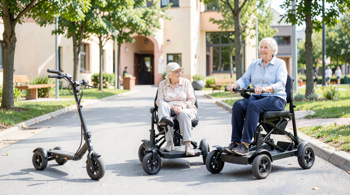
Some adults need more range and seating space than a small travel scooter provides without moving to a full-size heavy-duty platform. The Go Go Sport four-wheel scooter is described as supporting up to 325 pounds, traveling up to 14.5 miles per charge, disassembling into five pieces, and using larger 9-inch front and rear tires. Its listed features include a swivel seat, armrests, delta tiller, and increased legroom. These specifications indicate a compromise between car transport and outdoor capability.
The Metro Mobility M1 Portal is listed as a detachable four-wheel scooter with 9-inch flat-free tires, a 300-pound capacity, a 300-watt brushless motor, a stated top speed of 4.97 mph, LED headlight, horn, and a comfortable seat. Such a format may suit shopping, parks, community trips, and storage where a detachable design is important. However, the stated capacity, speed, and range should be compared with the user’s weight, route length, gradients, and expected surface conditions rather than treated as universal performance measures.
Coverage, regulation, and air travel
Medicare Part B may cover a power-operated scooter when it is medically necessary for use in the home and prescribed after the required evaluation. Coverage typically involves obtaining the device through a Medicare-enrolled supplier and paying applicable coinsurance after the Part B deductible. Eligibility is therefore based on medical necessity and program requirements, not merely age, convenience, or a desire for outdoor transportation.
The FDA regulates wheelchairs and mobility scooters as medical devices and provides consumer information about these products. The Department of Transportation explains airline accessibility obligations for passengers traveling with mobility devices, while the FAA provides battery and hazardous-material guidance. Lithium-ion batteries have specific handling requirements, including restrictions involving spare batteries and battery size. The Department of Justice explains when devices other than manual wheelchairs may qualify as mobility devices under the ADA. Airline and venue policies should be confirmed before travel.
Safety, suitability, and ownership realities
A scooter is generally intended for an adult who can maintain seated posture, steer, understand controls, and respond safely to surroundings. When significant postural support or motor-control assistance is needed, a power wheelchair may be more appropriate. Three-wheel maneuverability can help indoors, whereas four-wheel stability may be more appropriate on uneven sidewalks. A test drive or clinical assessment can reveal problems involving seat height, legroom, tiller position, hand strength, turning space, and transfer ability.
Ownership also involves practical friction beyond the headline specifications. Battery condition affects usable range, and published range figures may vary with rider weight and terrain, as expressly noted for the Supa Carbon Lite. Larger scooters require more storage space and may need a vehicle lift, ramp, or multiple-person handling. Buyers should verify warranty terms, service access, battery replacement arrangements, return conditions, charging requirements, and the manufacturer’s weight and terrain limits. FDA oversight does not eliminate the need to follow operating instructions, inspect equipment, and match the device to the intended environment.
Sources
- Monarch Mobility, Smarti Plus
- Monarch Mobility, Obsidian
- My Perfect Scooter, Pride PX4
- Monarch Mobility, Supa Carbon Lite
- Mobility City, Revo 2.0
- Mobility City, Go Go Sport
- Metro Mobility, M1 Portal
- Hoverfly, T3
- SKRT Mobility, RF02
- RydeGo, Maxima 4-Wheel
- Medicare.gov, Medical Scooters
- U.S. Food and Drug Administration, Wheelchairs, Scooters, and Strollers
- U.S. Department of Transportation, Disability and Air Travel
- Federal Aviation Administration, Wheelchairs and Mobility Devices
- U.S. Department of Justice ADA.gov, Mobility Devices
- Pride Mobility, Mobility Scooters
- Drive DeVilbiss Healthcare, Mobility Scooters
- Golden Technologies, Mobility Scooters
- MobilityWorks, Mobility Scooters
- SpinLife, Scooter Resources
Authored by MyTrendSpot team