Best physical therapy clinics for knee rehab: An evidence-informed comparison
The search for the best physical therapy clinics for knee rehab often begins with a practical question: which providers can support recovery from knee pain, ligament injury, meniscus repair, or surgery? Available clinic information shows that meaningful differences involve specialization, objective testing, clinician training, treatment setting, and the demands of a patient’s intended activities.
How knee rehabilitation clinics differ
There is no universally recognized national ranking for knee-rehabilitation clinics. A useful comparison therefore considers orthopedic expertise, sports-rehabilitation experience, postoperative coordination, clinician credentials, location, insurance participation, and whether treatment is designed for daily function or athletic performance. Large medical systems such as Hospital for Special Surgery, Mayo Clinic, Cleveland Clinic, UCSF Health, Stanford Health Care, and Johns Hopkins Medicine describe rehabilitation services for orthopedic, musculoskeletal, sports, and postoperative conditions. 1 2 3
Outpatient networks also provide knee-focused services in multiple markets. ATI Physical Therapy, Select Physical Therapy, Athletico, and PT Solutions describe orthopedic or knee-pain rehabilitation programs, although the exact clinician expertise, equipment, scheduling model, and insurance participation can differ by location. A national brand name does not by itself establish that every site offers advanced ACL, meniscus, or return-to-sport care. 3
Clinics with ACL and sports-rehabilitation emphasis
EDGE in Bergen County, New Jersey, describes one-on-one, criteria-based ACL rehabilitation for reconstruction, repair, combined ACL and meniscus injuries, and other knee injuries. Its stated progression moves from swelling control, motion, and quadriceps activation toward strength, running, cutting, jumping, and sport-specific demands. The clinic identifies patients in Paramus, Fort Lee, and surrounding Bergen County, including youth, collegiate, adult, and active populations. 4
Accelerate Sport & Spine Rehab in New Braunfels, Texas, presents a sports-oriented model for athletes recovering from ACL or meniscus surgery. The clinic describes exercise-based rehabilitation, progressive loading, movement-quality work, strength, stability, agility, and return-to-sport goals. Its published clinician biographies emphasize experience with athletic recovery, including a provider who reports personal experience with three ACL reconstructions. 5
Examples of knee-pain and performance-focused care
Athletico’s River West location in Chicago describes therapy for knee discomfort associated with sports injuries, ligament problems, meniscus injuries, daily activity limitations, and arthritis-related stiffness. The description connects treatment with walking, stairs, running, cycling, and other activities. Because the cited page represents one Chicago location, its services should not automatically be treated as identical across the wider network. 6
Made Strong Physical Therapy & Wellness in Westminster, Colorado, describes individualized knee-pain care led by Dr. Jen Reed. The published approach includes identifying movement patterns and muscle imbalances, customized exercise, hands-on manual therapy, dry needling, and 90-minute sessions. Penultimate Step in Maple Valley, Washington, describes progressive strength training, science-backed rehabilitation, blood-flow-restriction training, dry needling, and sports-performance goals. 7 8
Hospital and orthopedic-system options
Jacksonville Orthopaedic Institute’s JOI Rehab Sports Center is part of an orthopedic organization serving the Jacksonville, Florida, area. Its published site includes rehabilitation services, physician and staff information, appointment systems, patient resources, and multiple locations. An orthopedic-system setting may be relevant when rehabilitation must be coordinated with surgical evaluation or other medical services, although the appropriate department depends on the diagnosis and referral pathway. 10
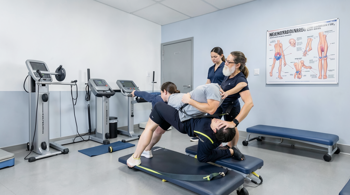
Hospital-based programs can offer broader medical infrastructure, while independent clinics may focus more narrowly on exercise progression or sports performance. Mend Physical Therapy in Boulder identifies Dr. Lucas Glomb as a Doctor of Physical Therapy, residency-trained, and board-certified Orthopedic Clinical Specialist. His stated focus includes ACL rehabilitation, knee therapy, advanced strengthening, and return to running, hiking, skiing, and competitive sports. 11
Why objective testing matters after ACL surgery
ACL rehabilitation frequently extends well beyond the immediate postoperative period. A protocol described by Jeremy Burnham, MD, at Ochsner-Andrews Sports Medicine Institute states that rehabilitation may take nine to twelve months and uses criteria-based progression rather than relying only on calendar timelines. The described phases address motion, strength, running, jumping, cutting, and return-to-play decisions, with objective testing used to assess readiness. 12
Forward PT’s Return+ platform describes repeated measurement of strength symmetry, range of motion, functional performance, and patient-reported outcomes across an episode of care. This type of tracking is different from a single end-stage assessment because it establishes a baseline and follows changes over time. Patients comparing clinics can ask which measures are recorded, how often testing occurs, and how results affect progression decisions. 13
Questions that reveal practical fit
Clinic selection should begin with the condition being treated. A patient with uncomplicated knee pain may need a different setting from someone recovering from ACL reconstruction, meniscus repair, total knee surgery, or a complex sports injury. The American Physical Therapy Association’s Find a PT directory is one resource for locating therapists by geography and practice focus, but credentials, treatment scope, and local availability still require direct verification. 14
Important questions include whether the therapist regularly treats the relevant diagnosis, whether care is one-on-one or shared across a treatment floor, which outcome measures are used, whether the clinic communicates with the surgeon, and whether the facility accepts the patient’s insurance. Other friction points include travel distance, visit frequency, authorization rules, copayments, equipment access, and the need to maintain a prescribed home-exercise program between appointments.
Risks, limitations, and realistic expectations
Clinic webpages are useful for identifying stated services, but they are not independent quality rankings. Most supplied descriptions emphasize expertise, advanced methods, athlete outcomes, or specialized experience without presenting a common set of audited comparison metrics. Patient testimonials and marketing language may reflect individual experiences rather than results that apply to every diagnosis, age group, surgical procedure, or activity level.
Rehabilitation also carries practical responsibilities and clinical uncertainties. Progress can be affected by swelling, range-of-motion limitations, strength deficits, pain, confidence, surgical protocols, medical complications, and adherence to prescribed activity restrictions. Decisions about running, jumping, cutting, or full sports participation should be coordinated with qualified clinicians and, when applicable, the surgical team. Insurance eligibility and clinician licensing should be confirmed before treatment begins.
Sources
- Hospital for Special Surgery, https://www.hss.edu/rehab/
- Mayo Clinic, https://www.mayoclinic.org/departments-centers/physical-medicine-rehabilitation/sections/overview/ovc-20203072
- Cleveland Clinic, https://my.clevelandclinic.org/departments/orthopaedics-rheumatology/depts/physical-therapy
- EDGE Sports Medicine, https://www.edgesportsmed.com/acl-rehab-bergen-county-nj/
- Accelerate Sport & Spine Rehab, https://acceleratenb.com/knees/
- Athletico Physical Therapy, https://www.athletico.com/locations/river-west/river-west-knee-pain-therapy/
- Made Strong Physical Therapy & Wellness, https://madestrongpt.com/knee-pain-physical-therapy-westminster-co/
- Penultimate Step, https://pssportsrehab.com/knee-pain-physical-therapy-maple-valley-wa/
- Jacksonville Orthopaedic Institute, https://www.joionline.net/joi-rehab-sports-center/
- Mend Colorado, https://www.mendcolorado.com/dr-lucas-glomb/
- Jeremy Burnham, MD, https://www.jeremyburnhammd.com/acl-physical-therapy-protocol/
- Forward PT, https://fwdptwi.com/services/return-plus-testing/
- American Physical Therapy Association, https://www.choosept.com/find-a-pt
Authored by MyTrendSpot team