Natural remedies for managing occasional difficulty sleeping: Evidence, options, and safety considerations
Natural remedies for managing occasional difficulty sleeping range from consistent sleep habits and relaxation techniques to chamomile tea, tart cherry juice, melatonin, magnesium, and herbal preparations. Evidence is uneven, so the most reliable starting point is usually a stable routine and a sleep environment that supports rest, while supplements require attention to interactions, side effects, and the underlying cause of sleeplessness.
Behavioral foundations for occasional sleep difficulty
Sleep hygiene is a primary non-drug approach for occasional difficulty sleeping. Guidance from NHS inform emphasizes understanding how daily behavior affects sleep, maintaining helpful routines, and treating the bed as a place associated with sleep rather than prolonged wakefulness. Cognitive behavioral approaches are also used in self-help guidance for mild-to-moderate sleep problems, particularly when worry and unhelpful habits keep insomnia going. 1
When wakefulness continues during the night, Sleep Foundation guidance recommends avoiding clock-watching and phones, leaving bed after about 20 minutes awake, choosing a quiet activity such as reading or journaling, and returning when sleepy. These steps reduce the frustration that can become associated with the bedroom. A consistent schedule, reduced evening stimulation, and attention to daytime habits are more firmly supported than many supplement claims. 2
Warm drinks and food-based options
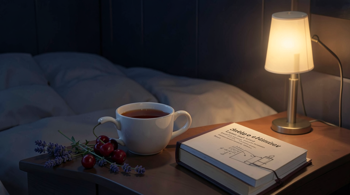
Johns Hopkins Medicine identifies warm milk, chamomile tea, and tart cherry juice as options some patients try for sleep trouble. The same source notes that scientific proof for these nighttime drinks is limited, although they may appeal to people seeking approaches without drug interactions. Warm milk has been associated with tryptophan-related serotonin pathways, chamomile contains flavonoids of research interest, and tart cherry juice may support melatonin production. 3
Food-based remedies should be viewed as supportive rituals rather than established treatments for insomnia. Chamomile tea is caffeine-free, while beverages containing caffeine, including green tea and Earl Grey, can be unsuitable close to bedtime for people sensitive to stimulation. Tart cherry juice has shown potential in research involving sleep time and sleep efficiency, but individual responses vary, and the available evidence does not establish it as a universal remedy. 4
Melatonin and circadian timing
Melatonin is a hormone involved in the sleep-wake cycle and is widely used as a supplement. Research summarized by Healthline reports that some studies found improvements in sleep latency, total sleep time, or overall sleep quality, while other studies did not find meaningful improvement. Benefits may be more relevant to jet lag, shift-work timing, or circadian rhythm problems than to every episode of ordinary sleeplessness. 5
Melatonin appears generally safe for adults when used for short periods, but long-term effects remain less certain. Reported side effects include nausea and dizziness, particularly at higher doses. GoodRx notes that timing is commonly discussed as one to two hours before bedtime, while dosage is not firmly defined. People who are pregnant, taking medicines, or managing chronic conditions should seek individualized advice before using it. 6
Herbs, minerals, and other supplements
Valerian root, lavender, magnesium, passionflower, and glycine are frequently discussed as natural sleep aids, but the strength of evidence differs. Valerian has a long history of use for sleep and anxiety, while lavender aromatherapy has been associated in studies with subjective sleep-quality improvements. Magnesium is often promoted for relaxation and sleep regulation, yet pharmacist-reviewed evidence indicates it may be more useful for some people with leg cramps than for insomnia itself. 7
Glycine, an amino acid, has been studied for effects on subjective sleep quality and sleep latency, and chamomile contains apigenin, a compound linked to sleep-related brain receptors. These findings do not guarantee a noticeable result from a tea, capsule, or aroma product. Herbal preparations can still produce side effects or interact with medicines, and “natural” labeling does not establish effectiveness, consistent quality, or suitability for every person. 8
Risks, limitations, and products to avoid
Natural remedies can create safety issues when they are combined with medicines, alcohol, cannabis, or other sedating substances. Herbal products may vary in formulation and strength, and supplement labels do not remove the need to consider allergies, pregnancy, age, kidney or liver disease, and prescribed treatment. Alcohol is not a dependable sleep remedy because it can interfere with sleep quality, even when it initially produces drowsiness. 9
Evidence should also be separated from marketing language. Reviews describe magnesium, valerian, lavender, chamomile, glycine, and tart cherry as options with mixed, limited, or condition-specific support rather than universal solutions. A cautious approach is to introduce only one change at a time, avoid combining several sedating products, and stop if unusual symptoms occur. Pharmacists and clinicians can assess potential interactions before a supplement is added to an existing regimen. 10
When occasional difficulty needs medical attention
Occasional sleep disruption is different from persistent insomnia. Cleveland Clinic describes insomnia as difficulty falling asleep or staying asleep that affects how a person feels or functions, and reports that roughly one in three adults worldwide experience insomnia symptoms. Long-lasting or severe sleep loss can affect alertness, memory, thinking, mood, and daily safety, including driving. Repeated symptoms deserve assessment rather than indefinite self-treatment. 11
Medical advice is particularly important when sleep difficulty is accompanied by loud snoring, breathing pauses, severe daytime sleepiness, restless legs, frequent nightmares, anxiety, depression, or another suspected health condition. Sleep apnea, restless legs syndrome, and narcolepsy can require targeted evaluation. For ongoing insomnia, cognitive behavioral therapy for insomnia, commonly called CBT-I, has stronger support than relying solely on supplements or herbal remedies. 12
Sources
- NHS inform, “How do I sleep better?”
- Sleep Foundation, “What to Do When You Can’t Sleep”
- Johns Hopkins Medicine, “Natural Sleep Aids: Home Remedies to Help You Sleep”
- American Journal of Lifestyle Medicine, research on tart cherry juice and sleep
- Healthline, “10 Natural Sleep Aids for Better Sleep”
- GoodRx, “The 10 Best Sleep Supplements, Backed by Pharmacists”
- National Council on Aging, “Best Natural Remedies for Sleep”
- Molecular Medicine Reports, research on chamomile and sleep-related effects
- Acibadem Hospitals Group, “Natural Sleep Aid: What Works, What Does Not, and Safety Notes”
- NCCIH, “Melatonin: What You Need to Know”
- Cleveland Clinic, “Insomnia: What It Is, Causes, Symptoms & Treatment”
- Acibadem Hospitals Group, discussion of CBT-I and persistent sleep problems
Authored by MyTrendSpot team