Warning signs of bursitis: A clinical guide to symptoms and red flags
What bursitis is and where it occurs
Bursitis is inflammation or irritation of a bursa, a fluid-filled sac that cushions the space between bones, tendons, muscles, ligaments, and skin. When the bursa becomes inflamed, extra fluid may collect inside it, producing pain, tenderness, swelling, or difficulty moving the nearby joint. Bursitis may be acute or chronic, and the underlying cause is not always identifiable. 1
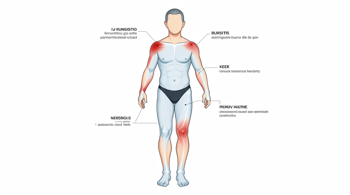
The shoulder, elbow, hip, knee, and heel are among the commonly affected locations. Bursitis may also develop near the Achilles tendon, foot, pelvis, toes, or the base of the big toe. Superficial bursae close to the skin can produce visible swelling, while deeper bursae may cause pain without an obvious lump. 2
Early warning signs to recognize
The most characteristic early signs are pain and tenderness in a focused area around a joint. Pressing directly over the bursa may reproduce the discomfort, and movement can make the pain more noticeable. Some people describe an ache, while others notice sharper discomfort during activities that place pressure on the affected region. Pain may also spread into nearby areas. 1
Visible or palpable swelling is another important sign, particularly when the inflamed bursa lies just beneath the skin. The area may feel full, puffy, or like a localized lump. Stiffness and aching can reduce the normal range of motion, although the degree of limitation depends on the bursa involved and the severity of inflammation. 3
- Localized pain near a joint
- Tenderness when the area is pressed
- Swelling or a visible lump
- Stiffness or reduced movement
- Warmth or redness over the affected area
How symptoms change with movement and pressure
Bursitis pain often becomes worse when the affected joint moves or when direct pressure is placed on the bursa. Kneeling can aggravate bursitis at the front of the knee, leaning on a desk or hard surface can irritate the elbow, and lifting the arm may increase shoulder symptoms. Repeated activity can intensify discomfort because it increases friction around the inflamed sac. 4
Rest does not always remove the pain completely. Penn Medicine describes bursitis as potentially painful during both movement and rest, while pain around the hip may worsen when lying on the affected side. This pattern can distinguish bursitis from simple short-lived soreness, although similar symptoms can occur with tendon, ligament, joint, or bone problems. 1
Common causes and associated conditions
Overuse is a frequent cause of bursitis. Symptoms may follow repetitive work, sports, kneeling, lifting, throwing, or a substantial change in activity, such as training for a marathon. Direct trauma and prolonged pressure can also irritate a bursa. The condition may develop gradually through repeated friction or appear suddenly after an impact. 1
Bursitis can also occur alongside rheumatoid arthritis, gout, pseudogout, osteoarthritis, psoriatic arthritis, or other inflammatory disorders. Infection is a less routine but clinically important cause. Risk may be higher when bacteria enter through trauma, an adjacent skin infection, or a medical procedure involving the bursa; diabetes, alcohol use, HIV, and systemic steroid use are listed as factors associated with septic bursitis in clinical guidance. 8
Red flags for infected bursitis
Warmth and redness can occur with ordinary inflammation, but rapidly increasing redness, marked warmth, worsening swelling, drainage, or fever raises concern for infection. Chills or a general feeling of illness are also warning features when they occur with a swollen, painful bursa. Infected bursitis can resemble other joint and soft-tissue conditions, so the appearance alone cannot confirm the cause. 6
Fever, significant warmth or redness, and rapidly progressive swelling warrant prompt medical assessment because infection may require different management from noninfectious bursitis. Sudden severe pain, substantial swelling, or inability to use the joint after an injury also deserves evaluation to rule out fracture, tendon injury, or another condition. 4
| Finding | Why it matters |
|---|---|
| Localized swelling and tenderness | Consistent with inflammation around a bursa |
| Fever or chills | May indicate infection |
| Rapidly spreading redness or swelling | Requires assessment for an advancing infection |
| Severe pain after trauma | May indicate an injury other than bursitis |
Diagnosis and when symptoms need assessment
Clinicians generally begin with a medical history and physical examination, asking about activity changes, pressure, trauma, pain patterns, and associated illnesses. Diagnosis is often clinical, but ultrasound may help evaluate a deep bursa. MRI, laboratory testing, or other imaging may be considered when the diagnosis is uncertain or another problem must be excluded. 2
When infection or crystal-related disease is suspected, fluid may be removed from the bursa for analysis and culture. Symptoms that persist, recur, worsen, or interfere with ordinary activities should be assessed rather than assumed to represent uncomplicated bursitis. The symptom pattern is useful, but pain near a joint has several possible causes and cannot establish a diagnosis by itself. 3
Initial management described in the clinical sources may include resting the joint, modifying the activity that causes pressure, and applying ice for short periods during the first several days. Depending on the cause and severity, clinicians may also consider splinting, nonsteroidal anti-inflammatory drugs, physical therapy, injections, or treatment directed at an underlying inflammatory or infectious condition. 2
Sources
- Penn Medicine, “Bursitis”
- Merck Manual Professional Edition, “Bursitis”
- Merck Manual Consumer Version, “Bursitis”
- Acibadem Hospitals Group, “Bursitis: Early Signs, Risk Factors, and How It Is Treated”
- CityHealth, “Urgent Care for Bursitis: When to Walk In and What Treatment to Expect”
- Prevention, “Doctors Explain Bursitis Causes and Home Treatments”
- Lexington Medical Center Blog, “Could Your Joint Pain Be Bursitis?”
- Guideline Genius, “Bursitis: Diagnosis & Management”
Authored by MyTrendSpot team