How to Treat a Burn at Home Safely: A Clinical First-Aid Guide
A burn at home can happen from hot water, cooking liquids, a stove, an oven, a curling iron, steam, chemicals, electricity, or sunlight. The safest response depends on the burn’s depth, size, location, and cause, because minor superficial injuries may be managed at home while serious burns require professional care.
Assess the Burn Before Treating It
A superficial, or first-degree, burn affects only the outer layer of skin. It usually appears red, painful, dry, and intact, without blisters, and common examples include sunburn and brief contact with a hot surface. These injuries often heal within seven to 14 days with appropriate care. 7
A partial-thickness, or second-degree, burn affects deeper skin and may produce blisters containing pale, watery fluid. A deep burn can look dry, leathery, white, brown, black, or charred, and severe burns may be less painful because nerve endings have been damaged. Pain intensity alone does not reliably show burn severity. 5
Cool the Burn With Running Water
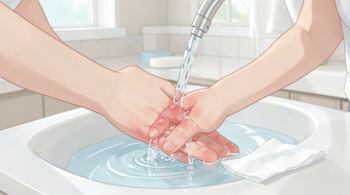
First, move away from the heat source and stop the burning process. Place a minor burn under cool, running water for about 10 to 20 minutes. Cooling can remove heat from the skin, reduce pain and swelling, and limit additional tissue damage. If running water is unavailable, a clean, cool wet cloth can be used. 6
Water should be cool or lukewarm rather than icy. Ice and ice water can worsen damage to already injured tissue, so they should not be applied directly to the burn. Cooling is most useful when started promptly, and one medical source advises beginning it as soon as possible and within three hours of the injury. 2
Remove Tight Items and Clean Gently
Rings, watches, bracelets, belts, and tight clothing near a burn should be removed carefully before swelling develops. Do not pull away fabric that has stuck to the skin, because doing so can enlarge the injury. Removing nearby jewelry and restrictive items is particularly important around fingers, wrists, ankles, and other areas that can swell quickly. 1
After cooling, wash a minor burn gently with mild soap and water, without scrubbing. Harsh cleaners and alcohol-based products can irritate damaged skin. Clean hands should be used when handling the injury or changing its covering, since an open or blistered burn has a greater risk of contamination. 6
Cover the Area and Protect Blisters
Cover a minor burn loosely with sterile gauze, a clean cloth, or a clean non-stick dressing. The covering protects the injured skin from friction and contamination, while a loose fit avoids pressure on tender tissue and allows room for swelling. A clean plastic bag may be used temporarily for a burn on the hand, according to NHS guidance. 4
Blisters should not be deliberately broken or popped. An intact blister helps protect the underlying skin as it heals and may reduce exposure to bacteria. If a blister breaks on its own, the area should be kept clean and covered, while increasing redness, swelling, drainage, or pain should be monitored as possible warning signs. 5
Manage Pain Without Irritating the Skin
Over-the-counter pain relievers such as acetaminophen or ibuprofen may help with discomfort from a minor burn. Medication should be used according to the product label and personal medical guidance, particularly when other health conditions or medicines may affect suitability. Raising the burned area, when practical, can also help reduce swelling. 4
Aloe vera lotion or gel may soothe a small, minor burn after the area has been cooled. Fresh burns should not be covered with butter, oils, toothpaste, greasy substances, or unapproved ointments, because these materials can trap heat or complicate later medical assessment. Ice is also inappropriate for the same tissue-damage concern. 5
Know When Emergency Care Is Needed
Emergency services or an emergency department are appropriate for burns that go through all layers of skin, look dry or leathery, appear charred, or contain white, brown, or black patches. Emergency evaluation is also advised when a burn is larger than 3 inches, wraps around an arm or leg, swells rapidly, or occurs with smoke inhalation. 1
Medical attention is needed for chemical, electrical, and lightning burns, even when the injury initially appears small. Burns involving the face, eyes, mouth, hands, feet, genitals, buttocks, or major joints also require particular caution. Babies and older adults may need evaluation for injuries that could be treated at home in other adults. 1
Monitor Healing and Possible Infection
Minor burns should remain clean, protected, and under observation during healing. Increasing redness, swelling, drainage or pus, worsening pain, red streaks extending from the injury, or fever can indicate infection or another complication. Persistent pain, a fever, worsening appearance, or a burn that does not begin healing within a few days warrants medical assessment. 5
Home care is intended for small, superficial injuries, not for burns whose depth or cause is uncertain. A burn can appear less painful than expected when tissue damage is deep, and second-degree injuries may heal differently depending on how far they extend into the dermis. When severity is unclear, professional assessment is safer than relying on appearance alone. 3
Sources
- Mayo Clinic, “Burns: First aid”
- Nebraska Medicine, “How to treat a burn at home: First aid tips and when to see a doctor”
- Cleveland Clinic, “First Aid Treatment for Burns”
- NHS 111 Wales, “Burns and scalds”
- American Burn Association, “Burn First Aid”
- Banner Health, “Burned? What to Do, How to Heal and When to Get Help”
- Cleveland Clinic, “First-Degree Burn”
Authored by MyTrendSpot team