Ways to manage bursitis at home: A clinician-informed care guide
Understanding bursitis and its common triggers
Bursitis is inflammation or irritation of a bursa, a small fluid-filled sac that cushions movement between bones, muscles, tendons, ligaments, and skin. It commonly affects the shoulder, elbow, hip, knee, and heel, and may cause localized tenderness, aching, swelling, warmth, redness, stiffness, or pain during movement and rest. Overuse, unusual activity, prolonged pressure, injury, changes in training, excess body weight, gout, rheumatoid arthritis, and infection are recognized causes. 1 2
- Common triggers include repetitive motion, kneeling, leaning on an elbow, overhead activity, or extended pressure on one side of the body. 3
- Joint-area pain can have causes other than bursitis, so persistent or uncertain symptoms should not be self-diagnosed indefinitely. 4
Rest the irritated joint without becoming completely inactive
Rest is a central part of early home care, but it means reducing the activity that provokes symptoms rather than keeping the entire body motionless. Temporarily avoid repetitive movement, heavy lifting, kneeling, prolonged standing, or direct pressure on the painful area. Penn Medicine specifically advises resting the joint and avoiding sleep on the affected side. Once acute pain begins to settle, gentle movement can help limit stiffness and support a gradual return to normal activity. 1 6
- Break demanding tasks into shorter periods and change position regularly.
- Stop an exercise or stretch if it clearly increases pain rather than easing stiffness.
- Return to activity gradually instead of immediately repeating the motion that caused the flare-up. 7
Apply ice safely during the first few days
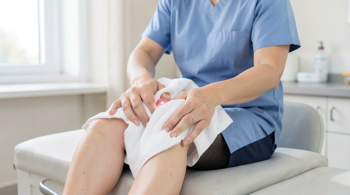
Cold application can reduce discomfort during an early flare-up. Penn Medicine recommends using ice three to four times daily for the first two or three days, placing the ice over a towel for about 15 minutes. Other clinical guidance describes sessions of approximately 15 to 20 minutes, two or three times daily. Ice should never be placed directly against the skin, and a person should remain awake while using it because excessive exposure can cause frostbite. 1 4
- Use a covered ice pack or wrapped cold pack.
- Inspect the skin after treatment and discontinue cold exposure if it becomes excessively numb, pale, or painful.
- Use cold as symptom relief, not as a reason to continue the activity that aggravated the joint. 8
Reduce pressure with positioning and practical changes
Reducing friction and pressure addresses a major mechanical cause of bursitis. For hip, knee, or ankle symptoms, Penn Medicine advises avoiding long periods of standing, distributing weight evenly, and standing on a cushioned surface. A pillow between the knees may reduce discomfort when lying on the side. Similar principles apply to other locations: avoid leaning on an elbow, kneeling directly on a painful knee, or sleeping on the affected hip or shoulder. 1 5
- Consider protective padding for activities that require kneeling or contact with a hard surface.
- Adjust work posture and alternate tasks that involve repeated reaching, lifting, or pressure.
- Choose supportive, flat footwear when foot, heel, or ankle symptoms are affected. 9
Consider over-the-counter pain relief carefully
Nonsteroidal anti-inflammatory drugs, commonly called NSAIDs, such as ibuprofen or naproxen may reduce pain and inflammation in some people. They are not appropriate for everyone, however, and should be taken only according to the product label or advice from a qualified clinician. Medical history, other medicines, stomach problems, kidney disease, cardiovascular conditions, pregnancy, and allergies can affect whether an NSAID is suitable. Topical or oral anti-inflammatory treatment is described as an initial option in clinical guidance, but medication does not establish the diagnosis. 2 3 10
- Do not combine NSAIDs unless a clinician specifically directs it.
- Ask a pharmacist or clinician about interactions and safety when regular medicines or chronic conditions are present.
- Follow package directions and discontinue use if concerning reactions develop. 11
Use gentle movement and rehabilitation as pain improves
Prolonged inactivity can contribute to stiffness, while appropriately guided movement may restore flexibility and strength. Gentle range-of-motion exercises and gradual stretching are generally introduced as acute pain improves, with the exact movements depending on whether the shoulder, hip, knee, elbow, or heel is involved. Physical therapy may address joint mechanics, posture, movement patterns, and supporting muscle strength. Exercises should be adjusted if they increase symptoms, and location-specific programs are safer than copying an unrelated routine. 6 7 8
- Begin with comfortable movement rather than forceful stretching.
- Increase duration or resistance gradually after routine movement is tolerated.
- Professional assessment may be useful when weakness, limited motion, or repeated flare-ups persist. 8
Know when home management is not appropriate
Infection can resemble ordinary bursitis but requires different treatment. Fever, chills, rapidly increasing swelling, pronounced warmth or redness, drainage, severe tenderness, sudden severe pain, or difficulty moving the joint warrant prompt medical assessment. Infection is among the possible causes of bursitis, and clinicians may use laboratory testing, imaging, or analysis of fluid from the bursa when the diagnosis is uncertain. Attempting to puncture or drain a swollen bursa at home can introduce infection and should be avoided. 1 2 4 15
- Seek urgent evaluation for fever with a red, hot, swollen bursa.
- Arrange clinical review when symptoms do not improve after one to two weeks of sensible home care.
- Medical evaluation is also appropriate when symptoms repeatedly return or follow an injury. 4 5
Set realistic expectations for recovery and prevention
Many noninfectious cases improve with conservative measures such as activity modification, rest, ice, pain relief when medically appropriate, and later rehabilitation. Recovery depends on the affected site, the underlying trigger, and whether another condition such as gout, rheumatoid arthritis, or tendon inflammation is involved. Prevention focuses on correcting the repeated pressure or movement that caused irritation, strengthening supporting muscles when advised, and increasing activity levels gradually rather than making abrupt changes. 2 5 8
- Track which movements, positions, or workloads worsen symptoms.
- Use padding, posture adjustments, and regular breaks to reduce recurring pressure.
- Arrange professional care if self-management fails, because treatment may include physical therapy, aspiration, prescription medicine, injection, antibiotics, or management of an underlying disorder. 2 6
Sources
- Penn Medicine, Bursitis, https://www.pennmedicine.org/conditions/bursitis
- Merck Manual Consumer Version, Bursitis, https://www.merckmanuals.com/home/bone-joint-and-muscle-disorders/muscle-bursa-and-tendon-disorders/bursitis
- Prevention, Doctors Share the Best Remedies for Bursitis, https://www.prevention.com/health/a71403579/doctors-explain-bursitis-causes-and-treatments/
- Ubie Doctor's Note, Is It Bursitis?, https://ubiehealth.com/doctors-note/is-it-bursitis-joint-inflaming-why-steps-42-doctor23e2
- Acibadem Hospitals Group, Bursitis: Early Signs, Risk Factors, and Treatment, https://acibademinternational.com/health-library/bursitis-early-signs-risk-factors-and-how-it-is-treated/
- Johns Hopkins Medicine, Bursitis, https://www.hopkinsmedicine.org/health/conditions-and-diseases/bursitis
- Rausch Physical Therapy, The Essential Guide to Bursitis Treatment, https://rauschpt.net/the-essential-guide-to-bursitis-treatment/
- Acibadem Hospitals Group, Bursitis Physical Therapy: Complete Patient Guide, https://acibademinternational.com/health-library/understanding-bursitis-physical-therapy-a-complete-patient-guide/
- Crouch Physio, Bursitis: The Dos and Don’ts, https://crouchphysio.com/bursitis-the-dos-and-donts-for-managing-this-painful-condition/
- Mayo Clinic, Bursitis Diagnosis and Treatment, https://www.mayoclinic.org/diseases-conditions/bursitis/diagnosis-treatment/drc-20353247
- Cleveland Clinic, Bursitis, https://my.clevelandclinic.org/health/diseases/10918-bursitis
- Healthdirect Australia, Bursitis, https://www.healthdirect.gov.au/bursitis
Authored by MyTrendSpot team