Compare Dental Costs for Seniors by State: A Data-Driven Analysis for 2026
Seniors researching how to compare dental costs for seniors by state will find that geography is the single most powerful cost variable outside of the procedure itself. A complete single-tooth implant averages $4,507 nationally in 2026, but that same procedure costs $3,759 in Alabama and $5,733 in California, a gap exceeding 52% for identical clinical work. 1 Compounding the challenge, Original Medicare excludes routine dental care entirely, leaving the majority of adults over 65 to absorb costs through private insurance, Medicare Advantage, discount plans, or out of pocket. 2
State-by-State Implant Cost Benchmarks
The 2026 Real Dental Costs open US Dental Cost Index, validated against ASQ360/CareCredit industry benchmarks at a rank correlation of 0.945, ranks implant pricing across all 51 markets. California is the most expensive state, with a per-tooth implant (post, abutment, and crown) averaging $5,733 and ranging from $4,013 to $8,026. New York averages $5,565, Hawaii averages $5,460, and Alaska averages $5,450. 1 At the lower end, Alabama averages $3,759 ($2,631 to $5,263), Arkansas averages $3,833, and Mississippi averages $3,885. 1
An important finding from the same dataset is that price rankings do not transfer uniformly across procedure categories. The rank correlation between what a state charges for braces and what it charges for restorative work (implants, crowns, dentures) is essentially 0.04, close to zero, meaning orthodontic pricing operates as an entirely independent market. 1 Seniors prioritizing restorative work should not assume a state ranked affordable for orthodontics will be affordable for implants or crowns.
| State | Implant Avg (2026) | Implant Range | Relative Cost Tier |
|---|---|---|---|
| California | $5,733 | $4,013–$8,026 | Highest |
| New York | $5,565 | $3,896–$7,791 | Very High |
| Hawaii | $5,460 | $3,822–$7,644 | Very High |
| Alaska | $5,450 | $3,815–$7,630 | Very High |
| Arkansas | $3,833 | $2,683–$5,366 | Very Low |
| Mississippi | $3,885 | $2,720–$5,439 | Very Low |
| Alabama | $3,759 | $2,631–$5,263 | Lowest |
Crown, Root Canal, and Cleaning Costs Across States
Geographic variation extends well beyond implants. FAIR Health data consistently documents price variation of up to 60% across US dental markets for the same procedures. 3 A porcelain crown in Bridgeport, Connecticut runs $1,400 to $2,100, while the identical procedure in Mississippi costs $750 to $900, a difference of $700 to $1,200 on a single tooth. 3 Root canal treatments nationally average $1,000 to $1,500, while tooth extractions range from $75 to $300 depending on complexity and state. 4
Routine cleanings also show significant state-level dispersion. A standard cleaning runs approximately $90 in Alabama but reaches $180 in New York. 5 Seniors in lower-cost states such as Oklahoma, Tennessee, Kentucky, and West Virginia consistently see crowns priced between $800 and $1,050 and implants between $3,000 and $4,000, while Florida, a major retirement destination, occupies a medium-high tier with crowns ranging from $1,000 to $1,400 and implants from $3,600 to $4,800. 3 Urban markets within any state tend to run materially higher than rural markets, with city-level gaps as large as 83% recorded within a single state. 1
The Medicare Coverage Gap and Its Financial Impact on Seniors
Original Medicare Parts A and B were designed in 1965 and explicitly excluded routine dental care, a structural omission that has never been legislatively corrected. The exclusion covers cleanings, fillings, extractions, dentures, and implants. 2 Research shows that nearly half of all Medicare beneficiaries did not visit a dentist during a recent study period, with cost cited as the leading barrier. 6 Approximately 26% of adults over 65 have lost all their teeth, and those who retain teeth often face escalating costs for crowns, root canals, and restorations that Medicare will not offset. 6
Seniors facing major restorative work can spend $3,000 to $8,000 in a single year entirely out of pocket under Original Medicare. 7 Medicare Advantage (Part C) plans partially address this gap: many bundle dental benefits worth $1,000 to $3,000 annually, covering preventive cleanings and portions of major work. Among top-rated Medicare Advantage plans, 94% of comprehensive in-network dental services carry a $0 copay. 6 However, coverage varies significantly by plan and county, and some plans have reduced benefits in certain states. In Massachusetts and other areas, UnitedHealthcare's AARP Medicare Advantage product dropped its $1,000 dental treatment benefit in 2026, leaving members with only cleanings, exams, and X-rays. 8
Medicaid Dental Coverage: A Patchwork by State
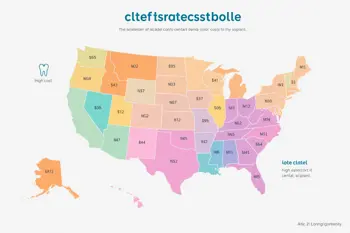
For income-eligible seniors, Medicaid represents a potential pathway to reduced-cost dental care, but the benefit structure varies dramatically by state. Roughly 18 states offer adults comprehensive coverage including preventive, basic, and major restorative work as well as dentures. Approximately 16 states provide limited coverage covering preventive care and some basics. Around 12 states restrict adult coverage to emergency extractions and pain relief only. Four states cover almost nothing for adult teeth beyond federally mandated emergency services. 9
The federal government mandates emergency dental services for adults on Medicaid nationwide, establishing a floor that includes severe pain, active infection, and necessary extractions. Everything above that floor is determined at the state level, creating an uneven landscape where a senior's zip code is the primary determinant of Medicaid dental access. 9 By contrast, children on Medicaid in all 50 states receive comprehensive dental coverage under federal Early and Periodic Screening requirements. The PACE program (Program of All-Inclusive Care for the Elderly), available in certain states, provides coordinated care that may include dental services depending on the plan's benefit package. 10
Senior Dental Insurance: Cost Structures and Plan Comparisons
Standalone dental insurance for seniors typically carries monthly premiums between $20 and $80, with annual maximums ranging from $1,000 to $5,000 depending on plan tier. 7 Seniors averaging $685 out of pocket annually on dental care may find standard preventive coverage sufficient, but those facing dentures, crowns, or implants require plans with higher annual maximums and no lengthy waiting periods for major services. 7 Spirit Dental, for example, offers plans from $33 to $57 per month with annual maximums of $3,000 to $5,000 and no waiting period for major work, while AARP/Delta Dental PPO plans via UnitedHealthcare range from $26 to $52 monthly with $1,000 to $2,500 annual maximums that apply after waiting periods. 7
Dental discount plans are a structurally different product: they are not insurance, carry no annual maximum or claims process, and cost $8 to $15 per month or $100 to $300 annually. They provide negotiated rate reductions of 10% to 60% at participating providers but transfer all remaining cost to the patient. 11 Their value depends entirely on the density of participating dentists in the patient's state, which varies considerably. A low-premium plan in a rural state with few participating providers offers materially less practical value than the same plan in a metropolitan market. Key plan variables seniors should evaluate beyond premium include deductible, copay structure, waiting periods for major work, annual maximum, and network breadth in their specific state. 12
Cost-Reduction Pathways Available in Most States
Several structural alternatives exist for seniors seeking to reduce out-of-pocket dental costs regardless of state. Dental schools accredited by the American Dental Association provide services at 30% to 50% below private practice rates for most procedures, and programs are available in the majority of states. 13 Full dentures at a dental school may cost $600 to $1,500, compared to the national private-practice average of $1,360 to $3,565 per arch. 14 Federally Qualified Health Centers (FQHCs) offer dental services on a sliding fee scale based on income and operate in all states, providing a safety-net option for seniors on fixed incomes who do not qualify for Medicaid. 15
Cosmetic procedures such as veneers and whitening receive no coverage under any insurance category and are paid entirely out of pocket. The national average for cosmetic dentistry ranges from $1,670 to $4,390, with a full smile makeover potentially exceeding $40,000. 16 Seniors should distinguish between medically necessary restorative work, which may attract at least partial plan coverage, and elective cosmetic procedures, which will not. State-level price variation for cosmetic work does not follow the same geographic ranking as restorative procedures, reinforcing the principle that seniors should obtain itemized procedure-level quotes from local providers rather than relying on state-level averages alone before making treatment decisions.
Sources
- Real Dental Costs – State of U.S. Dental Costs 2026: realdentalcosts.com/en/state-of-us-dental-costs-2026/
- Medicare.gov – Dental Services Coverage: medicare.gov/coverage/dental-services
- ToothCostGuide – Cheapest States for Dental Work in 2026: toothcostguide.com/guides/cheapest-states-for-dental-work/
- Healthline – How Much Does a Root Canal Cost: healthline.com/health/how-much-does-a-root-canal-cost
- The Dental Healers – Dental Costs by State 2026: thedentalhealers.com/dental-costs-by-state/
- Budget Seniors – Dental Plans for Seniors: budgetseniors.com/insurance/dental-insurance-for-seniors/
- ToothCostGuide – Best Dental Insurance for Seniors 2026: toothcostguide.com/guides/dental-insurance-for-seniors/
- Budget Seniors – AARP Dental Plans for Seniors: budgetseniors.com/insurance/aarp-dental-plans-for-seniors/
- ToothCostGuide – Medicaid Dental Coverage by State 2026: toothcostguide.com/guides/medicaid-dental-coverage/
- CMS – Program of All-Inclusive Care for the Elderly (PACE): cms.gov/medicare/coverage/pace
- HealthInsurance.org – Dental Insurance vs. Dental Discount Plans: healthinsurance.org/faqs/whats-the-difference-between-dental-insurance-and-dental-discount-plans/
- Dental Coverage Guide – Dental Insurance Cost for Seniors 2026: dentalcoverageguide.com/dental-insurance-cost-for-seniors/
- American Dental Association – Dental Schools: mouthhealthy.org/en/dental-schools
- Pearl – Full Dentures Cost National Average: dentalcosts.hellopearl.com/procedure/dentures
- Health Resources and Services Administration – Find a Health Center: findahealthcenter.hrsa.gov
- Pearl – Cosmetic Dentistry Cost by State: dentalcosts.hellopearl.com/procedure/cosmetic-dentistry
Authored by MyTrendSpot team