Affordable tooth replacement dental implants near me: A clinical and cost-planning guide
Searching for affordable tooth replacement dental implants near me usually means comparing a stable, long-term replacement with options that may have lower initial costs. Dental implants can support crowns, bridges, or dentures, but suitability and total treatment expense depend on oral health, bone volume, the number of missing teeth, and any required preparatory procedures. 1
What dental implants replace
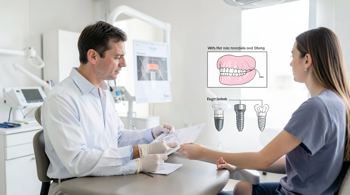
A dental implant replaces the root portion of a missing tooth and supports a visible restoration. The typical structure includes an implant placed in the jawbone, an abutment that connects the implant to the restoration, and a crown, bridge, or denture-style replacement. The American Dental Association describes implants as foundations for restoring function after tooth loss, while treatment planning depends on individual oral conditions. 1 2
- Single missing teeth may be restored with an implant and crown.
- Several missing teeth may be treated with multiple implants, an implant-supported bridge, or an implant-supported denture.
- Complete treatment requires clinical examination and imaging rather than a price comparison alone.
Eligibility and clinical assessment
Implant candidacy is evaluated through oral examination, imaging, medical-history review, and assessment of the gums and jawbone. Bone volume, gum disease, smoking status, medications, and medical conditions can affect the recommended approach. Cleveland Clinic notes that bone grafting may be needed when the jaw does not provide adequate support, while the final decision may involve comparing implants with bridges or removable dentures. 10
- Active gum disease may require management before implant placement.
- Insufficient bone can add grafting or other preparatory stages.
- A damaged tooth may require extraction before replacement.
- Medical history and medication use should be reviewed before surgery.
Stages and timing of treatment
Implant treatment is generally staged rather than completed in one appointment. Mayo Clinic describes a process that can include evaluation, surgical placement, a healing period, and attachment of the replacement tooth. During healing, the implant integrates with surrounding bone. The number of implants, need for extraction or grafting, and type of final restoration influence the treatment sequence and total fee. 11
| Stage | Purpose |
|---|---|
| Evaluation | Assess oral health, bone, medical history, and restoration options. |
| Placement | Position the implant in the jawbone when clinically appropriate. |
| Healing | Allow integration before the final restoration is attached. |
| Restoration | Attach a crown, bridge, or denture-supported replacement. |
What makes the total cost vary
Implant pricing cannot be interpreted reliably without an itemized treatment plan. Published dental cost guidance identifies the number of implants, preparatory procedures, materials, geographic area, and insurance coverage as important variables. A complete estimate should clarify whether consultation, imaging, extraction, bone grafting, the implant fixture, abutment, temporary restoration, final crown, and follow-up visits are included. 13
- One implant and crown is a different cost category from a full-arch restoration.
- Grafting, extraction, sedation, or temporary teeth may be separate line items.
- Materials and restoration design can affect the final estimate.
- Written estimates make comparisons between offices more meaningful.
Coverage and lower-cost care settings
Coverage is not uniform. Original Medicare generally excludes routine dental services, including most implants, although limited dental coverage may apply when treatment is directly connected to a covered medical procedure. Adult Medicaid dental benefits vary by state. Federally supported health centers may use sliding-fee schedules based on household income and family size, but implant treatment is not available at every location. 6 7 4 5
- Health-center locations can be identified through the HRSA locator.
- Dental schools may provide supervised care through student clinics at reduced fees.
- Local assistance information may be available through the 211 network.
- Eligibility rules and services must be verified with each program.
Insurance, financing, and payment risks
Dental insurance commonly includes annual maximums, waiting periods, exclusions, and procedure limitations, so a written pre-treatment estimate is important. Financing can divide payments into monthly obligations, but promotional terms, interest, deferred-interest conditions, and fees require careful review. The existence of a payment plan does not establish clinical suitability or reduce the need to compare the complete treatment cost. 12
- Ask whether the estimate reflects the entire treatment sequence.
- Check the interest rate, repayment period, fees, and consequences of missed payments.
- Confirm how insurance coordination affects the patient balance.
- Compare the total amount paid, not only the monthly figure.
Alternatives, risks, and ongoing maintenance
Removable dentures generally have a lower initial cost, while bridges may cost less than implants but require reshaping adjacent teeth. Implants can provide stability and help preserve jawbone, yet surgery carries risks and maintenance remains necessary. Brushing, flossing, professional evaluations, and management of gum health are still required. No replacement option eliminates the need for follow-up care, and implant success depends on patient-specific factors. 10 1
- Ask which teeth or structures must be altered for each alternative.
- Discuss healing complications, restoration failure, and maintenance requirements.
- Review how smoking, gum disease, and medical conditions may affect outcomes.
- Obtain a second clinical opinion when the proposed plan is extensive or unclear.
Questions to document before treatment
A careful comparison should document the diagnosis, proposed restoration, treatment stages, expected healing, risks, alternatives, and complete financial responsibility. NIDCR identifies lower-cost care resources as part of dental-care planning, while ADEA describes dental-school clinics as a possible source of supervised treatment. These resources can broaden the range of care settings considered, but each patient still requires an individual assessment. 3 9
- What is the recommended alternative if implants are unsuitable?
- Which procedures and follow-up visits are included in the estimate?
- What happens if grafting, a temporary restoration, or a replacement component becomes necessary?
- Which clinician performs each surgical and restorative stage?
Sources
- American Dental Association, Dental Implants: https://www.ada.org/resources/ada-library/oral-health-topics/dental-implants
- MouthHealthy, Implants: https://www.mouthhealthy.org/all-topics-a-z/implants
- National Institute of Dental and Craniofacial Research, Dental Care: https://www.nidcr.nih.gov/health-info/dental-care
- Health Resources and Services Administration, Find a Health Center: https://findahealthcenter.hrsa.gov/
- Health Resources and Services Administration, Affordable Care and Sliding-Fee Programs: https://www.hrsa.gov/get-health-care/affordable/hill-burton
- Medicare.gov, Dental Services: https://www.medicare.gov/coverage/dental-services
- Medicaid.gov, Dental Care: https://www.medicaid.gov/medicaid/benefits/dental-care/index.html
- 211, Health-Care Expenses: https://www.211.org/get-help/healthcare-expenses
- American Dental Education Association, Student Clinics: https://www.adea.org/GoDental/Health-Well-Being/Student-Clinics/
- Cleveland Clinic, Dental Implants: https://my.clevelandclinic.org/health/treatments/10946-dental-implants
- Mayo Clinic, Dental Implant Surgery: https://www.mayoclinic.org/tests-procedures/dental-implant-surgery/about/pac-20384622
- CareCredit, Dental Financing: https://www.carecredit.com/dentistry/
- Healthline, Dental Implant Cost Guide: https://www.healthline.com/health/dental-and-oral-health/dental-implants-cost
Authored by MyTrendSpot team