Police impound trailers: a buyer checklist for wiring and tires: Editorial due-diligence checklist for electrical circuits, tire safety, and road-readiness
Police impound trailers are often sold “as-is, where-is,” meaning the purchase process typically does not include the same level of post-sale consumer protection seen in dealer settings. 1 As a result, verifying trailer wiring and tire condition becomes a primary safety and compliance step before towing, registration, or any attempt to use the trailer on public roads. 1
Police impound auction reality check: why “as-is, where-is” changes inspection priorities
Public auction listings for police impound trailers and other government surplus property are commonly framed as “as-is, where-is.” 1 In practical terms, descriptions can be incomplete because the selling agency may not have operated the trailer recently, and the listing party may be describing equipment without personal operational testing. 10 This creates a due-diligence gap that must be closed with hands-on checks, documentation review, and electrical and running-gear testing.
The inspection burden also interacts with vehicle history uncertainty. Police and impound sales can involve seized or abandoned property, limited keys, and unknown operating condition, which increases the probability of deferred repairs surfacing after pickup. 9 A wiring harness can be corroded or damaged, and tires can look serviceable while still being near end-of-life due to age or load mismatch. 3 In this environment, a structured checklist is less about preference and more about risk management.
Wiring checklist: lighting circuits, grounds, and brake actuation verification
Trailer electrical issues are frequently not “mystery wiring failures” but corrosion, broken conductors, or ground faults. 18 Used-trailer inspection guidance emphasizes testing and visual checks for damaged wiring harnesses and verifying that all lights function, including brake, turn signals, and running lights. 3 For police impound trailers, this priority increases because storage conditions can accelerate corrosion in exposed under-frame routing areas. 18
Begin by confirming the trailer’s connector type and circuit mapping, especially for systems that use a 4-pin or 7-way interface. 18 Then validate all circuits with continuity testing and functional checks, focusing on brake light, turn signal, and clearance or marker light circuits. 3 Where possible, test brake actuation with a brake controller or while connected to a towing vehicle to confirm proper response across all wheels. 17
- Visually inspect wiring harness routing under the frame for exposed wires, corrosion, frayed sections, and loose connections. 3
- Perform continuity testing across brake, turn, and clearance light circuits, because harness corrosion and water intrusion can hide intermittently failed paths. 3
- Verify the ground connection because ground faults are a common cause of “no lights” failures on the road. 22
- Use a brake controller test when available to validate electric brake wiring behavior. 17
Ground integrity and connector corrosion: the failure mode to treat as high priority
Multiple used-trailer wiring references highlight corrosion as a dominant failure mechanism, particularly at ground connections. 18 A typical grounding arrangement involves a single bolt to the trailer frame, and moisture plus dissimilar-metal contact can drive rapid corrosion in under-frame environments. 18 For police impound trailers, the probability of such corrosion is elevated due to unknown storage exposure and the likelihood of prior weather contamination around connectors.
Connector-level verification is therefore not optional when road legality depends on functional signals. Trailer lighting circuits, including brake lights and turn signals, are safety-critical and must function properly for road use. 19 Testing ground continuity and inspecting connector condition supports a more reliable diagnosis than repeatedly replacing bulbs or fuses without isolating the fault location. 14
- Check connector and plug condition for oxidation or corrosion at terminals before relying on any “works sometimes” observation. 26
- Validate continuity from the connector through the circuit rather than assuming the tail lamps are the only possible point of failure. 14
- Inspect and confirm secure wiring routing under the frame so harness damage does not recur during normal vibration. 3
Tire checklist: date codes, sidewall condition, tread pattern, and load rating match
Tire assessment should include both condition and age. Trailer inspection guidance stresses checking tread depth and sidewalls for dry rot, plus verifying tire date codes, with anything older than 5 years flagged for replacement consideration in general used-trailer workflows. 3 Separate guidance for impound-style due diligence recommends verifying that tires are not older than 6 to 10 years regardless of tread depth, because age alone can drive failure risk. 27
Visual cues should not be limited to tread wear. Confirm wheel and tire integrity, including the absence of sidewall cracking and uneven wear patterns that can imply alignment or bearing issues. 4 Max Built Trailers’ checklist emphasizes replacing tires older than 5 years, and Country Blacksmith’s inspection framing treats tire blowouts and related safety failures as consequences of deferred inspection. 3 For police impound trailers where tire age may be unknown, date-code validation becomes the most defensible step.
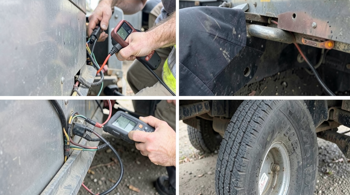
| Tire check | What to verify | Why it matters for impound risk |
|---|---|---|
| DOT date code | Confirm manufacturing age and do not rely on tread-only judgment | Tires can fail even with good tread due to age 27 |
| Sidewalls | Dry rot and cracking assessment | Dry rot can indicate structural weakness before tread issues appear 4 |
| Uneven wear | Look for abnormal patterns across tires | Uneven wear may reflect running-gear misalignment or bearing problems 4 |
| Load rating | Match tire load range to trailer GVWR and axle setup | Load mismatch increases overheating and failure risk 5 |
Matching tires to GVWR and wheels: preventing load-range mismatches
Trailer GVWR is a structural spec that determines maximum allowable operating weight and must inform tire selection. Trailer GVWR information is permanently affixed to the trailer frame, and it drives maximum tire load rating and total weight capacity planning. 5 This matters in police impound contexts because tire replacements in the prior owner or storage period may not have followed the original spec, especially where the trailer was abandoned or unmaintained.
Inspection guidance also stresses verifying wheel and tire compatibility and integrity, including ensuring wheels are not bent or cracked and that load range meets or exceeds the trailer’s GVWR requirements. 4 A matching process should include checking axle rating, because Max Built’s checklist highlights verifying axle rating values such as 3,500 lb, 5,200 lb, or 7,000 lb and ensuring surrounding components are appropriate for that rating. 4 If axle rating or GVWR information cannot be confirmed on the trailer, the risk profile increases.
- Locate GVWR markings on the trailer frame or manufacturer label to set the tire load target. 5
- Verify tire load range meets or exceeds GVWR expectations and does not exceed wheel capacity constraints. 4
- Inspect wheels for bends, cracks, and mismatched sets that can worsen vibration and uneven wear. 4
Stored-and-left trailers: wheel bearings, spare tire verification, and “first tow” risk reduction
Impound trailers can be sitting unused for extended periods, which changes the failure landscape relative to regularly maintained equipment. Wheel bearing inspection is critical in this context and should include checking for play, noise, and heat generation indicators, with regreasing or replacement when movement is detected. 28 Used-trailer guidance also recommends spinning wheels to detect grinding or wobble consistent with bad bearings, since hub condition can correlate with overall maintenance quality. 4
Spare tire readiness should also be verified, not assumed. The impound-focused buyer research highlights checking for the spare tire mounting bracket and confirming the spare tire itself meets current DOT standards rather than only verifying presence. 29 In a road-side failure scenario, an older spare can compound safety issues, including inability to safely carry expected loads. 29
- Confirm bearings condition before road use, considering that stored equipment may require regreasing or bearing service. 28
- Check wheel rotation for grinding or wobble to identify bearing problems early. 4
- Verify spare tire mounting hardware presence and spare tire DOT compliance. 29
Regulatory and documentation friction points: legal road-readiness, eligibility, and compliance maintenance
Road readiness is not only mechanical. Trailer lighting circuits, including brake lights and turn signals, are safety-critical and must function properly for road use. 19 In practice, trailer registration processes and state requirements can require safety inspection outcomes before plates are issued. 20 Because police impound trailers are often sold without an included repair warranty, safety corrections typically become the buyer’s responsibility before full legal use.
Eligibility and administrative steps also influence the timeline from purchase to use. Buyer due diligence guidance for used trailers emphasizes that ownership records and inspection readiness affect whether a trailer can be used legally after transfer. 12 Additionally, used-trailer purchase planning for fleets highlights compliance as a key stage to avoid situations where the trailer is out of compliance at a weigh station or unable to proceed to service without remedial work. 8
- Confirm documentation and identity items such as VIN or serial information before assuming compatibility with your intended use. 12
- Plan for safety inspection steps required by state registration processes when applicable. 20
- Expect that “as-is” auction terms can mean limited seller obligations for wiring, brakes, and tire safety fixes. 10
Sources
- https://searchlabz.com/policeimpoundtrailerauctionbuyingguide/
- https://primeloadtrailers.com/how-to-inspect-a-trailer-before-buying/
- https://maxbuilttrailers.com/resource-center/the-ultimate-checklist-for-inspecting-a-trailer-before-you-buy/
- https://www.ibextrailers.com/post/how-to-inspect-a-used-trailer-before-you-buy
- https://towlos.com/blog/used-trailers-how-to-buy-smart-and-avoid-expensive-surprises/
- https://reganmotors.com/how-to-inspect-a-used-trailer-before-buying/
- https://appletruckandtrailer.com/how-to-buy-used-trailers-guide-for-fleets/
- https://weanable.com/en/articles/how-to-buy-police-impound-rvs-a-practical-guide-for-2026-c84163
- https://scopewires.com/a-practical-guide-to-buying-rvs-from-police-impound-lots-in-2026/
- https://bidprowl.com/guides/how-to-inspect-before-bidding
- https://www.governmentauctions.org/blog/2026/07/31/government-truck-auctions/
- https://eathealthy365.com/common-car-trailer-auction-pitfalls-to-avoid/
- https://ironmannindustries.com/what-to-do-bought-used-trailer-michigan/
- https://punzandjokes.com/what-to-inspect-before-purchasing-a-pre-owned-trailer/
- https://jacosuperiorproducts.com/blogs/news/trailer-wiring-and-lights-101-how-to-diagnose-and-fix-the-most-common-trailer-electrical-problems
- https://www.fhtrailer.com/news-show-3604.html
- https://eathealthy365.com/a-guide-to-testing-a-trailer-wiring-harness/
- https://www.infanta.net/blog/7-pin-trailer-wiring-fix-troubleshoot-guide.html
- https://www.truckntow.com/blogs/articles/how-to-wire-a-7-way-trailer-plug-to-a-truck
- https://www.fmcsa.dot.gov/regulations/title-49-transportation
- https://www.nhtsa.gov/vehicle-owners/tires
- https://www.tireindustry.org/consumers/tire-basics
- https://protrailer.com/maintenance
- https://eathealthy365.com/testing-your-7-pin-trailer-wiring-connection/
- https://eathealthy365.com/a-guide-to-testing-a-trailer-wiring-harness/
- https://www.hitchgate.com/guides/trailer-wiring
- https://towlos.com/blog/used-trailers-how-to-buy-smart-and-avoid-expensive-surprises/
- https://www.sae.org/standards/
- https://primeloadtrailers.com/how-to-inspect-a-trailer-before-buying/
- https://www.aamva.org/Standards-and-Best-Practices
- https://bid4assets.com
Authored by MyTrendSpot team