Dental hygienist salary trends by state comparison: A data-based analysis
Dental hygienist salary trends by state comparison shows a wide national spread in reported compensation, with differences shaped by geography, labor demand, employer type, licensing conditions, and part-time work patterns. State averages should therefore be read as historical market indicators rather than guaranteed individual offers. The figures below compare official federal benchmarks with other published estimates and explain why rankings can change by year, methodology, and whether a source reports mean or median pay.
National salary trend and measurement
The U.S. Bureau of Labor Statistics reported a 2024 median annual wage of $94,260 for dental hygienists, equivalent to $45.32 per hour, with 221,600 jobs recorded in the occupation. BLS also projects 7% employment growth from 2024 through 2034 and about 15,300 openings annually, primarily reflecting replacement needs and occupational transfers. Dental hygienists are classified under SOC 29-1292, a standard that supports consistent comparisons across states and metropolitan areas. 1
A separate salary trend series based on BLS OEWS reporting lists national median annual pay at $77,090 in 2020, $77,810 in 2021, $81,400 in 2022, $87,530 in 2023, $94,260 in 2024, and $98,100 in 2025. That source estimates $102,946 for 2026 and projects $108,032 for 2027 using a 4.94% historical CAGR. The 2026 and 2027 figures are estimates or projections, not completed federal observations. 2
Highest-paying state benchmarks
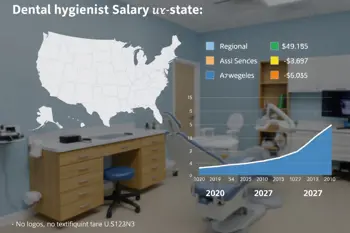
Published state averages consistently place several Pacific and western states near the top, although exact rankings vary by release. One BLS-based compilation reports Alaska at $115,510 annually, California at $108,200, Washington at $106,200, Oregon at $94,420, Nevada at $89,460, Maryland at $89,340, Connecticut at $88,610, New Jersey at $87,070, Massachusetts at $87,030, and Colorado at $86,890. The same table reports hourly averages ranging from $55.53 in Alaska to $41.77 in Colorado. 3
Other published datasets show different levels because they use different years, statistical measures, or modeling approaches. A May 2023 BLS summary places Alaska near $114,320 in mean annual pay, while a separate current-market table lists Washington at $131,530 average annual pay and California at $128,110. These differences do not necessarily indicate an error. They demonstrate why a state comparison should identify the data year, distinguish mean from median, and avoid treating one ranking as permanent. 4 5
| State | Published annual average | Published hourly average |
|---|---|---|
| Alaska | $115,510 | $55.53 |
| California | $108,200 | $52.02 |
| Washington | $106,200 | $51.06 |
| Oregon | $94,420 | $45.40 |
| Nevada | $89,460 | $43.01 |
Lower-paying state benchmarks
The same state dataset places many Southern and Midwestern markets below the national figures cited above. Examples include Florida at $73,180, Georgia at $73,140, Kansas and Wisconsin at $72,540, North Carolina at $72,500, Ohio at $72,280, Indiana at $74,450, Arkansas at $74,360, Louisiana at $74,240, Missouri at $74,230, and Utah at $74,110. Texas is listed at $75,970, while Illinois is listed at $76,640. These values are statewide averages and do not describe every metropolitan labor market. 3
A separate BLS-based guide reports Alabama as the lowest-paying state at approximately $56,630 in mean annual pay, while placing Alaska at approximately $114,320. The contrast illustrates the scale of geographic variation, but it also highlights a methodological limitation: a mean annual wage can differ materially from a median, and annual figures can be affected by the share of hygienists working part time. Hourly pay and guaranteed hours may provide a clearer comparison for individual employment decisions. 4
Why state rankings differ
Salary variation reflects more than regional geography. Local labor demand, cost of living, practice ownership, employer mix, licensing rules, and scope-of-practice conditions can influence compensation. Nearly all hygienists work in dentists' offices, and many work part time, so annual salary may not be directly comparable across states when scheduled hours differ. Metropolitan areas can also diverge sharply from statewide averages, particularly where high-cost urban labor markets coexist with lower-paying rural areas. 1 2
Employer structure is another relevant factor. Private dental offices, outpatient care centers, physician offices, and government facilities are included in national occupational estimates, while dental service organization consolidation can affect wage-setting and scheduling practices. Scope-of-practice rules may influence the services hygienists can provide and the settings in which they can work. These regulatory differences create market friction, because a credential that supports a particular role in one state may require different licensing or supervision conditions elsewhere. 4 6
Nominal salary versus purchasing power
A high nominal wage does not automatically represent the strongest economic position. Pacific states frequently appear near the top of salary tables, but housing, transportation, taxes, insurance, and other living expenses can reduce the practical value of that income. Conversely, a lower statewide wage in a Southern or Midwestern market may provide greater purchasing power where everyday costs are lower. A cost-of-living adjustment is therefore useful, but it should supplement rather than replace the reported wage benchmark. 2 3
Compensation comparisons should include hourly wage, expected weekly hours, paid time off, retirement contributions, health coverage, commuting costs, and license-related expenses. A salary table based on full-time-equivalent assumptions may not reflect a schedule consisting of several part-time positions. The relevant comparison is the complete compensation structure attached to a realistic workload, not simply the highest annual number in a state ranking. This distinction is especially important in an occupation where part-time employment is common. 1 4
How to interpret salary data responsibly
BLS OEWS data is generally the most suitable foundation for state-to-state analysis because it uses a consistent occupational classification and federal methodology. CareerOneStop, O*NET, and Data USA provide additional occupational or geographic context, while private sources such as Indeed, Glassdoor, ZipRecruiter, Salary.com, and Talent.com may reflect job postings, employee submissions, modeled estimates, or current-market observations. Those sources can be informative, but they should not be merged without checking definitions, dates, samples, and whether the statistic is a mean, median, or advertised rate. 7 8
Several safeguards reduce the risk of overstating a trend. Confirm whether the data covers May 2023, 2024, or a later estimate; check whether annual pay assumes full-time work; compare the state figure with the relevant metropolitan area; and separate completed BLS observations from projected values. Licensing eligibility also requires attention because all states require dental hygienists to be licensed, with requirements that vary by state. Salary is only one part of the decision, and job availability, schedule stability, regulatory oversight, and replacement demand also affect the practical value of a market. 1 4
Sources
- U.S. Bureau of Labor Statistics, Occupational Outlook Handbook: Dental Hygienists, https://www.bls.gov/ooh/healthcare/dental-hygienists.htm
- Dental Hygienist Pay, Dental Hygienist Salary by State, https://dentalhygienistpay.com/salary/
- World Population Review, Dental Hygienists Salary by State, https://worldpopulationreview.com/state-rankings/dental-hygienists-salary-by-state
- Dentx, Dental Hygienist Salary by State, https://dentx.ca/blog/dental-hygienist-salary-by-state/
- Rippling, Dental Hygienist Salary in the U.S., https://www.rippling.com/blog/dental-hygienist-salary-in-the-us-2026
- Indeed, Dental Hygienist Salaries by State, https://www.indeed.com/career-advice/finding-a-job/highest-paid-dental-hygienist-state
- CareerOneStop, Dental Hygienists Occupation Profile, https://www.careeronestop.org/Toolkit/Careers/Occupations/occupation-profile.aspx?keyword=Dental%20Hygienists
- Homebase, Each State's Highest-Paying Hourly Jobs, https://www.joinhomebase.com/blog/highest-paying-hourly-jobs-by-state
Authored by MyTrendSpot team