How to clean earwax at home safely: Clinical guidance and warning signs
How to clean earwax at home safely starts with recognizing that most ears do not need internal cleaning. Earwax normally protects the ear canal, traps dust and debris, and moves outward naturally, while home treatment is generally considered only when buildup causes symptoms or prevents an ear examination. 1
Why earwax usually should be left alone
Earwax, or cerumen, is not simply dirt that must be removed. It helps protect and lubricate the delicate skin of the ear canal, contributes to a water-resistant barrier, and helps keep particles away from the eardrum. Normal jaw movement from chewing and talking assists the gradual outward movement of older wax. 2
Routine deep cleaning can interfere with this self-cleaning process. Cotton swabs and similar objects may push wax farther into the canal instead of removing it, increasing the likelihood of impaction. A soft, damp cloth can be used on the visible outer ear, but objects should not be inserted into the canal. 3
When home treatment may be reasonable
Home softening may be considered when symptoms fit uncomplicated wax buildup, such as a blocked or full sensation, mild hearing reduction, itching, or hearing-aid feedback. Symptoms should not automatically be assumed to come from wax, because pain, discharge, dizziness, fever, or sudden hearing change can signal another condition. 5
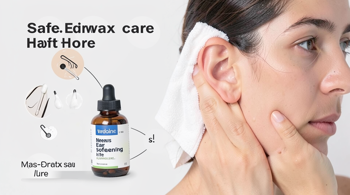
Pharmacy earwax-softening drops may contain carbamide peroxide, while other recommended softening agents can include saline, mineral oil, or olive oil. These products are intended to loosen wax so it can move outward more easily, and they should be used only according to the package directions because drops can irritate the ear canal or eardrum. 1
How to use softening drops cautiously
Read the product instructions before use and do not exceed the stated amount or duration. The purpose of drops is to soften wax, not to scrape it out. If discomfort increases, treatment should stop rather than being followed by additional drops or mechanical cleaning. Persistent blockage requires assessment rather than repeated experimentation at home. 1
Softening drops are not suitable for everyone. They should not be used when a perforated eardrum is known or suspected, and professional advice is appropriate for people with ear tubes, previous ear surgery, current ear infection, significant ear pain, or uncertain symptoms. These conditions can make treatment or irrigation riskier. 5
Methods and tools to avoid
Cotton swabs, hairpins, keys, fingernails, and other objects can scratch the canal, drive wax deeper, or injure the eardrum. Small camera-equipped cleaning gadgets also do not remove the need for a clinical examination and may encourage digging where the eardrum cannot be seen safely. The absence of visible wax on an object does not show that the ear is clear. 6
Ear candling is neither a safe nor an effective removal method. The candle can burn the face or ear, and material left behind may be candle residue rather than wax drawn from the canal. Irrigation performed without screening for eardrum problems, infection, or surgical history can also cause complications, so forceful flushing should not be treated as a routine household procedure. 4
When irrigation or professional removal is safer
Healthcare professionals can inspect the ear with an otoscope before deciding whether wax is responsible for symptoms. If removal is needed, available clinical methods include a curet or other specialized instrument, suction, or controlled irrigation using warm water and saline or diluted hydrogen peroxide. The choice depends on the ear’s condition and the location or consistency of the wax. 1
Professional guidance is especially important for people with a current or previous eardrum perforation, ear tubes, ear surgery, infection, substantial pain, diabetes, weakened immunity, or repeated impaction. Hearing-aid users may also need individualized advice because devices can contribute to recurring buildup and symptoms may have more than one cause. 7
Warning signs and follow-up
Medical assessment should replace home treatment when there is severe or persistent pain, drainage, bleeding, fever, marked dizziness, balance difficulty, or sudden hearing loss. Earwax can cause fullness, tinnitus, reduced hearing, or dizziness, but those symptoms can also reflect infection, injury, or another ear disorder that requires different care. 8
If mild blockage does not improve after correctly following a softening-drop product’s instructions, further treatment should be guided by a clinician. People with recurring buildup may require periodic checkups, sometimes once or twice each year, rather than frequent self-cleaning. The safest long-term approach is to clean only the outer ear and leave the canal undisturbed unless symptoms justify evaluation. 1
Sources
- Mayo Clinic, Earwax blockage: Diagnosis and treatment
- National Institute on Deafness and Other Communication Disorders, Earwax
- MedlinePlus, Earwax
- American Academy of Otolaryngology-Head and Neck Surgery, Earwax and Ear Care
- NHS, Earwax build-up
- Cleveland Clinic, Ear Wax Removal
- Johns Hopkins Medicine, Ear Wax Removal
- Healthdirect Australia, Ear wax
Authored by MyTrendSpot team