Get Your Dental Implants in a Single Day: Clinical Context and Patient Expectations
Get your dental implants in a single day is a phrase commonly used to describe immediate-load treatment, in which implant posts are placed and a temporary fixed restoration is attached during the same appointment. The approach can restore appearance and basic function quickly, but the permanent crown or bridge is generally placed only after the implants have healed and integrated with the jawbone. 1
What “single-day” dental implants mean
Same-day dental implants do not usually mean that every stage of treatment is completed within one day. The surgical placement and temporary teeth may occur during one appointment, while the final restoration is delivered later after healing. This distinction is important because the temporary prosthesis protects the treatment plan while the implant becomes stable within the bone. 1
The approach may involve one missing tooth, several teeth, or a full arch. Full-arch treatment is often associated with systems described as All-on-4 or All-on-X, in which four to six strategically positioned implants support a fixed bridge. Unlike removable dentures, the bridge is secured to the implants, although the first restoration is generally provisional rather than the final prosthesis. 4
Who may qualify for treatment
Potential candidates typically have sufficient bone density and volume to provide initial implant stability, healthy gum tissue, and general health compatible with oral surgery. A clinical evaluation is required because candidacy depends on anatomy, oral health, treatment goals, and the ability to maintain the restoration, rather than on a simple checklist. 1
Active gum disease, significant bone loss, uncontrolled diabetes, heavy smoking, or an infection at the proposed implant site may complicate immediate loading. Some patients previously considered unsuitable may become candidates after updated imaging or alternative planning, but grafting, disease treatment, or a staged implant approach may be necessary before immediate restoration is considered. 3
- Sufficient bone for initial fixation
- No active periodontal infection at the treatment site
- Health adequate for a surgical procedure
- A bite and treatment plan that can protect the temporary teeth
Why 3D planning matters
Single-day treatment depends heavily on work completed before surgery. Three-dimensional CBCT imaging can map bone volume, nerve positions, and sinus anatomy, while digital planning software helps determine implant locations and angles. This preparation allows the surgical and restorative steps to be coordinated rather than improvised during the appointment. 9
Some treatment centers also use guided surgery, digital impressions, prefabricated prosthetics, or an in-house laboratory. These systems can support precise placement and same-day adjustment of a temporary bridge. The presence of advanced technology does not guarantee eligibility or a particular result, because bone quality, implant stability, bite forces, and medical factors still influence the plan. 2
What happens during the procedure
The treatment day commonly begins with final health checks and confirmation of the surgical design. Depending on the extent of treatment and the clinical setting, extractions may be performed before implants are placed. A temporary fixed crown or bridge can then be attached when the implants achieve adequate initial stability for immediate loading. 9
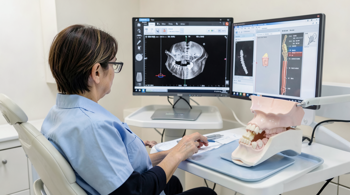
Full-arch procedures may involve several implants supporting one provisional bridge, rather than an individual implant and crown for every missing tooth. The temporary teeth are intended to provide appearance and useful function during healing, but clinicians may recommend a modified diet and careful chewing to reduce forces on the implants. Sedation options vary by provider and patient needs. 7
Healing and the permanent restoration
Immediate placement of temporary teeth does not eliminate the biological healing period. Osseointegration, the process in which bone becomes attached to the implant surface, must occur before the final restoration is fabricated. The supplied clinical summaries describe a typical healing interval of approximately three to six months, although individual timelines vary. 10
Follow-up appointments are part of the treatment, not an optional addition. Examinations may assess gum health, implant stability, bite contacts, hygiene, and the condition of the provisional bridge. Once healing is satisfactory, the temporary restoration can be replaced with a custom permanent crown or bridge designed for longer-term strength, fit, and appearance. 1
| Stage | Typical purpose |
|---|---|
| Evaluation | Review health, gums, bone, imaging, and treatment goals |
| Surgery day | Place implants and attach a temporary fixed restoration when appropriate |
| Healing | Monitor integration and protect the provisional teeth |
| Final restoration | Replace temporary teeth after clinical assessment |
Risks, limitations, and maintenance
Immediate loading can have outcomes comparable to delayed loading when patient selection and treatment protocols are carefully controlled, but it is not risk-free. Implant failure, infection, bone loss, prosthetic fracture, discomfort, bite problems, and the need for additional procedures remain possible. Risk may increase when disease is untreated, smoking is heavy, medical conditions are poorly controlled, or bone support is inadequate. 6
Long-term maintenance includes daily cleaning around the implants and bridge, professional examinations, and management of clenching or grinding when present. Fixed implant teeth do not require removal at night in the same way as conventional dentures, but they still accumulate plaque and can develop biological or mechanical complications. The final cost and treatment duration also depend on extractions, grafting, sedation, laboratory work, and restoration design. 5
Patients evaluating this option should request a written treatment sequence that identifies which teeth are temporary, when the permanent restoration is expected, what follow-up is included, and which risks apply to the individual case. A second clinical opinion may be appropriate when the proposed plan does not clearly explain imaging findings, alternatives, maintenance responsibilities, or the circumstances that could prevent same-day loading. 8
Sources
- ClearChoice, “Who can get one-day dental implants? A comprehensive guide,” https://www.clearchoice.com/dental-implant-resources/am-i-a-candidate-for-one-day-dental-implants/
- Central Coast Dental Implant Center, “Teeth in a Day,” https://centralcoastdentalimplants.com/teeth-in-a-day/
- Wright Periodontics, “Teeth-In-a-Day Dental Implants,” https://www.wrightperio.com/dental-implants/teeth-in-a-day/
- Atlanta Dental Center, “New Teeth in One Day,” https://atlantadentalcenter.com/service/new-teeth-in-one-day/
- Ponce Dental Studio, “Same-Day Dental Implants,” https://poncedentalstudio.com/restorative-dentistry/dental-implants/same-day-dental-implants/
- DeVaney Dentistry, “One Day Smile,” https://www.drdevaney.com/one-day-smile/
- Loftus Family Dental, “Same-Day Smile,” https://dentistincoeurdalene.com/dental-implants/same-day-smile/
- First Dental Implant Center, “Teeth In 1-Day,” https://firstdentalimplantcenter.com/cosmetics/teethxpress/
- Fusion Dental Implants, “Same Day Teeth Roseville,” https://fusiondentalimplants.com/blog/same-day-teeth-roseville-ca
- Mayo Clinic, “Dental implant surgery,” https://www.mayoclinic.org/tests-procedures/dental-implant-surgery/about/pac-20384622
Authored by MyTrendSpot team