Continuous Glucose Monitors
Continuous glucose monitors represent one of the most significant advances in diabetes care and metabolic health monitoring of the past two decades. These small, wearable sensors attach to the skin and transmit glucose readings every one to five minutes, replacing or supplementing the traditional finger-stick blood glucose test that captures only a single, isolated data point. The shift to continuous data has fundamentally changed how clinicians and patients understand blood sugar dynamics, exposing patterns that a single daily measurement cannot reveal.
How Continuous Glucose Monitors Work
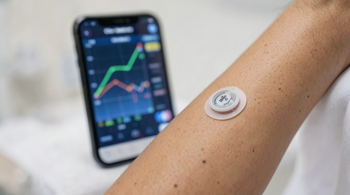
A CGM system typically consists of two primary components: a disposable sensor and a display device such as a smartphone app or dedicated receiver. The sensor contains a tiny flexible probe inserted just beneath the skin, where it measures glucose concentrations in interstitial fluid, the fluid surrounding cells, rather than directly in the bloodstream. 1 Because interstitial glucose tracks blood glucose closely, with a physiological lag of roughly five to fifteen minutes, CGM readings provide a reliable approximation of circulating blood sugar in real time. 2
Older CGM designs used a separate transmitter that wirelessly relayed sensor data to a receiver. Most contemporary systems have eliminated this third component, integrating the transmitter directly into the sensor patch and connecting via Bluetooth to a smartphone. 3 Sensors must be replaced at manufacturer-specified intervals, commonly every seven to fourteen days for wearable models, though newer implantable platforms extend sensor life considerably longer. 4
Who Uses Continuous Glucose Monitors and Why
CGMs were originally developed for people with type 1 diabetes who depend on precise insulin dosing to survive. That clinical use case remains central. The American Diabetes Association recommends CGM use for all individuals with type 1 diabetes and considers it beneficial for type 2 diabetes patients who use insulin or medications that carry hypoglycemia risk. 5 A landmark 2023 study published in Nature Medicine equipped 665 healthy adults with CGMs and found that 25% spent more than 70 minutes per day with blood glucose above 140 mg/dL, a threshold considered prediabetic territory by most clinical guidelines, even though these individuals had no diagnosed metabolic condition. 6
More recently, CGM adoption has extended to people with prediabetes, those pursuing weight management, and wellness-oriented consumers seeking metabolic feedback. A 2024 Weizmann Institute study tracking 8,315 non-diabetic adults found that 40% of individuals initially classified as having normal fasting glucose would have been reclassified into the prediabetic range based on subsequent CGM measurements, and 3% into the diabetic range. 7 These findings suggest that single fasting glucose snapshots miss metabolic dysfunction already underway in a substantial portion of the population.
Key Device Categories and Major Systems
The CGM landscape now divides broadly into two categories: prescription-grade systems for diabetes management and over-the-counter wellness devices for people without diabetes. The FDA cleared the first OTC CGM, Abbott Lingo, in 2024, followed by Dexcom Stelo, making it possible to purchase a CGM at major retail locations without a prescription. 6 Among prescription-grade systems, the Dexcom G7 holds the largest market share in the United States. Each G7 sensor lasts 10 days and is the smallest clinical-grade CGM currently available. 7
Accuracy is measured using Mean Absolute Relative Difference (MARD), where lower scores indicate greater precision. MARD scores across cleared devices range from approximately 7.9% for the Dexcom G7 to higher values for other systems. 6 At the long-duration end of the market, Senseonics received FDA approval for the Eversense 365 in September 2024 and CE Mark approval in January 2026, making it the world's first and only one-year implantable CGM. Real-world evidence presented at the 2026 ATTD conference demonstrated sustained performance and strong patient adherence across the full twelve-month sensor lifespan. 8
| System | Sensor Wear Duration | Category | Notable Feature |
|---|---|---|---|
| Dexcom G7 | 10 days | Prescription | Smallest clinical-grade design; 5-minute readings |
| Abbott FreeStyle Libre 3 | 14 days | Prescription | 1-minute glucose readings; no overpatch required |
| Medtronic Guardian 4 | 7 days | Prescription | Predictive alerts; integrates with MiniMed pumps |
| Senseonics Eversense 365 | 365 days | Implantable / Prescription | Fully implanted; longest sensor life available |
| Dexcom Stelo | 15 days | OTC / No prescription | First Dexcom OTC device; wellness-focused |
| Abbott Lingo | 14 days | OTC / No prescription | First FDA-cleared OTC CGM (2024) |
Clinical Evidence and Documented Benefits
A systematic review of ten studies covering 4,006 participants found that CGM was more effective at reducing HbA1c compared with usual care, with a weighted mean difference of negative 0.43%. 9 Research across various diabetes populations consistently shows that CGM use improves HbA1c levels by an average of 0.5% to 1.0%. 5 The Dexcom CONNECT randomized controlled trial, presented at the 2026 American Diabetes Association Scientific Sessions, demonstrated clinically and statistically significant A1C reductions among people with type 2 diabetes who do not use insulin, marking the first Level A evidence for CGM benefit in this non-insulin-treated population. 10
Clinical studies also demonstrate that real-time CGM reduces time spent in hypoglycemia by 40% to 50% and improves glycemic variability compared to intermittent glucose testing. 5 A July 2026 report from Seoul Economic Daily cited research showing CGMs cut type 1 diabetes death risk by 62% among consistent users. 11 Additionally, researchers published a GluFormer foundation model in Nature trained on more than 10 million glucose measurements from 10,812 adults, demonstrating that CGM-derived representations could identify 66% of incident diabetes cases and 69% of cardiovascular deaths in the highest-risk quartile, far outperforming standard HbA1c stratification. 12
Limitations, Risks, and Practical Considerations
Despite strong clinical evidence, CGMs carry meaningful limitations that users and clinicians must weigh carefully. Sensor accuracy can be affected by interfering substances, including certain medications, which alter the electrochemical signal at the sensor's glucose-sensing element. A review published in the Journal of Diabetes Science and Technology identified multiple labeled interfering substances across commercially available CGM designs, with manufacturers incorporating various design mitigations at different levels of effectiveness. 13 A pilot study assessing four CGM systems during commercial flights found that accuracy performance under altitude and pressure conditions remains insufficiently characterized for routine clinical reliance in aviation environments. 14
From a practical standpoint, sensors must be replaced at regular intervals, and improper placement or failure to allow the skin to dry completely before application can compromise adhesion. 2 CGM devices are contraindicated for individuals with certain psychiatric conditions, those who are unconscious, and children below the minimum age specified per device labeling. 15 Clinicians also caution that wellness-focused CGM use without proper medical guidance can produce confusion, health anxiety, or inappropriate dietary restriction, particularly when users misinterpret normal postprandial glucose excursions as pathological. 16 CGM readings reflect interstitial glucose, not direct blood glucose, meaning a physiological lag exists that can matter in rapidly changing glucose scenarios such as intense exercise.
Coverage, Cost, and Emerging Technology
Medicare and most private insurance plans cover CGMs for eligible diabetes patients, though coverage criteria vary by insurer. Eligibility typically requires documentation of insulin use, diabetes type, and in some cases prior authorization. Sensor costs before insurance coverage generally range from approximately $35 to $150 per sensor depending on the system and supplier. 4 OTC devices like Dexcom Stelo are available at a retail price point of approximately $99 per pack, making metabolic monitoring accessible to a much broader consumer segment than prescription pathways previously allowed. 17
On the technology frontier, Glucotrack submitted an Investigational Device Exemption to the FDA in May 2026 to initiate a U.S. clinical study of its fully implantable continuous blood glucose monitoring platform, designed to operate without any on-body wearable. 18 Patent landscape analysis by PatSnap Eureka identified three interlinked technical domains driving current CGM innovation: enzymatic electrochemical transduction using glucose oxidase, electrochemical impedance spectroscopy as an in-line calibration tool, and computational intelligence layers including machine learning and sensor fusion algorithms. Medtronic MiniMed led the dataset with approximately 22 patent filings, followed by Dexcom with approximately 16. 19 The FDA also approved the Signos system in August 2025 as the first glucose monitoring platform specifically cleared for weight management, pairing a Dexcom CGM with an AI-powered application to deliver personalized metabolic and lifestyle guidance. 20
Sources
- National Institute of Diabetes and Digestive and Kidney Diseases (NIDDK) - niddk.nih.gov
- Centers for Disease Control and Prevention (CDC) - cdc.gov/diabetes/treatment/continuous-glucose-monitors
- Medtronic MiniMed - minimed.com/en-us/about-diabetes/treatments/continuous-glucose-monitoring
- Wearable Wellness Guide - wearablewellnessguide.com/blood-sugar/buy-a-cgm
- National Center for Biotechnology Information (NCBI) / PubMed - pubmed.ncbi.nlm.nih.gov
- BetterVitals CGM Review 2026 - bettervitals.com/learn/best-continuous-glucose-monitor-2026
- HealthcareDiscovery.ai - Dexcom G7 CGM Review 2026
- GlobeNewswire - Senseonics Eversense 365 Real-World Evidence at ATTD 2026
- Elsevier Pure / UAE Ministry of Health - Systematic Review on CGM Benefits in Primary Care
- Morningstar / Business Wire - Dexcom CONNECT Study 2026
- Seoul Economic Daily - Continuous Glucose Monitors Cut Type 1 Diabetes Death Risk by 62%
- Nature - GluFormer Foundation Model for CGM Data (2025)
- Journal of Diabetes Science and Technology - Interfering Substances on CGMs (2025)
- KU Leuven Lirias - CGM Performance During Commercial Flights Study
- GlucoSensor User Manual - glucosensor.com
- Listen Notes / Endocrine Matters Podcast - Dr. Arti Thangudu on CGM Use and Caution
- Athletech News - Dexcom Stelo CGM Review 2026
- GlobeNewswire - Glucotrack IDE Submission May 2026
- PatSnap Eureka - CGM Sensor Technology Landscape 2026
- CNBC - FDA Approves Signos Glucose Monitoring for Weight Loss (August 2025)
Authored by MyTrendSpot team