Best Water Resistance Rower Machines for Home Workouts: A Data-Driven Buyer's Analysis
How Water Resistance Rowing Machines Actually Work
Water resistance rower machines operate through a sealed tank filled with water and an internal paddle system. When a user pulls the handle, the paddles spin through the water, generating drag that grows proportionally with stroke speed. 1 This means resistance is entirely self-regulating: a harder pull produces greater resistance, and easing off reduces it instantly, just as a boat responds on open water. Unlike magnetic systems with fixed resistance levels or air rowers with a damper dial, water rowers require no manual adjustment during a session to modulate intensity. 2
According to fitness assessments referenced by independent reviewers, a rowing stroke on a water resistance machine engages approximately 85% of the body's major muscle groups, covering the quads, glutes, hamstrings, back, arms, core, and calves within a single compound movement. 3 Because the motion is fluid and the resistance never creates jarring peak-load spikes, the exercise is classified as low-impact, making it practical for users managing joint sensitivity or recovering from certain injuries. The meditative sound of water swishing during each stroke is also consistently cited by users as a psychological benefit that distinguishes water rowers from noisier air resistance alternatives. 4
Frame Materials and Their Effect on Performance
The majority of premium water rowers reviewed in 2025 and 2026 use solid hardwood frames, most commonly American ash, solid oak, walnut, or beech. Hardwood construction absorbs vibration and dampens mechanical sound more effectively than steel or aluminum, contributing to the characteristically quiet operation these machines are known for. 5 The WaterRower A1, for instance, uses a solid American ash hardwood frame and has been independently measured at approximately 55 dB during operation, a level described by testers as closer to light rain than gym equipment. 6 Several models reviewed in 2026, including the JOROTO MR280PRO and the YOSUDA Black Water Rower, specify FSC-certified wood construction, which adds an independently verified sustainability credential to the purchase.
Steel-frame water rowers also exist in the category and generally offer a smaller physical footprint, making them more suitable for apartments or rooms with limited floor space. The MERACH R280 features a wooden frame alongside a 400-pound weight capacity, which testers scored 9.0 out of 10 for stability and build quality, noting that higher weight capacity ratings typically reflect a more robust and laterally stable frame construction overall. 7 Buyers should cross-reference the stated weight capacity against their own requirements and consider whether the manufacturer specifies a tested capacity or a theoretical structural limit, as these are not always the same figure.
Key Specifications Compared Across Major Models
The following table summarizes independently reviewed and manufacturer-published specifications for a range of water resistance rower machines positioned for home use in 2025 and 2026. Price figures reflect general market observations and are not guarantees of current availability.
| Model | Frame | Weight Capacity | Foldable | Bluetooth / App | Approx. Price Range |
|---|---|---|---|---|---|
| WaterRower A1 | Solid ash hardwood | Not specified (standard adult) | Vertical storage only | Add-on required ($80) | $750-$850 |
| MERACH R280 | Solid wood | 400 lbs | Yes, 180 degrees | Yes, MERACH app | Mid-range |
| YOSUDA Black Water Rower | FSC-certified beech | 400 lbs | Yes, 180 degrees | Yes, Bluetooth app | Mid-range |
| JOROTO MR280PRO | FSC-certified solid oak | 180 kg (396 lbs) | Yes, 180 degrees | Yes, Bluetooth | Mid-range |
| Stamina Elite Wave 1450 | Steel | Not specified | No | Chest strap heart rate | $1,299 |
| JASPORT R1E | FSC-certified oak | 150 kg (330 lbs) | Not specified | Bluetooth, Kinomap | Premium |
| WalkingPad WR20 | Walnut or Red Oak | 176 lb max resistance | Tri-fold | Not specified | $799 |
Tank size is a frequently overlooked specification with direct performance implications. Larger tanks hold more water volume and allow for a wider effective resistance range, which matters more to experienced or stronger rowers than to beginners. The JASPORT R1E uses a 28-liter tank with a 12-blade paddle system, while the JOROTO MR280PRO specifies a 14-liter capacity. 8 Buyers who row at high stroke rates or high force outputs should prioritize larger tank volumes, as under-filled or undersized tanks can produce inconsistent resistance at peak effort.
Storage, Footprint, and Practical Space Considerations
Home water rowers typically require a floor footprint of approximately 8 to 9 feet in length and 2 to 3 feet in width during use, with total machine weight commonly ranging between 100 and 150 pounds depending on the frame material and tank capacity. 9 Several 2026 models have addressed this by incorporating folding rail systems. The MERACH R280 and YOSUDA Black Water Rower both offer 180-degree fold capability with integrated transport wheels, allowing the machine to be repositioned without lifting. The WalkingPad WR20 introduces a tri-fold design that the manufacturer states reduces the folded volume to smaller than a standard chair. 10
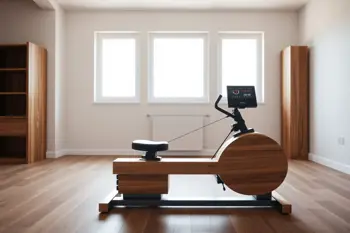
The WaterRower line uses a different storage approach: the machine stores vertically at approximately 211 cm tall rather than folding flat. This vertical footprint requires adequate ceiling clearance and a stable surface, and buyers in rooms with standard 8-foot ceilings should measure carefully before purchasing this format. The JOROTO MR26 model specifies a folded storage volume of 0.73 cubic meters, giving buyers a concrete metric to compare against available closet or corner space. 11 For apartment users in particular, verifying folded dimensions against actual available space before purchasing is a practical step that product listings frequently omit guidance on.
Performance Monitoring, Connectivity, and Subscription Costs
Performance monitoring on water rowers spans a wide capability range. Entry-level and mid-tier machines typically include an LCD monitor displaying time, distance, stroke count, strokes per minute, and estimated calorie burn. The WaterRower A1's S4 monitor is described by independent reviewers as basic by 2026 standards: it displays core metrics but does not show power output in watts and requires an $80 add-on accessory to enable Bluetooth connectivity. 12 In contrast, models such as the MERACH R280, YOSUDA Black Water Rower, and JOROTO MR23 include integrated Bluetooth as a standard feature, allowing workout data to sync to manufacturer apps or third-party fitness platforms without additional hardware.
Several brands in the water rower category now bundle limited subscriptions with the machine purchase. The JOROTO MR26 includes a 44-day Kinomap subscription, while the JOROTO MR280PRO includes a 30-day Kinomap trial. The Stamina X Water Rower bundles access to the muuv audio coaching app. 13 Buyers should note that these bundled periods expire, and ongoing subscription access typically carries a recurring monthly or annual fee that adds to the total cost of ownership beyond the initial hardware price. Premium connected rowers such as the Hydrow Arc, tested by The Manual and priced at approximately $2,095 at time of publication, require a separate membership to access the guided workout library that constitutes a core part of its value proposition. 14
Maintenance Requirements, Risks, and Buyer Cautions
Water rowers carry ongoing maintenance responsibilities that air or magnetic machines do not. The water tank requires periodic treatment with a purification or algae-inhibiting tablet, typically every three to six months, to prevent microbial growth and keep the water clear. 15 Skipping this step can lead to discoloration, odor, and potential degradation of internal paddle components over time. Most manufacturers include a starter supply of purification tablets and specify the correct chemical to use, but buyers should confirm ongoing tablet availability and cost for their chosen model before purchasing.
Additional maintenance considerations include inspecting the seat rail for debris or wear, periodically tightening fasteners on foldable hinge mechanisms, and checking the tank seal integrity on machines transported frequently. Wood-frame machines are sensitive to sustained high humidity or direct sunlight exposure, which can cause warping or finish degradation over time. 16 Buyers should also be aware that water rowers with higher weight capacity ratings place more lateral load on the frame joints during aggressive rowing, which can accelerate wear on lower-quality hinge or connection points on entry-level models. Reviewing the manufacturer's stated warranty period, particularly whether it covers the frame separately from mechanical components, provides a useful signal of the manufacturer's own confidence in long-term durability.
Sources
- Merachfit.com - 5 Best Water Rowing Machines for Home 2026: Ultimate Buying Guide
- Fitandwell.com - Best Rowing Machines for Full-Body Home Workouts
- Fitandwell.com - Best Rowing Machines for Full-Body Home Workouts (muscle engagement data)
- Garagegymreviews.com - Best Water Rowing Machine: 5 Options
- Merachfit.com - Frame Material and Weight Capacity Section
- Bestpick.guide - WaterRower A1 Review 2026
- Cardiocanine.com - MERACH R280 Water Rowing Machine Review 2026
- Jasport.de - JASPORT R1E Rowing Machine with Water Resistance
- HomeGym101 via LLM General Research - Home Water Rower Space Requirements
- Walkingpad.com - WR20 Tri-Fold Water Rowing Machine
- Joroto.eu - JOROTO MR26 YAMO Series Water Rower
- Bestpick.guide - WaterRower A1 Review 2026 (S4 Monitor Section)
- Staminaproducts.com - Stamina X Water Rower and Joroto.eu - MR26 / MR280PRO Kinomap Subscriptions
- Themanual.com - I Put the Hydrow Arc Rower to the Test
- American Fitness Professionals Association via LLM General Research - Water Rower Maintenance
- Cardiocanine.com - YOSUDA Black Water Rower Review 2026
Authored by MyTrendSpot team