Swimming Programs for Seniors Near Me: A Complete Guide to Local Aquatic Options and What to Expect
Searching for swimming programs for seniors near me reflects a growing awareness that water-based exercise is one of the most medically appropriate and accessible forms of physical activity for older adults. When submerged to chest depth, water supports approximately 80% of body weight, meaning knees, hips, and the lower back experience a significant reduction in gravitational load. 1 This physiological reality makes aquatic environments particularly valuable for seniors managing arthritis, recovering from joint replacement, or dealing with chronic pain conditions like fibromyalgia. The range of programs available today spans clinical aquatic therapy, community-run water aerobics, Medicare-linked fitness memberships, and volunteer-led grassroots groups.
The Science Behind Water Exercise for Older Adults
Research published in the Journal of Aging Research indicates that regular swimming can reduce the risk of heart disease in older adults by up to 30%. 2 A study conducted by the American Council on Exercise found that aquatic exercise can increase flexibility by 20% in as little as 12 weeks. 2 These figures reflect the dual mechanism of water exercise: the buoyancy reduces compressive forces on joints while the resistance of water, which acts in all directions simultaneously, builds functional strength without the strain associated with land-based weight training or high-impact cardio. For adults above the age of 65, who commonly experience declining strength, coordination, and balance, these combined effects address multiple risk factors at once, including fall prevention.
Water resistance is also uniquely adjustable. Moving slowly through water creates a gentle stimulus, while increasing pace or incorporating foam dumbbells and flotation belts escalates the cardiovascular and muscular demand considerably. 3 This scalability makes pool-based programs suitable across a wide spectrum of fitness levels, from someone attending their first post-surgery session to a lifelong lap swimmer maintaining competitive fitness into their 80s. Physical therapist Ken Shah, who leads a free aquatic therapy program at the Knolls of Melville in New York, noted that many seniors feel limited by ground exercises due to gravity, but regain significant functional movement in water. His program grew from 5 participants in its first year to 48 registered seniors with a waitlist, demonstrating the demand. 4
Types of Senior Swimming Programs Commonly Available
Senior aquatic programming generally falls into several distinct categories, each serving a different need and population. Clinical aquatic therapy is delivered by licensed physical therapists in heated pools and is typically prescribed for specific medical conditions. The All Seniors Foundation in Los Angeles County, for example, offers free supervised aquatic therapy sessions led by licensed, aquatic-certified physical therapists, covering seniors aged 60 and older with arthritis, post-surgical needs, or general mobility challenges, regardless of insurance status or income level. 5 At the other end of the spectrum, community pool programs like the Senior Swim at TCAP Family Aquatic and Fitness Centre in Prince Edward Island, Canada, offer drop-in free swimming sessions with gradual beach-style pool entry and access to hot tubs and saunas. 6
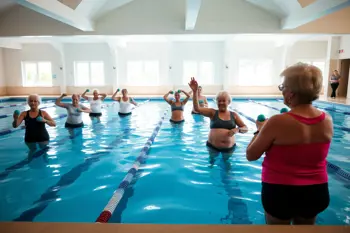
Water aerobics classes represent the most widely available format. These instructor-led sessions typically run 45 to 60 minutes and combine cardio, strength, and mobility exercises using water resistance as the primary training tool. Programs like AquaFit, offered at Aquaducks Swim School in Singapore for adults and seniors aged 55 and older, report that participants can burn up to 400 calories per 45-minute session depending on effort and water temperature. 7 In the United States, similar formats appear at community centers, YMCAs, Jewish Community Centers, and senior living facilities. The Weinstein JCC in Richmond, Virginia, for instance, offers its S'WET Silver program, a low-impact water workout blending LIIT, joint mobility, and functional movement, specifically designed for active adults seeking a balanced full-body workout, with class sizes limited to 12 participants. 8
Where to Find Programs: Key Provider Categories
Several institutional categories consistently host senior aquatic programming across different regions. Understanding which organizations to contact locally can significantly simplify the search process.
| Provider Type | Program Examples | Typical Cost Range |
|---|---|---|
| YMCA Branches | Water fitness, senior swim, aqua aerobics | Membership-based; often subsidized |
| Jewish Community Centers (JCCs) | Master swim programs, silver water fitness | Members from $90/session block; nonmembers higher |
| Parks and Recreation Departments | Municipal pool senior hours, water fitness classes | Low-cost to free for qualifying residents |
| SilverSneakers (Medicare-linked) | Aquatic access at partner facilities nationwide | Covered under many Medicare Advantage plans |
| Non-profit senior foundations | Clinical aquatic therapy, transportation support | Free for qualifying seniors |
| Private swim schools and fitness centers | Private water wellness sessions, group aqua Pilates | $65 per 30-minute private session and above |
The SilverSneakers program deserves particular attention because it functions as a coverage benefit embedded within many Medicare Advantage and Medicare Supplement insurance plans. Eligible seniors aged 65 and older gain access to participating fitness facilities, which commonly include pool access and group water fitness classes, at no additional out-of-pocket cost. 9 The Streamwood Park District in Illinois, for example, participates in SilverSneakers, granting members access to pools, cardio equipment, and group fitness classes through this mechanism. Seniors should verify their specific plan's participation before assuming coverage applies at a given location.
Grassroots and Community-Led Programs
Some of the most impactful senior swimming programs operate outside formal institutional frameworks. Trenton's Water Walkers, a group of predominantly older women who gather daily at the city-owned Hetzel outdoor pool in New Jersey, was founded by certified water aerobics instructor Donna Wellons during the COVID-19 pandemic and has grown into a sustained community fitness movement. 10 Clara Blakely Sampson, an 87-year-old participant who has attended for five consecutive seasons, credited the water with maintaining her mobility. The Socorro County Senior Water Aerobics program in New Mexico has operated for more than five decades, meeting Tuesday through Friday at the Socorro Regional Aquatic Center with volunteer callers leading exercises. 11 Participation costs $4 per session, an increase from the historical $1 daily fee, which some members have noted creates access friction for lower-income seniors.
In Knox, Australia, the volunteer-run Eastern Sirens organization received a Community Development Fund grant to introduce seniors' artistic swimming, or synchronised swimming, classes for older residents. Co-founder Prateeti Sabhlok noted that participating in synchronised swimming has been shown in published research to improve cognitive abilities and memory in older adults, in addition to physical benefits like flexibility and strength. 12 These community-originated programs often develop strong social bonds that participants describe as equally important to the physical outcomes, a pattern consistently observed across multiple geographic contexts.
Eligibility, Access Barriers, and Practical Considerations
Not all senior swimming programs are open to every older adult without conditions. Clinical aquatic therapy programs typically require a physician referral or documented medical need, and eligibility criteria vary by organization. The All Seniors Foundation in Los Angeles specifies that qualifying participants must be 60 or older and present with conditions such as arthritis, joint pain, post-surgical recovery, fibromyalgia, or general mobility challenges. 5 Royal Life Saving Australia's Seniors Water Wellness Program in Campbelltown, funded by the NSW Government, targets adults aged 60 and older who are looking to return to aquatic recreation, and explicitly states that participants do not need to be proficient swimmers. 13 Importantly, pool availability, transportation access, session timing, and physical facility accessibility remain practical barriers for many seniors, particularly those in rural areas or without personal transportation.
Cost structures also vary considerably and should be evaluated carefully. Community center classes like Coastal Seniors of South Walton's water aerobics sessions in Florida run at $5 for members and $10 for non-members per class, with registration required in advance. 14 Private water wellness sessions at facilities like SwimTec in Orlando are priced at $65 per 30-minute private session, with the option to bring a partner for an additional $10. 15 Registration deadlines, class size caps, seasonal closures, and facility maintenance schedules can disrupt continuity of attendance, and prospective participants should confirm current program status directly with providers before planning a routine.
Health Considerations and Program Selection Guidance
Before beginning any aquatic exercise program, older adults with cardiovascular conditions, recent surgical history, open wounds, or uncontrolled chronic conditions should consult a physician. The Arthritis Foundation confirms that water-based exercises are safe and effective for seniors to manage pain and improve joint function, but program intensity and format should align with individual health status. 16 Instructor qualifications matter significantly: programs led by licensed physical therapists or certified aquatic fitness professionals, such as those credentialed through the Aquatic Exercise Association (AEA), provide a higher standard of tailored, evidence-based movement guidance compared to general fitness instruction.
Seniors exploring programs should consider whether they need a therapeutic format with clinical oversight or a social fitness format focused on general conditioning. For those with significant mobility limitations, programs featuring gradual pool entry, heated water, and one-on-one options will be more appropriate than lap-focused or competitive masters swimming formats. The Master Fins Adult Swimming Program at the Weinstein JCC, for example, requires the ability to swim 25 yards of each competitive stroke and is oriented toward fitness and competitive swimmers, not beginners or those with physical limitations. 8 Matching the correct program type to individual needs and ability level is the most critical factor in achieving sustainable, beneficial participation in senior aquatic fitness.
Sources
- Alex's Swim School – Swimming Lessons for Seniors: Low-Impact Fitness and Health Benefits in the GTA (alexswimschool.com)
- Active Aging Daily – Swimming for Seniors: Benefits, Safety, and Techniques (activeagingdaily.com)
- Aquatic Performance Training – How Aquatic Therapy and Workouts Improve Mobility for Seniors (aquaticperformancetraining.com)
- Long Island Press – Ken Shah Leads Seniors in Aquatic Therapy to Enhance Balance, Mobility (longislandpress.com)
- All Seniors Foundation – Senior Aquatic Therapy for LA Seniors (allseniors.org)
- go!PEI – Senior Swim Program at TCAP Family Aquatic and Fitness Centre (gopei.ca)
- Aquaducks Swim School – AquaFit Water Exercise Classes for Adults and Seniors (aquaducks.com.sg)
- Weinstein JCC – S'WET Silver and Master Fins Adult Swimming Program (weinsteinjcc.org)
- Streamwood Park District – SilverSneakers Program Information (streamwoodparks.org)
- WHYY – Trenton's Water Walkers Caters to Older Women (whyy.org)
- Pueblo Chieftain – Socorro Seniors Rally Around Water Aerobics (dchieftain.com)
- The National Tribune – Seniors About to Make Splash: Eastern Sirens Knox Synchronised Swimming (nationaltribune.com.au)
- Royal Life Saving / Drowning Prevention – Campbelltown Seniors Water Wellness Program (drowningprevention.org.au)
- Coastal Seniors of South Walton – Water Aerobics Class (coastalseniorsofsouthwalton.org)
- SwimTec – Water Wellness and Mobility Sessions at Rosen Aquatic Center Orlando (swimtec.com)
- Arthritis Foundation – Water Exercise for Joint Health (arthritis.org)
Authored by MyTrendSpot team