Smart Fitness Mirrors: An In-Depth Analysis of Interactive Home Gym Technology
The home exercise sector has undergone a significant technological shift with the integration of interactive, digital displays into standard residential environments. Among the most prominent developments in this space is the rise of Smart Fitness Mirrors, which function as reflective looking glasses when idle and transform into high-definition, interactive training monitors when activated. Market data shows that the global fitness mirrors market was valued at USD 372.34 million in 2024 and is projected to reach USD 745.28 million by 2030, representing a compound annual growth rate of 12.26% 1. This growth is driven by consumer demand for space-saving home gym equipment, advanced sensor tracking, and guided physical training.
These devices utilize a combination of semi-reflective glass, liquid crystal displays, and localized processing hardware to superimpose digital instructional overlays onto the user's own reflection. By allowing users to monitor their physical alignment while simultaneously observing an instructor, these systems aim to replicate the dynamics of professional studio training. The hardware and software structures of these devices vary significantly, ranging from simple media-streaming monitors to advanced, high-precision biometric scanners and digital strength training systems.
Hardware Architecture and Display Technologies
The core utility of a smart fitness mirror relies heavily on its physical display properties and processing units. Standard commercial configurations typically employ Full High Definition (FHD) IPS panels embedded behind tempered glass. For instance, several entry-level and mid-range devices utilize 43-inch screens with 1920 by 1080 resolution, running on operating systems such as Android 11 or Android 12 to ensure low-latency application performance 2 3. These displays are engineered with high brightness levels to overcome the natural tint of reflective glass coatings, ensuring that on-screen graphics, text, and virtual trainers remain clearly visible during exercise sessions.
Physical durability and environmental resilience are also key considerations in mirror design. Some models feature IP33 or IP44 water and dust resistance, along with automatic defogging technologies 2 3. These features are particularly important when devices are installed in high-humidity areas such as bathrooms or multi-use home health suites. Additionally, premium configurations incorporate 10-point capacitive touch panels, dual-channel audio speakers, and physical inputs like USB and HDMI to facilitate direct user interaction and external media casting 2 3.
Artificial Intelligence and Biometric Motion Tracking
One of the key technical advancements in modern smart fitness mirrors is the integration of computer vision and real-time motion tracking. Rather than acting as simple display monitors, advanced mirrors utilize integrated camera arrays and edge-computing processors to analyze user movement. The MAGIC AI Mirror, named one of TIME Magazine's Best Inventions of 2024, utilizes proprietary ReflectAI technology to track user movements, count repetitions automatically, and evaluate form accuracy in real time 4. This system monitors movements across nearly 400 unique exercise variations, providing immediate form correction and pace adjustments to replicate the guidance of an in-person trainer 4.
Other advanced systems utilize more complex skeletal tracking arrays to map the human body during physical activity. The AEKE Smart Home Gym K1 system, for example, utilizes a 3D camera to track 42 distinct skeletal points and 17 key joint positions 5. This deep spatial mapping allows the device to identify postural issues, such as hip imbalances or joint misalignment, during strength and flexibility routines. By processing this structural data locally, these platforms aim to minimize latency in form feedback while addressing user privacy concerns associated with cloud-based camera data storage 5 6.
Biometric Scanning and Composition Metrics
Beyond active workout tracking, certain fitness mirrors serve as comprehensive diagnostic tools for physical wellness. Some specialized systems operate primarily as three-dimensional body measuring scanners. Devices like the Vercon 3D Body Smart Scanning Mirror utilize automated 360-degree rotating turntables alongside integrated camera arrays to map anatomical markers at the head, shoulders, waist, knees, and ankles in real time 7. This spatial data is converted into a high-precision 3D digital twin of the user's physical silhouette.
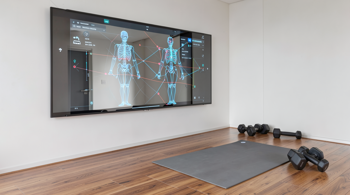
To complement visual posture mapping, these diagnostic mirrors often incorporate bioelectrical impedance analysis (BIA). By utilizing 8-electrode BIA technology, the system delivers precise, high-precision body composition metrics, including body fat percentage, muscle mass distributions, and visceral fat indicators 7. These metrics are compiled into localized digital reports, allowing users to track structural changes, identify potential health risks, and monitor training efficacy over extended periods without relying on external medical testing equipment.
Digital Resistance and Integrated Strength Equipment
While early fitness mirrors focused primarily on bodyweight cardio, yoga, and aerobics, newer hardware integrations have expanded into heavy strength training. This is achieved through the incorporation of digital resistance systems or companion smart accessories. The IMBODY Power S represents an all-in-one smart home gym configuration that combines a 43-inch smart fitness mirror with an integrated second-generation digital resistance system 8. This unit delivers up to 260 pounds of adjustable digital resistance with precise 0.5-kilogram control increments, employing adjustable smart arms and high-strength cable systems to simulate free weights without physical plates 8.
Other manufacturers address strength training by bundling connected physical weights. For example, some models include smart adjustable dumbbells or dedicated storage compartments containing custom kettlebells, dumbbells, resistance bands, and yoga blocks 4 9. These physical accessories communicate directly with the mirror's sensors or computer vision software, allowing the system to track lifted weights, log total volume, and suggest progressive overload targets based on the user's historical performance data.
Comparative Analysis of Hardware and Features
The following table outlines the technical variations, software integrations, and physical dimensions of prominent smart fitness mirrors available in the consumer and commercial markets:
| Brand / Model | Display Dimensions | Primary Operating System | Tracking & Resistance Mechanism | Subscription Structure |
|---|---|---|---|---|
| MAGIC AI Mirror | Standard Wall Mirror | Proprietary ReflectAI | Multi-point body tracking; companion smart weights 4 | Free lifetime membership included 4 |
| IMBODY Power S | 43" Smart Mirror 8 | Android Interface | 260 lbs digital resistance; smart arms 8 | No monthly subscription required 8 |
| AEKE Smart Gym K1 | 43" 4K Screen 10 | Android OS | 42-point skeletal tracking 5 | No ongoing subscription fees 5 |
| Echelon Reflect 60" | 32" HD Touchscreen 11 | Echelon Proprietary | On-screen metrics & companion app tracking 11 | Monthly or annual premium plan 11 |
| NordicTrack Vault | 32" HD Touchscreen 9 | iFIT Integration | 60" reflective mirror & storage system 9 | iFIT subscription required 9 |
Market Challenges, Consumer Retention, and Privacy
Despite the technological advancements in smart fitness mirrors, the industry faces notable market friction points and user retention challenges. Academic research investigating these devices as interactive educational platforms highlights a documented "retention crisis" 12. While factors such as clear feedback and performance expectations initially drive consumer adoption, many users abandon the hardware once the initial novelty fades. Furthermore, research indicates that the highly evaluative nature of camera-based interfaces can trigger social physique anxiety in certain demographics, which negatively impacts long-term behavioral intention to use the devices 12.
Privacy concerns also represent a major barrier to wider consumer adoption, as these systems place high-definition cameras and biometric sensors directly into private living spaces. To build consumer trust, manufacturers are increasingly forced to implement hardware-level camera covers, edge-based data processing that keeps video footage off corporate servers, and secure data storage solutions 1 6. Addressing these technical, psychological, and privacy concerns remains essential for manufacturers seeking sustained growth in the connected home fitness industry.
Sources
- ResearchAndMarkets.com - Fitness Mirrors Market Insights Report 2025-2030 (https://www.businesswire.com/news/home/20250905728486/en/Fitness-Mirrors-Market-Insights-Report-2025-2030-Shift-Towards-Digital-and-Home-Based-Fitness-Rise-of-Smart-Home-Gyms---ResearchAndMarkets.com)
- HomeZapTech - Smart Fitness Mirror Review 2026 (https://homezaptech.com/smart-fitness-mirror-review/)
- YUSUN SMART - Smart Fitness Mirror Android 12 Touch Screen (https://yusunsmart.com/product/smart-fitness-mirror-touch-screen-yoga/)
- YouTube: MagicDotFit - "I Quit the Gym for This AI MAGIC Fitness Mirror" (https://www.youtube.com/watch?v=f8n7mNMv0Jw)
- Eagle Country - AEKE Smart Home Gym K1 90-Day Trial (https://lifestyle.myeaglecountry.com/story/311736/aeke-smart-home-gym-k1-delivers-sustained-results-in-90-day-independent-trial/)
- IEEE - Privacy-Preserving Multimodal Smart Mirror System 2026 (https://doi.org/10.1109/iitcee67948.2026.11394087)
- Vercon Smart Mirror - 3D Body Smart Scanning Mirror (https://verconsmartmirror.com/cs/product/3d-body-smart-scanning-mirror/)
- IMBODY - IMBODY POWER S Smart Home Gym Mirror (https://imbody.com/products/power-s)
- Gym Equipment Co - NordicTrack Vault Smart Fitness Mirror (https://www.gymequipmentco.com/products/nordictrack-vault-smart-fitness-mirror/)
- Of Zen and Computing - 8 Best Smart Home Gym Mirrors (https://www.ofzenandcomputing.com/best-smart-home-gym-mirrors/)
- The Fitness Outlet - Echelon Fitness Reflect Touch Smart Fitness Mirror 60" (https://thefitnessoutlet.com/products/echelon-fitness-reflect-touch-smart-fitness-mirror-60)
- International Journal of Human-Computer Interaction - Investigating Smart Fitness Mirrors Based on Extended UTAUT2 (https://doi.org/10.1080/10447318.2026.2641709)
Authored by MyTrendSpot team