Vibration Plate Exercise Machines for Weight Loss: An Evidence-Based Consumer Guide
Vibration plate exercise machines for weight loss are now appearing in living rooms, social media feeds, and physical therapy clinics alike, driven by a wave of consumer interest and fitness marketing. These platforms deliver high-frequency oscillations that trigger involuntary muscle contractions, and while manufacturers make wide-ranging body composition claims, published clinical evidence tells a more measured story. Understanding what the research supports, what machine specifications matter, and who should exercise caution is essential before evaluating this category of fitness equipment.
How Whole-Body Vibration Training Works
Vibration plates function by generating rapid mechanical oscillations beneath the user's feet, typically operating at frequencies between 5 and 50 Hz, which travel upward through the musculoskeletal system. 1 These signals trigger a neuromuscular response known as the tonic vibration reflex, compelling muscles throughout the body to contract and relax in rapid succession without voluntary effort. Fitness-grade machines generally target the lower end of this frequency range for circulation and lymphatic flow effects, while higher settings in the 30 to 50 Hz band are associated with greater muscle activation. 2
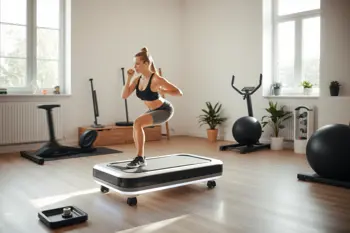
The primary mechanism by which these machines contribute to calorie expenditure is those involuntary muscle contractions. Research published through the National Center for Biotechnology Information indicates that vibration training improves body composition and muscle strength when used as part of a comprehensive fitness program, though the effect is substantially amplified when users perform dynamic movements such as squats, lunges, and plank holds on the plate rather than standing passively. 3 Most manufacturers cap recommended session length at approximately 30 minutes, and general guidance is to begin at lower intensity settings before progressing.
What Clinical Evidence Shows About Weight Loss
The honest scientific picture is more nuanced than most product marketing suggests. Analysis from fitness research sources indicates that vibration training plus calorie restriction outperforms calorie restriction alone for fat loss, with the most consistent effects observed in postmenopausal women and metabolic-syndrome populations. The effect size documented across published trials is typically characterized as small to moderate, with roughly 0.5 to 1 kg of additional fat loss differential over a 12-week period compared to dieting alone. 4
A clinical study indexed at NCBI found that vibration plate training combined with resistance exercise produced greater fat loss outcomes than passive vibration standing alone. 5 Research published in the International Journal of Obesity similarly indicated that vibration training can perform comparably to traditional exercise modalities for long-term weight management outcomes. 6 The American Council on Exercise states that vibration plates are most effective for weight loss when integrated with conventional aerobic activity and consistent nutritional habits, rather than used as a standalone method. 7
Machine Categories and Key Specifications
The consumer market spans a wide spectrum of price points and engineering approaches. Entry-level platforms typically operate with a single motor, offer oscillation-only motion, and support user weights between 265 and 330 lbs. Mid-range and advanced home models incorporate dual or triple-motor systems delivering oscillation, lateral, and pulsation motion simultaneously across frequency ranges from 4 to 40 Hz with amplitude adjustability. Consumer Reports, which tested six vibration plates in 2026, found that build quality varied substantially across this range, with at least one lower-cost model exhibiting concerning performance issues during testing. 8
| Market Tier | Typical Frequency Range | Motor Configuration | General Weight Capacity |
|---|---|---|---|
| Entry-Level | 7-14 Hz | Single motor (150-200W) | 265-330 lbs |
| Mid-Range | 4-40 Hz | Dual motor (300-400W) | 330-440 lbs |
| Advanced Home | 4-40 Hz, multi-mode | Triple motor (600W+) | 440-500 lbs |
| Professional Grade | 30-45 Hz, 1Hz increments | High-torque, electronic control | 300+ lbs, commercial rated |
Professional-grade platforms, such as those in the Power Plate my8 category priced above $8,000, offer features including electronically controlled resistance cables, coach-led digital workout libraries exceeding 250 sessions, and vibration frequency adjustment in 1 Hz increments across a 30 to 45 Hz range. 9 Research indicates that optimal muscle activation for fitness benefits occurs at frequencies between 25 and 50 Hz, a specification range that mid-range and above platforms are more likely to achieve consistently. 2
Secondary Health Benefits Reported in Research
Beyond body composition, researchers at institutions including UT MD Anderson Cancer Center have explored vibration plates primarily for their bone and muscle health applications. Gabriel Pagnotti, Ph.D., a biomedical engineer whose work focuses on mechanical signals and musculoskeletal health in oncology contexts, has noted that mechanical signals delivered through vibration plates interact with the skeletal remodeling process in ways comparable to physical activity inputs such as walking and weightlifting. 10 Consumer Reports' review of clinical literature found evidence supporting potential improvements in blood and lymphatic flow, reduction in swelling, and possible benefits for populations managing conditions such as lipedema, fibromyalgia, and sarcopenia.
GoodRx's clinical review identifies seven potential benefit categories supported by available research, including circulation improvement, muscle strengthening, and exercise recovery support, while noting that research on vibration plate benefits overall remains limited in scope and scale. 11 Health coach Robin Laird, who documented a six-month personal trial of the Lifepro Rumblex Pro platform, reported consistent effects on digestion and circulation, and identified five measurable longevity-relevant benefits by the conclusion of the trial period, though individual outcomes varied considerably depending on activity level and diet adherence. 12
Safety Considerations and Contraindications
Medical consensus across sources including the Mayo Clinic, WebMD, and the Cleveland Clinic identifies several populations for whom vibration plate use requires physician clearance or is inadvisable. Standard contraindications include pregnancy, recent joint or orthopedic surgery, the presence of cardiac pacemakers, severe or chronic migraines, acute inflammatory conditions, and the presence of certain surgical implants. 13 The Mayo Clinic specifically positions vibration plates as a supplemental exercise tool rather than a primary weight loss method, consistent with the broader clinical literature. 14
Beyond medical contraindications, practical safety guidance includes starting at the lowest available frequency and intensity settings, limiting initial sessions to 10 minutes or less to assess individual tolerance, ensuring the platform is placed on a stable non-slip surface, and following manufacturer-specified session length limits which generally cap at 30 minutes per use. Consumer Reports noted that some lower-cost platforms exhibited instability during testing, and that comfort and surface quality varied enough across tested models to affect the safety and usability of the experience at higher intensity settings. 8
Realistic Expectations and Practical Integration
Evidence-based analysis from fitness research sources is consistent on one central point: vibration plate training functions as an adjunct tool, not a primary weight loss mechanism. Used three to four times per week alongside a meaningful calorie deficit, published trials suggest a plate adds a modest but measurable fat-loss differential over a 12-week protocol. 4 Marketing claims that equate 10 minutes of passive standing on a vibration plate to 60 minutes of running, or promise significant weight loss within two weeks, are not supported by the peer-reviewed trial literature available as of 2026. Users who perform active exercises during sessions, including squats, lunges, and push-up holds, consistently show greater outcomes than those who stand passively.
Practical integration means treating the vibration plate as approximately 10 to 20 percent of a broader fitness strategy that still includes a caloric deficit, regular cardiovascular movement, and adequate sleep. Frequency range, motor power, weight capacity, and platform stability are the specification categories most worth scrutinizing when evaluating machines, as these variables directly influence whether the device can sustain the frequencies associated with measurable physiological response during exercise. 2 Consulting a healthcare provider before beginning any whole-body vibration protocol remains advisable, particularly for individuals with pre-existing cardiovascular, orthopedic, or neurological conditions.
Sources
- News Observer - Vibration plate benefits, risks and who should skip it (newsobserver.com, 2026)
- Journal of Sports Medicine and Physical Fitness - Vibration frequency and muscle activation research (jsmf.org)
- National Center for Biotechnology Information - Vibration training body composition systematic review (ncbi.nlm.nih.gov/pmc/articles/PMC5989357/)
- Best Vibration Plates UK - Vibration Plates and Weight Loss: What the Evidence Shows (bestvibrationplates.co.uk, 2026)
- NCBI Obesity Study - Vibration plate and resistance training fat loss outcomes (ncbi.nlm.nih.gov/pmc/articles/PMC3637368/)
- Nature / International Journal of Obesity - Vibration training and long-term weight management (nature.com/articles/ijo2010173)
- American Council on Exercise - Vibration training effectiveness guidance (acefitness.org)
- Consumer Reports - 4 Best Vibration Plates of 2026, Tested by Experts (consumerreports.org, 2026)
- Power Plate - Power Plate my8 product specifications (powerplate.com)
- UT MD Anderson Cancer Center - Vibration plates: Are there health benefits? (mdanderson.org)
- GoodRx - 7 Benefits of Vibration Plates to Shake Up Your Fitness Routine (goodrx.com)
- Women's Health Magazine UK - I used a vibration plate for 6 months: honest results (womenshealthmag.com, 2026)
- WebMD - Vibration training contraindications and safety (webmd.com)
- Mayo Clinic - Whole body vibration: An effective workout? (mayoclinic.org)
Authored by MyTrendSpot team