Electric Mobility Scooters on Sale: A Consumer's Guide to Models, Specs, and Market Pricing
Understanding the Electric Mobility Scooter Market
Electric mobility scooters on sale today span a remarkably wide price range, reflecting differences in motor power, battery capacity, frame construction, and intended terrain. Research data from specialty retailers indicates that entry-level models from brands such as Bangeran and ComfyGo are historically available in the $949 to $1,149 range, while mid-tier units from manufacturers like Paiseec, Merits, and Shoprider occupy the $1,069 to $2,950 segment. 1 Premium and all-terrain configurations, such as the Green Transporter Cheeta Golf All-Terrain and the Shoprider Excursion Heavy Duty, are positioned between $4,495 and $5,295 at retail. 2
Consumer Reports has documented that its lab-tested scooter evaluation set ranged in price from $500 to $2,850, reflecting the mainstream portion of the market. 3 Approximately 40 percent of adults aged 65 and older live with a mobility disability, and research identifies elderly individuals as the primary user base for these devices, though conditions such as osteoarthritis, multiple sclerosis, and chronic fatigue syndrome drive demand across all age groups. 3 This broad user base explains the diversity of configurations currently marketed.
Key Performance Specifications to Compare
Before evaluating any electric mobility scooter on sale, understanding the core technical benchmarks is essential. Speed ratings across currently marketed models range from 3.7 mph on compact travel units such as the Hoverfly T3 to 6.2 mph on models like the Paiseec S3, while heavy-duty configurations including the GIO Regal PR reach 25 km/hr. 4 Range per charge varies just as significantly: lightweight travel scooters typically deliver 12 to 16 miles, whereas extended-battery variants and heavy-duty models can achieve 25 to 50 miles on a full charge. 5
Weight capacity is another critical specification. The majority of consumer-grade units support 270 to 330 lbs, with models such as the Hoverfly T3 and T4 rated to 330 lbs and lighter travel models like the ScootNGo Lite rated to 270 lbs. 6 Heavy-duty bariatric configurations from brands including Afikim, Pride Mobility, and Baja Mobility can support substantially higher loads, with certain three-wheel heavy-duty designs marketed with capacities reaching 500 lbs. 7 Battery charging times across current models generally fall within the 5 to 8 hour window, consistent with broader industry averages for lithium and lead-acid battery systems. 8
Major Segments: Portable, Mid-Size, and Heavy-Duty
The electric mobility scooter category effectively divides into three functional segments. Portable and travel-class scooters prioritize low weight and foldability, with units such as the ScootNGo Lite weighing 45 lbs with battery, and the ScootNGo Voyager reaching just 39.7 lbs. 9 These models are typically flight-approved and designed to fold in seconds for vehicle transport, with the Paiseec D3 achieving an ultra-light 39.7 lbs and offering 18.6 miles of range from a 270W motor. 10 Retail pricing for this segment historically sits between $699 and $1,499.
Mid-size four-wheel models balance stability and range. The Metro Mobility M1 Portal 4-Wheel offers a 22.5Ah lithium battery, 20-mile range, 330 lb capacity, and a maximum speed of 5 mph. 11 Heavy-duty configurations occupy the upper end of the market. The Avenger GA541 4-Wheel Heavy Duty Electric Scooter and the Shoprider Excursion Heavy Duty are representative examples priced at $5,259 and $5,295 respectively, engineered for users requiring reinforced frames and extended daily use. 12
Notable Brands and Their Positioning
Several manufacturers appear consistently across specialty medical retailers and mass-market platforms. Pride Mobility is one of the most widely distributed brands in the U.S., operating sub-brands including Go Go Travel Mobility and Baja Mobility, with its Go Go Ultra X 3-Wheel model retailing around $1,193 and offering a 300 lb weight capacity, 8-mile range, and 4.3 mph maximum speed across a feather-touch disassembly five-piece design. 13 Afikim, Merits USA, Golden Technologies, EV Rider, and Shoprider are among the other established names catalogued across heavy-duty specialist retailers such as Mobility Scooters Direct. 14
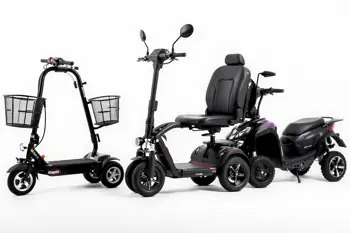
Newer entrants including Hoverfly, Paiseec, ComfyGo, and ScootNGo have expanded the accessible price tier substantially. The ComfyGo Z-4 Ultra-Light Electric Mobility Scooter, for example, is available in a 12Ah standard-range variant at $1,249 and a 30Ah extended-range variant at $1,349 to $1,499 depending on tire configuration. 15 The iScooter X01 3-Wheel Mobility Scooter enters the market at $599.99 with a 300W peak motor, 5 mph maximum speed, 12.4-mile range, and 300 lb load capacity, targeting value-conscious buyers. 16
Insurance, FSA/HSA Eligibility, and Financing Considerations
Many electric mobility scooters qualify as FSA/HSA-eligible medical devices, a designation that can meaningfully offset acquisition cost. Specialist retailers including Skyward Medical and Independent Living Superstore explicitly list their inventory as FSA/HSA eligible. 17 Medicare and supplemental insurance plans may also cover a portion of mobility scooter costs when a healthcare provider prescribes the device, though coverage eligibility depends on the plan classification of the specific model and the documented medical necessity determination. 8 Consumers should verify coverage directly with their insurer and obtain appropriate documentation before purchase.
Financing options have become common among specialty retailers. Zero-percent financing programs are offered by platforms such as Hoverfly, while independent retailers like Mobility Queens advertise financing availability alongside warranty terms. 6 Warranty terms in the current market typically include 1-year coverage on electronic components such as the battery, motor, controller, and display, with some brands offering extended frame warranties of up to 5 years, as seen with the ScootNGo Lite and Folo models. 9
Risk Factors, Maintenance Realities, and Consumer Cautions
Electric mobility scooters carry several practical risks that prospective buyers should assess objectively. Range figures published by manufacturers typically reflect optimal flat-surface testing conditions; real-world range on inclines, uneven pavement, or in cold temperatures can be meaningfully lower. Battery degradation over time is a documented characteristic of both lithium and lead-acid battery systems, with replacement battery costs ranging from $80 to $200 or more depending on the model. 10 Buyers should confirm parts availability and service infrastructure before committing, particularly for brands with limited dealer networks.
Weight and disassembly logistics deserve careful evaluation for users who plan to transport their scooter frequently. While models marketed as portable may weigh under 50 lbs, the heaviest individual disassembled component, often the main frame, can still exceed 30 lbs, presenting challenges for users with limited upper body strength. 3 Return policies vary significantly: some retailers offer 14-day return windows with inspection requirements, while others extend to 30 days. Regulatory compliance, including FDA classification for certain medical-grade devices, is an additional factor; the Hoverfly T5 is marketed as FDA-cleared, illustrating that clearance status differs across models and should be confirmed when medical reimbursement is being pursued. 6
Sources
- Skyward Medical - 4-Wheel Mobility Scooters On Sale (skywardmedical.com)
- Skyward Medical - Green Transporter and Shoprider Product Listings (skywardmedical.com)
- Consumer Reports - Best Mobility Scooters, January 2026 (consumerreports.org)
- Hoverfly - Electric Mobility Scooter Collection and Paiseec S3 Product Page (hoverflys.com / mobilityqueens.com)
- Paiseec D3 Lightweight Mobility Scooter and ComfyGO MS3000 Product Pages (paiseec.com / mobilityqueens.com)
- Hoverfly - T3 and T4 Electric Mobility Scooter Collection (hoverflys.com)
- Mobility Scooters Direct - Heavy Duty Mobility Scooters Category (mobilityscootersdirect.com)
- General Research - LLM Compiled Industry Data on Medicare Coverage and Battery Life
- ScootNGo - Lite and Voyager Mobility Scooter Product Pages (scootngo.com)
- Paiseec - D3 Lightweight Mobility Scooter Product Page (paiseec.com)
- Metro Mobility - M1 Portal 4-Wheel Heavy Duty Scooter (metromobility.com)
- AllCare Store - Avenger GA541 and Skyward Medical Shoprider Excursion Listings (allcarestore.com / skywardmedical.com)
- DME Superstore - Pride Mobility Go Go Ultra X 3-Wheel Scooter (dmesuperstore.com)
- Mobility Scooters Direct - Heavy Duty Brand Filter Page (mobilityscootersdirect.com)
- Mobility Queens - ComfyGO Z-4 Ultra-Light Electric Mobility Scooter (mobilityqueens.com)
- iScooter Global - iScooter X01 Mobility Scooter 3 Wheels (iscooterglobal.com)
- Independent Living Superstore - Merits Roadster 3 Portable Mobility Scooter (independentlivingsuperstore.com)
Authored by MyTrendSpot team