Sustainable Everyday Essentials: A Consumer's Research Guide to Materials, Certifications, and Real-World Tradeoffs
Interest in sustainable everyday essentials has grown substantially as consumers seek to reduce household plastic consumption and move toward zero-waste routines. The category spans a wide range of product types, from organic cotton basics and reusable kitchen tools to refillable personal care products and compostable packaging, each with distinct material compositions, certification standards, and environmental tradeoffs that require careful evaluation before any purchasing decision.
What Makes a Product Genuinely Sustainable
An eco-friendly product is typically defined by a minimal environmental footprint, use of reusable or compostable materials such as bamboo, organic cotton, or silicone, reduced reliance on single-use plastics, and durability sufficient to avoid frequent replacement. 3 The Federal Trade Commission's Green Guides provide regulatory oversight specifically designed to prevent companies from making misleading or vague environmental marketing claims, meaning that terms like "eco-friendly" carry legal responsibility when used commercially. 2
Life Cycle Assessment data confirms that replacing single-use plastic products with durable reusable alternatives reduces a household's carbon footprint across a product's total lifespan. 4 However, the environmental benefit depends heavily on how frequently a reusable item is actually used. A beeswax food wrap or silicone baking mat only outperforms its disposable counterpart when used consistently over many cycles, a practical consideration often omitted from product marketing.
Key Material Categories Across Product Types
Sustainable everyday essentials draw on a core set of verified materials. In textiles, GOTS-certified organic cotton and TENCEL Modal derived from sustainably managed forests are two of the most rigorously third-party verified options. Organic Basics produces apparel using 57% organic cotton and 38% TENCEL Modal blended into jersey fabric, with one pants style documented to produce 12% less CO2e than the industry standard. 3 Unless Collective uses 200 GSM regenerative Pima cotton that is 100% plastic-free and garment-dyed with non-toxic, water-safe colorants, while Ecotton's everyday tees blend 50% Lenzing Modal from beech trees with 50% combed cotton, producing a 100% biodegradable, AZO-free fiber. 3
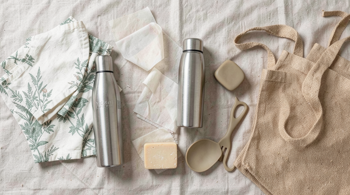
In kitchen and home goods, materials such as LFGB-certified non-toxic silicone, premium organic cotton, and natural sisal fiber form the functional backbone of reusable alternatives. Reusable silicone baking mats made from LFGB-certified silicone meet stricter and safer testing standards than FDA approval. 1 Organic cotton dishcloths, such as the seven-cloth packs offered by Ecovask, are machine washable up to 60 degrees Celsius and tumble-dry compatible. 8 Swedish dishcloths, beeswax food wraps, and solid dish soap bars represent additional kitchen-category staples with documented plastic-free credentials.
Personal Care and Hygiene Essentials
Personal care is one of the highest-impact categories for sustainable swaps because conventional products often contain synthetic fabrics and chemical finishes that sit directly against the skin. Sustainable Jungle notes that conventional basics from fast fashion brands frequently involve chemical dyes and softeners, making organic, non-toxic textiles a meaningful change for everyday garments. 3 KENT's organic supima cotton underwear is described as free from petrochemicals, pesticides, and microplastics, arriving in 100% compostable packaging, with the product itself also compostable at end of life. 3
In menstrual care, Riley's organic cotton pads are certified to the Global Organic Textile Standard (GOTS), made without chlorine bleach, rayon, titanium dioxide, dyes, or GMOs, and include biodegradable backing film and FSC-certified recyclable packaging. 3 Ambra's Bare Essentials range uses recycled nylon sourced from pre-consumer waste, offering a seamfree construction designed for all-day comfort while diverting manufacturing scraps from landfill. For body care, Australian Pink Clay soap bars formulated with Shea Butter and Hemp Oil represent a solid-format, toxin-free alternative to liquid soap in plastic bottles. 1
Certifications and Third-Party Verification Standards
Third-party certification is the most reliable signal that a sustainability claim has been independently verified. The following table summarizes the key certifications consumers encounter in this market:
| Certification | What It Verifies | Relevant Categories |
|---|---|---|
| GOTS (Global Organic Textile Standard) | Organic fiber content and safe processing across the full supply chain | Apparel, underwear, period care |
| OEKO-TEX STANDARD 100 | Tested for harmful substances across all components | Textiles, accessories |
| B Corp Certification | High standards of social and environmental performance, transparency, and accountability | All product types |
| LFGB (European Food Safety) | Non-toxic food-contact materials with stricter standards than U.S. FDA | Kitchen silicone goods |
| FSC (Forest Stewardship Council) | Responsibly managed forest sourcing for wood and paper | Packaging, modal fibers |
| GRS (Global Recycled Standard) | Verified recycled content in fabric and materials | Recycled nylon, polyester |
B Corp certification, issued by B Lab Global, requires companies to meet high standards of social and environmental performance, transparency, and legal accountability. 1 Brands like Gaia Herbs have achieved B Corp status alongside commitments to carbon neutrality and zero-waste farming practices. Consumers should request specific certification documentation rather than accepting general claims, since the FTC Green Guides hold marketers legally responsible for substantiating environmental statements. 2
Reusable Travel and On-the-Go Essentials
Travel accessories represent a rapidly expanding segment of sustainable everyday essentials. Quince's Eco-Compression Packing Cubes are each made from 61 recycled water bottles, manufactured in Sedex-certified factories, and can compress by up to 60% in height. 3 Baggu packing cubes are machine washable, made from pre-consumer waste to conserve petroleum resources, and packaged in FSC-certified 100% recycled paper stock with non-plastic eco-friendly coatings. 3 Reusable water bottles such as the Ocean Bottle Lite are constructed from recycled ocean-bound plastic and stainless steel; each unit sold funds the collection of 1,000 plastic bottles before they reach the ocean. 6
Natural-fiber shopping bags made from 100% biodegradable hessian jute provide a durable, compostable alternative to plastic carrier bags, with reinforced stitching for load-bearing use. 3 Jute gym bags certified to Oeko-Tex standards offer similar functionality for daily commuting. Reusable bamboo cloth wipes, wet bags, and snack bags round out a portable eco-kit that eliminates recurring purchases of disposable equivalents across multiple product categories.
Documented Limitations and Consumer Considerations
Sustainability claims require critical scrutiny. Recycling of used clothing in the U.S. remains constrained because most textiles are not currently collected for recycling at scale. 9 Similarly, recycling outcomes for plastic packaging depend entirely on local municipal programs and what specific facilities can accept and process, making broad claims about recyclability unreliable without local verification. 11 The U.S. EPA also notes that composting food scraps can divert waste from landfills and reduce methane emissions, but this benefit depends on access to home or municipal composting infrastructure. 6
Material tradeoffs also exist within the sustainable category itself. Recycled synthetic fabrics such as recycled nylon or recycled polyester release plastic microfibers into wastewater during washing; Organic Basics explicitly recommends using a GUPPYFRIEND washing bag to capture microfibers when laundering recycled nylon garments. 3 The U.S. Department of Energy identifies cold-water laundry washing as a meaningful energy-saving behavior, reinforcing that how products are used and maintained affects their real-world environmental footprint as significantly as what they are made from. 10 Circularity, the capacity for a product to be composted, recycled, or refilled rather than landfilled, remains the most reliable long-term metric for evaluating genuine sustainability performance. 5
Sources
- Go For Zero Australia - goforzero.com.au
- Federal Trade Commission - FTC Green Guides - ftc.gov
- Sustainable Jungle - sustainablejungle.com
- U.S. Environmental Protection Agency - EPA Sustainable Materials Management - epa.gov
- Ellen MacArthur Foundation - Circular Economy Overview - ellenmacarthurfoundation.org
- U.S. Environmental Protection Agency - Composting at Home - epa.gov
- B Lab Global - B Corp Certification - bcorporation.net
- Ecovask New Zealand - ecovask.nz
- Ellen MacArthur Foundation - A New Textiles Economy - ellenmacarthurfoundation.org
- U.S. Department of Energy - Water Heating and Laundry Energy Use - energy.gov
- U.S. Environmental Protection Agency - Plastics Recycling - epa.gov
Authored by MyTrendSpot team