Surplus Military Field Gear Available in Canada: A Buyer's Research Guide
Surplus military field gear available in Canada attracts a broad audience, from bushcraft enthusiasts and backcountry hikers to collectors and airsoft participants. The category encompasses everything from authentic Canadian Armed Forces clothing to decommissioned load-bearing equipment, and understanding where this gear originates, what condition it realistically arrives in, and what limitations govern its sale is essential before any acquisition decision.
How Canadian Military Surplus Enters the Civilian Market
Canadian Armed Forces surplus disposal is handled through federal materiel management channels rather than direct consumer retail. 6 The Department of National Defence processes decommissioned equipment through government liquidation and procurement surplus programs, which then release inventory in wholesale lots. 1 Private businesses purchase these lots through government auctions and designated disposal channels, subsequently making individual items available to the public through both physical storefronts and e-commerce platforms. 3
Several major auction platforms operating within Canada, including Proxibid and BidSpotter, periodically list surplus military-style lots depending on what individual government or institutional auctions make available. 7 8 Major distribution hubs for surplus gear in Canada tend to cluster near historical military base locations, with cities such as Ottawa, Montreal, and Edmonton serving as notable regional centers. 3 Many domestic retailers also supplement Canadian-sourced stock by importing global military surplus from allied nations to broaden available selection. 4
Categories of Field Gear Commonly Found in the Canadian Surplus Market
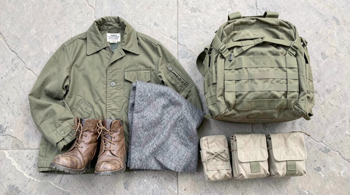
The range of surplus field gear available through Canadian-market retailers is broad. Clothing represents the largest segment, including combat jackets, field trousers, fleece midlayers, and cold-weather systems. The Canadian Mk.II Combat Jacket, constructed from a breathable 50/50 NyCo Sateen fabric and originally issued as part of the decades-long "Uniform, Combat General Service" system, appears across multiple surplus channels in deadstock or lightly used condition. 2 The Canadian Army cold-weather fleece, originally issued as part of a layered thermal system in the late 1980s and 1990s, features nylon-reinforced shoulder, elbow, and chest panels and a high collar designed for sub-zero field environments. 2
Footwear is another prominent category. Original Canadian Army STC combat boots in suede brown leather, manufactured domestically and classified as new surplus, represent one documented example of authentic Canadian-issue footwear reaching the civilian market. 2 Royer of Quebec, a military contractor with a long history of producing footwear for the Canadian Armed Forces, produced waterproof combat boots featuring a GORE-TEX-style lining, full-grain leather uppers, a double-density shock-absorbent sole, and a 9-inch height with 10 eyelets. 2 Load-bearing equipment such as tactical packs, MOLLE-compatible pouches, and field rucksacks also circulate regularly, alongside sleep systems, wool blankets, and miscellaneous accessories.
Notable Authentic Canadian-Issue Items in Circulation
Several specific items with documented Canadian military origin appear in the broader surplus market accessible to Canadian buyers. The Canadian military 100% wool blanket, produced by various Canadian government contractors and measuring approximately 60 inches by 80 inches, was historically issued to keep soldiers warm in harsh winter conditions. 2 While no longer part of standard Canadian soldier kit, these blankets circulate in both new and used condition through surplus retailers, with individual blankets sometimes displaying lettering, striping, or color variation depending on the production batch. 2
The 1980s-era "Crewman" Canadian bomber jacket, featuring an asymmetric chest pocket and CLIX zipper hardware derived from a 1970s cold-weather pattern, represents the type of vintage collectible that appears through specialty surplus channels. 2 A Canadian Air Force Gentex Model 411 flying helmet, unissued and dated August 1990, with a composite outer shell, single clear visor, removable web liner, and adjustable chinstrap, illustrates the collector-grade end of the spectrum where provenance and condition documentation carry significant weight. 2 CADPAT-patterned camouflage gear remains among the most sought-after items by collectors given its recognizable Canadian-specific disruptive pattern. 3
Condition Realities and Pricing Factors
Pricing for surplus field gear in the Canadian market is primarily determined by two variables: item condition and historical rarity. 3 Condition classifications typically range from "new/unissued" or "new old stock" at the higher end of the pricing spectrum, down through "very good," "good," and "used/fair" grades that reflect increasing levels of wear, staining, missing components, or field modifications. Many surplus retailers explicitly note that condition-varying items may include fading, corrosion to metal hardware, missing buttons, or non-standard accessories, and buyers should review item descriptions carefully before forming expectations. 5
Availability across all condition grades is inventory-dependent and subject to frequent change, as surplus lots are finite by nature. 4 Stock that appears listed may be exhausted rapidly, and certain size ranges within a given item often deplete faster than others. Buyers researching footwear, for instance, will encounter size matrices where the majority of options are listed as out of stock at any given time, reflecting the reality that surplus runs do not replenish on demand the way commercial manufacturing does. Unissued or deadstock examples command notably higher prices than their used counterparts, and items with intact original labeling or documentation of manufacture date and contractor identity carry additional collector value.
Legal Considerations and Restricted Items
Not all military surplus items are freely available for civilian purchase in Canada. Legal restrictions govern the sale of specific categories of controlled equipment. Body armor, for example, is subject to provincial regulation across Canada; in certain provinces including Ontario, the purchase and possession of body armor without appropriate authorization is restricted or prohibited for civilians. 3 Current-issue specialized equipment that has not been formally decommissioned through official disposal channels may also be subject to restrictions. Buyers should independently verify applicable provincial and federal regulations before acquiring any item that falls into a potentially restricted category.
Tactical helmets meeting ballistic protection standards, such as NIJ Level IIIA-rated helmets, are commercially available through Canadian tactical retailers, but buyers should understand that these are distinct from decommissioned surplus in many cases and carry their own regulatory context depending on the end use. 2 Items marketed as Canadian Forces surplus should carry clear documentation of their surplus status. Purchasing through established retailers who clarify item provenance, government contractor origin, and condition grading reduces the risk of acquiring misrepresented equipment. The Government of Canada provides official guidance on how surplus materiel is disposed through designated channels, which is useful background for understanding legitimate supply pathways. 6
Practical Considerations for Prospective Buyers
Several practical factors merit attention when researching Canadian surplus field gear. Sizing systems for Canadian military clothing differ from standard North American commercial sizing. Canadian military garments historically used a dual-figure sizing system combining height and chest measurements, meaning a size labeled 7346, for example, indicates a garment suited to approximately 6 feet of height with a 46-inch chest circumference. 2 Buyers unfamiliar with this system should cross-reference chest and overall height measurements provided by the retailer before selecting a size.
Material age is a relevant consideration for older surplus items. Wool blankets, canvas packs, and cotton-based garments from earlier decades may not conform precisely to their labeled dimensions due to age-related shrinkage or fabric relaxation. 2 Surplus electronics, communication equipment, and protective gear with safety functions should be assessed with particular care, as materials may have degraded beyond functional reliability. Beyond clothing and personal equipment, the broader surplus market accessible through Canadian auction platforms also includes generators, communications equipment, and vehicles, though these categories involve substantially more complex acquisition logistics and condition verification processes. 1 Consulting condition guides published by individual retailers and reviewing all stated restrictions prior to purchase represents the baseline due diligence approach for this category of gear.
Sources
- Government of Canada Public Services and Procurement - tpsgc-pwgsc.gc.ca
- GoMilitar / Americana Pipedream / Venture Surplus / Universal Surplus / MilitaryGearGo / WW2 Originals / Canadian Optics - Product and category research data
- TruePrepper - Top 10 Military Surplus Sites Online - trueprepper.com
- Army Surplus Warehouse Canada - armysurpluswarehouse.ca
- Sold for Less - soldforless.com
- Government of Canada - Department of National Defence Surplus Materiel - canada.ca
- Proxibid Canada Auctions - proxibid.com
- BidSpotter Canada - bidspotter.com
Authored by MyTrendSpot team