Custom Engagement Rings: A Consumer Research Guide
Design your own custom engagement ring is a process that can begin with a setting, a natural diamond, a laboratory-grown diamond, a gemstone, or a bridal set. Existing jeweler workflows show that customization ranges from combining compatible components online to developing a fully bespoke design through consultation, computer-aided design, and workshop production. 1 2
What Custom Engagement Rings Include
A custom engagement ring is designed around selected priorities rather than taken unchanged from a standard collection. Those choices may include the center stone, setting style, precious-metal type, band shape, accent stones, engraving, and the way the ring fits alongside a future wedding band. Bespoke does not necessarily mean ornate or unusual: a simple solitaire can still be individually configured for proportion, comfort, stone shape, or personal meaning. 9 10
- Component-based customization pairs a chosen stone with a compatible setting.
- Design-led customization develops a setting around a particular stone or concept.
- Heirloom-led projects may incorporate an existing diamond, gemstone, or design reference.
How the Design Process Usually Works
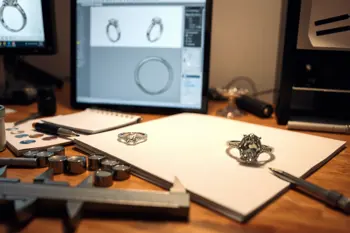
Published custom-design processes commonly begin with a consultation in which the client discusses reference images, lifestyle requirements, metal preferences, and structural details. The jeweler may then source diamonds or colored gemstones, prepare sketches or CAD models, and provide a digital rendering for review. Some projects use a wax or resin prototype before casting, while others proceed directly from an approved digital design to fabrication. Final steps include setting, polishing, inspection, and presentation. 3 5 6 7
- Consultation and concept development
- Stone sourcing and technical review
- CAD rendering or physical prototype
- Casting, stone setting, finishing, and inspection
Choosing the Center Stone
For a traditional diamond, the Gemological Institute of America identifies color, clarity, cut, and carat weight as the four principal quality factors. These characteristics influence appearance and documented value, but they should be considered together rather than treated as isolated rankings. Laboratory-grown diamonds have essentially the same chemical composition and physical properties as mined diamonds, according to the Federal Trade Commission, but their laboratory origin must be accurately disclosed. The grading document should match the stone supplied in the finished ring. 11 12
- Confirm the stone shape, measurements, and carat weight.
- Review the grading report and origin disclosure.
- Ask how the stone will be protected by the proposed setting.
Settings, Metals, and Wearability
Setting geometry determines how a center stone is held, how much light reaches it, and how exposed it is to impact. Common design directions include solitaire, halo, trilogy, bezel, tension-style, and Art Deco-inspired arrangements, with examples documented in bespoke portfolios. Metal selection also affects appearance, structure, and maintenance. Platinum, 14-carat or 18-carat gold, and other alloys can create different visual and practical results. A consultation should address daily activity, band fit, stone security, and whether the design can be resized. 2 8 10
- Platinum and gold offer distinct color and construction characteristics.
- Full-circle stone arrangements may have limited resizing options.
- Intricate shoulders and hidden details require careful structural review.
Pricing and Contract Variables
The final cost of a custom ring is not determined by design labor alone. Major variables include the center stone, metal purity and weight, setting complexity, accent stones, CAD or modeling charges, casting, finishing, and any specialist work. Online build-your-own systems demonstrate one model in which a selected diamond is paired with a compatible setting, while dedicated custom services address designs beyond a standard catalog. Because production, return, and deposit terms differ by jeweler, written estimates should identify each component and its conditions. 13 14 15 16
- Request a written description of the metal, stones, and dimensions.
- Separate design, manufacturing, setting, and documentation charges.
- Review deposits, approval stages, cancellation rules, and return limits.
Documentation, Maintenance, and Consumer Risk
Before production, ring size should be confirmed because resizing can be difficult for intricate designs, eternity bands, and settings with stones around the circumference. Buyers should also verify metal purity, gemstone disclosures, grading documentation, warranty coverage, care arrangements, and resizing policy. For insurance records, purchase receipts, appraisals, grading reports, and clear photographs provide documentation describing the ring and its value. Ongoing maintenance remains necessary because prongs, settings, and polished surfaces can experience wear through ordinary use. 9 17 18 19
- Confirm the final ring size before fabrication.
- Keep the invoice, appraisal, report, and photographs together.
- Clarify inspection, repair, warranty, and insurance responsibilities.
- Consider how the ring will be cleaned, stored, and checked over time.
Sources
- Brilliant Earth, Design Your Own Engagement Ring
- Serendipity Diamonds, Bespoke Engagement Rings
- Hannoush Jewelers Connecticut, Custom Engagement Rings
- A Star Diamonds, Custom Engagement Ring Design
- Graham Jewelers, Custom Engagement Rings
- Diamond Studio NZ, Bespoke Design Process
- R.F. Moeller Jeweler, Custom Designed Engagement Rings
- Luxury London, How to Design a Bespoke Engagement Ring
- Avita Jewellery, Bespoke Engagement Rings Consultation Guide
- Flora Bhattachary, Guide to Bespoke Engagement Rings
- Gemological Institute of America, The 4Cs
- Federal Trade Commission, Lab-Grown Diamonds
- Blue Nile, Build Your Own Ring
- James Allen, Custom Engagement Rings
- Brilliant Earth, Custom Engagement Rings
- Ritani, Custom Engagement Rings
- Tiffany & Co., Engagement Rings
- Cartier, Engagement Rings
- Jewelers Mutual, The Jewelry Insurance Guide
Authored by MyTrendSpot team