Hudson River fall color cruises through the Catskill Mountains region: A seasonal reporting guide
Hudson River fall color cruises through the Catskill Mountains region offer a water-level view of autumn landscapes, including forested slopes, riverfront villages, historic estates, and mountain ridgelines. The route connects scenic observation with the cultural history of the Hudson Valley, from Sleepy Hollow and West Point to Kingston, Catskill, Hyde Park, and Albany. Cruise formats range from approximately 90-minute sightseeing trips to eight-day small-ship itineraries. 1
What the river scenery includes
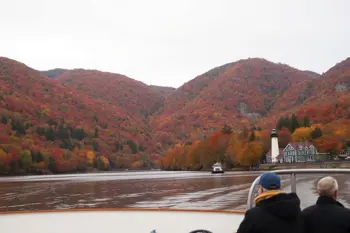
The Catskill Mountains generally appear as a dramatic backdrop from the Hudson rather than as an interior destination reached by the vessel. On the river, passengers may see wooded hillsides, the eastern Catskill escarpment, lighthouses, orchards, vineyards, villages, and stretches of undeveloped shoreline. Fall color comes from deciduous trees such as maples, oaks, and birches, producing changing combinations of red, orange, yellow, and gold as the season advances. 2
Kingston provides one of the clearest examples of the river-and-mountain perspective. Sightseeing cruises departing from the historic Rondout waterfront travel southward toward Hyde Park, with views of estates, villages, lighthouses, and the Catskill Mountains. The Rip Van Winkle II offers sheltered and open-deck viewing areas, while onboard commentary places visible landmarks in their historical setting. The vessel’s route is approximately 90 minutes according to the published tour description. 3
Cruise formats and departure patterns
Hudson River fall excursions fall into two broad categories: short sightseeing cruises and multiday small-ship journeys. Kingston-based trips are designed as relatively compact outings, while longer itineraries connect New York City and Albany with intermediate ports. Published American Cruise Lines schedules describe an eight-day, seven-night round trip from New York City, with ports including Albany, Kingston, West Point, Sleepy Hollow, and New York City. 4
One published 2026 itinerary for the American Ranger lists departures on October 2, October 9, October 16, and October 23. The same listing describes a starting fare of $8,675 per person based on double occupancy, with port fees excluded and itineraries potentially operating in reverse. These figures describe a particular published multiday program, not a general cost for all Hudson River cruises. Vessel, duration, inclusions, and departure date can materially change the overall expense. 1
When autumn color is most visible
Late September through October is the principal fall-foliage period identified for Hudson River itineraries, but the timing is not uniform across the Catskill region. Elevation, local weather, and the specific year influence when higher mountain slopes and lower river communities change color. A cruise scheduled early in the season may encounter more green at lower elevations, while a later sailing may find some leaves past peak or fallen. Official foliage updates are therefore more useful than relying on a fixed calendar date. 5
The river itself allows passengers to observe a broad geographic progression during a multiday journey. A route traveling between New York City and Albany passes from urban waterfronts into the Hudson Valley, where forested highlands and estates become more prominent. However, tidal conditions, rain, wind, visibility, and operating decisions can affect both the schedule and the appearance of the landscape on a particular sailing. Weather forecasts and operator notices remain relevant even during the traditional foliage window. 6
Ports, landmarks, and shore context
Shore stops add historical and cultural context to the autumn scenery. Sleepy Hollow is associated with Washington Irving’s “The Legend of Sleepy Hollow,” the Old Dutch Church, its historic burying ground, and the nearby lighthouse. West Point is connected with the United States Military Academy and its strategic role in American history. Hyde Park is known for grand estates, while Catskill is linked to Thomas Cole and the Hudson River School of landscape painting. 4
Kingston offers a particularly relevant shore option for visitors interested in maritime history. The Hudson River Maritime Museum documents the river’s working-waterway heritage and is located near the Rondout waterfront cruise area. The wider Hudson River Valley National Heritage Area contains nationally significant historic, cultural, and scenic resources, meaning a cruise itinerary can function as an introduction to destinations that require additional time to explore on land. 7
Access and transportation considerations
Transportation planning differs according to the embarkation point. Amtrak’s Empire Service and Adirondack routes provide rail access to Hudson Valley destinations including Hudson and Albany, which can support connections near northern cruise ports. Metro-North’s Hudson Line serves river communities such as Beacon and Poughkeepsie from New York City, but it does not directly reach every Catskills-area cruise departure. Kingston departures may therefore require a separate ground connection from a rail station or regional airport. 8
New York City departures offer a different logistical pattern because the city is both a major transportation hub and a major sightseeing destination. Published itineraries describe the transition from the Manhattan skyline and George Washington Bridge into the quieter Hudson Valley. Travelers combining a cruise with land exploration should account for transfer time, luggage handling, weather disruptions, and the distance between rail stations, hotels, waterfronts, and excursion sites. These practical details can influence the usable time at each destination. 9
Planning limits and conditions to evaluate
Fall weekends are a high-demand period for regional sightseeing, and the research indicates that popular Kingston- and Albany-area foliage cruises may reach capacity well before departure. Dates, vessel type, duration, departure location, accessibility arrangements, and reservation requirements should be checked directly with the operator. A short narrated cruise and an eight-day small-ship itinerary are not interchangeable experiences, particularly in time commitment, shore access, onboard facilities, and exposure to changing weather. 10
Outdoor conditions create additional uncertainty. The National Weather Service provides forecasts and warnings relevant to river travel, while foliage reports provide changing information about regional color progression. Scenic Hudson maintains information about parks and viewpoints that can complement a river itinerary, but land-based sites may have different opening schedules or transportation needs. The most reliable expectations are therefore specific rather than absolute: a cruise can provide broad seasonal views, but no sailing can guarantee peak color, clear skies, or identical scenery from year to year. 11
Sources
- USA River Cruises, Hudson River Fall Foliage Cruise: https://usarivercruises.com/cruise/hudson-river-independence-2-3/
- Outdoor Guide, Hudson River Fall Foliage Cruise: https://www.outdoorguide.com/1996709/hudson-river-fall-foliage-cruise-next-level-leaf/
- Happy To Visit, Hudson River Sightseeing Cruise from Kingston: https://happytovisit.com/hudson-river-sightseeing-cruise-from-kingston/
- USA River Cruises, Hudson River Cruise Destination Information: https://usarivercruises.com/destination/hudson-river-cruises/
- I LOVE NY, Fall Foliage Report: https://www.iloveny.com/seasonal/fall/foliage-report/
- National Weather Service: https://www.weather.gov/
- National Park Service, Hudson River Valley National Heritage Area: https://www.nps.gov/hurv/index.htm
- Amtrak, Empire Service: https://www.amtrak.com/routes/empire-service-train.html
- MTA Metro-North Railroad schedules: https://new.mta.info/agency/metro-north-railroad/schedules
- The Catskills tourism organization: https://www.visitcatskills.com/
- Scenic Hudson: https://www.scenichudson.org/
Authored by MyTrendSpot team