Warning signs of multiple sclerosis: A clinical overview of symptoms and evaluation
How multiple sclerosis symptoms begin
Multiple sclerosis is a chronic neurological disorder in which the immune system mistakenly attacks myelin, the protective covering around nerve fibers in the brain and spinal cord. Damage can also involve nerve fibers and cell bodies, creating plaques or lesions that disrupt communication within the central nervous system. Symptoms commonly begin between ages 20 and 40, although MS can occur in children and older adults. 1
There is no single symptom pattern that confirms MS. Some people experience one neurological change, while others notice several symptoms affecting vision, sensation, strength, coordination, or bladder control. In many cases, symptoms emerge over hours or days, last longer than 24 hours, and then improve partially or fully. Periods of worsening may alternate with stretches in which symptoms are less noticeable. 2
Vision changes and optic nerve symptoms
Vision problems are among the warning signs that can draw attention to MS. Optic neuritis, caused by inflammation of the optic nerve, may produce blurred or reduced vision in one eye. Pain or aching that becomes more noticeable when the eye moves is another reported feature. Some people describe colors as less vivid or vision as if viewed through a haze, although experiences vary. Sudden or painful vision loss requires prompt medical assessment because several eye and neurological conditions can cause it. 3
MS may also affect eye movement and coordination between the eyes, resulting in double vision or unusual visual tracking. These symptoms do not establish an MS diagnosis by themselves. Clinicians consider the duration, distribution, examination findings, and whether abnormalities have occurred at different times or in different parts of the central nervous system. MRI findings and other tests may be used alongside the clinical history. 4
Numbness, tingling, and electric-shock sensations
Numbness, tingling, or pins-and-needles sensations may occur in the face, arms, legs, or torso when MS-related lesions interfere with sensory pathways. The sensation may be intermittent or persistent and can affect one side of the body or several areas. An unusual sensory change is more concerning when it is new, clearly different from familiar positional tingling, and accompanied by weakness, balance difficulty, or another neurological change. 2
Lhermitte's sign is an electric-shock-like sensation that travels down the spine or into the limbs when the neck bends forward. It is associated with MS but is not exclusive to the condition, so it cannot independently confirm a diagnosis. Sensory symptoms can also arise from other neurological, metabolic, or musculoskeletal causes. Recording when the sensation began, how long it lasted, and what movements affected it can help organize a clinical evaluation. 4
Weakness, stiffness, and movement difficulties
Muscle weakness, spasms, tremors, stiffness, and clumsiness can occur when MS affects pathways controlling movement. Early functional clues may include difficulty walking, dragging a foot, dropping objects, needing unusual effort to climb stairs, or struggling with fine hand movements. Balance and coordination problems can make ordinary mobility less reliable. These changes may appear during a relapse and then improve, or they may gradually become more persistent. 2
Neurological deficits in MS can involve more than one body region and may recur with periods of remission or partial recovery. However, weakness that develops suddenly can also signal other urgent conditions, including stroke, particularly when paired with facial drooping, speech difficulty, or severe confusion. Persistent dizziness, facial weakness, or worsening walking difficulty should be medically assessed rather than attributed to MS without examination. 3
Fatigue, cognition, and emotional changes
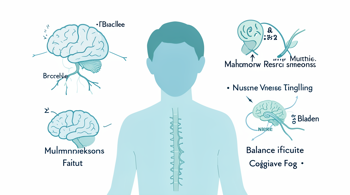
Fatigue is a frequently reported MS symptom and may be disproportionate to recent activity. It can interfere with work, walking, concentration, or routine household tasks. Cognitive changes may include difficulty focusing, slower processing, memory problems, or a subjective sense of brain fog. These symptoms can fluctuate and may become more noticeable when other neurological symptoms are active. Sleep disruption, mood disorders, medication effects, and other medical conditions can also contribute. 2
Depression and other emotional changes may accompany MS, either as responses to living with a chronic neurological disorder or as effects of disease-related changes in the nervous system. Mood symptoms should be considered clinically rather than treated as proof of MS. A pattern combining cognitive or emotional changes with objective sensory, visual, or motor symptoms deserves a comprehensive medical history and neurological examination. 1
Bladder, bowel, pain, and other neurological clues
Bladder symptoms can include urgency, frequency, or poor control, while bowel dysfunction may also occur when MS affects nerve pathways involved in pelvic function. Sexual problems, swallowing difficulty, dry mouth, and oral changes have been reported among the broad range of possible symptoms. Facial pain resembling an electric shock, known as trigeminal neuralgia, is another neurological symptom associated with MS. These problems can have many non-neurological explanations. 2
Pain, muscle spasms, and stiffness may affect the limbs or back, sometimes alongside weakness or altered sensation. Symptoms may be constant, episodic, or triggered by illness, heat, or exertion, but the available research emphasizes that MS affects individuals differently. A symptom diary can document onset, duration, body location, associated changes, and recovery. That information can help clinicians distinguish a possible relapse from unrelated or overlapping conditions. 1
When symptoms warrant medical evaluation
New neurological symptoms that persist beyond 24 hours, develop over hours or days, worsen before improving, or interfere with walking, vision, coordination, or daily function should be evaluated by a healthcare professional. Painful vision loss, progressive weakness, persistent dizziness, and substantial balance problems warrant particular attention. Emergency assessment is appropriate for sudden one-sided weakness, sudden vision loss, major speech changes, or severe confusion because these symptoms can indicate time-sensitive conditions other than MS. 3
MS diagnosis is not based on a symptom checklist. Clinicians use the history and neurological examination together with tests such as magnetic resonance imaging, seeking evidence of characteristic lesions separated in both location and time. Other conditions can mimic MS, so evaluation may require a differential diagnosis rather than immediate labeling. Early assessment can identify the cause of symptoms and, when MS is confirmed, support treatment and long-term management planning. 4
What the symptom pattern can and cannot show
MS has a variable course. A small number of people have mild symptoms with little disability, while others develop worsening neurological problems over time. Most people experience episodes that resolve fully or partially, followed by longer periods without noticeable symptoms. This variability means that symptom severity alone does not predict the eventual course, and the presence of one familiar warning sign does not establish that MS is present. 1
Several warning signs become more informative when considered as a pattern: a new visual disturbance in one eye, sensory changes lasting more than a day, weakness or clumsiness, balance impairment, bladder dysfunction, and cognitive or fatigue-related limitations. Even then, confirmation requires clinical assessment and appropriate testing. Maintaining a balanced view helps avoid both dismissing persistent neurological symptoms and assuming that every episode of tingling, fatigue, or dizziness represents MS. 4
Sources
- National Institute of Neurological Disorders and Stroke, Multiple Sclerosis (MS): https://www.ninds.nih.gov/health-information/disorders/multiple-sclerosis-ms
- Mass General Brigham, Early Signs of MS You Shouldn't Ignore: https://www.massgeneralbrigham.org/en/health-wellness/early-signs-ms
- Cleveland Clinic, Don't Ignore These Possible Early Signs of Multiple Sclerosis: https://health.clevelandclinic.org/early-signs-of-ms
- MSD Manual Professional Edition, Multiple Sclerosis (MS): https://www.msdmanuals.com/professional/neurologic-disorders/demyelinating-disorders/multiple-sclerosis-ms
Authored by MyTrendSpot team