Techniques to reduce anxiety daily: Evidence-Based Guidance for Routine Coping
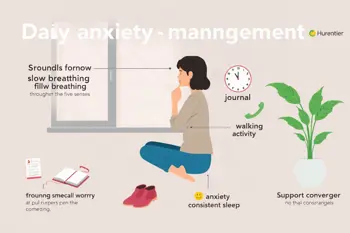
Techniques to reduce anxiety daily can include breathing exercises, grounding, structured worry time, cognitive behavioral strategies, physical activity, sleep routines, and supportive social contact. Research-based guidance emphasizes consistency and personalization because anxiety may involve physical symptoms, catastrophic thoughts, avoidance behaviors, or an ongoing baseline of tension.1
Match the technique to the anxiety pattern
Anxiety commonly appears through four overlapping patterns: physical symptoms such as a racing heart or tight chest, worried thoughts involving catastrophizing and “what if” questions, avoidance behaviors such as cancelling plans, and persistent background tension. Identifying the dominant pattern can make a daily response more precise. Physiological tools generally target bodily arousal, cognitive tools address interpretations, behavioral tools address avoidance, and lifestyle tools support the underlying baseline.1
- Physical arousal: try slower breathing and muscle relaxation.
- Racing thoughts: use grounding, mindfulness, or scheduled worry time.
- Avoidance: consider gradual, planned behavioral changes.
Use controlled breathing for physical arousal
Slow diaphragmatic breathing can encourage a relaxation response by slowing breathing and reducing bodily tension. The research summary describes controlled breathing as capable of lowering heart rate, blood pressure, and subjective anxiety within minutes, although individual responses differ. One practical format is box breathing: inhale through the nose for four counts, hold for four, exhale through the mouth for four, hold for four, and repeat four to six times.1
- Practice during a calm period so the method is familiar during stress.
- Keep the breathing gentle rather than forcing deep breaths.
- Stop if dizziness or discomfort develops and return to normal breathing.
Ground attention in the present moment
The 5-4-3-2-1 exercise is a mindfulness-based grounding method intended to interrupt spiraling thoughts by directing attention to current sensory information. It involves naming five things seen, four things felt, three things heard, two things smelled, and one thing tasted. The purpose is not perfect counting, but shifting attention away from imagined future threats or past events and toward present-moment experiences.6
- Use visible objects, physical sensations, nearby sounds, familiar smells, and a taste.
- Describe observations plainly instead of judging them.
- Repeat the sequence when attention returns to anxious predictions.
Apply CBT tools to worried thoughts and avoidance
Cognitive behavioral therapy addresses the relationship among anxious interpretations, physical symptoms, and avoidance behaviors. Its cognitive component involves identifying unhelpful thought patterns and developing more balanced responses, while its behavioral component changes avoidance and safety behaviors that can maintain anxiety. A Simply Psychology summary reports response rates of 60 to 80 percent for CBT in clinical trials across anxiety disorders, while also noting that trained therapist support can be important for severe presentations.4
- Write the anxious prediction and distinguish it from an established fact.
- Consider alternative explanations and evidence for and against the prediction.
- Approach manageable activities gradually rather than reinforcing broad avoidance.
Schedule worry instead of allowing it to fill the day
Worry postponement is a cognitive behavioral technique that assigns recurring concerns to a fixed daily period. During the day, a person can record a brief note and defer detailed attention until the scheduled time. Research summarized by Psychology Today reports that worry time has been associated with decreases in worry severity, anxiety, negative affect, and insomnia. The method does not require suppressing concerns; it limits when extended rumination receives attention.10
- Choose a consistent 15-minute period for writing and reviewing worries.
- Separate actionable problems from hypothetical scenarios.
- For actionable issues, record one realistic next step rather than repeatedly rehearsing the problem.
Build daily lifestyle supports
Regular physical activity can improve mental health and reduce short-term feelings of anxiety, while consistent sleep habits support emotional regulation. Poor or disrupted sleep can worsen anxiety, creating a two-way relationship between sleep and anxious symptoms. Reducing caffeine may also help people whose anxiety includes restlessness, rapid heartbeat, or difficulty sleeping. These measures are supportive habits, not guaranteed cures, and their effects vary across individuals.2
- Schedule movement in a form that is practical and sustainable.
- Keep wake and sleep times as consistent as circumstances allow.
- Observe whether caffeine changes physical anxiety or sleep quality.
Use mindfulness, structure, and social support
Mindfulness-based interventions may reduce anxiety by changing a person’s relationship to anxious thoughts rather than eliminating every anxious thought. A cited meta-analysis examined 209 studies involving 12,145 patients and found significant improvements across anxiety and depression measures, while later evidence also indicates that benefits vary by condition and practice. A simple routine, regular social connection, and planned pauses can add predictability and reduce the space available for unstructured rumination.8
- Set aside a short period for nonjudgmental attention to breathing or sensations.
- Use morning, midday, and evening anchors instead of pursuing a perfect schedule.
- Maintain contact with supportive people when stress becomes difficult to manage alone.
Recognize limits and seek appropriate assessment
Daily coping techniques are not substitutes for evaluation when anxiety is persistent, difficult to control, or interfering with work, relationships, sleep, or ordinary activities. Generalized anxiety disorder is characterized by excessive worry that is difficult to control and can disrupt daily functioning. A qualified healthcare professional can assess possible causes, discuss psychotherapy or other treatment options, and help determine whether symptoms reflect an anxiety disorder or another health concern.9
- Seek professional guidance when symptoms remain disruptive despite consistent self-management.
- Discuss severe physical symptoms with a healthcare professional rather than assuming anxiety is the cause.
- Use coping tools as part of an individualized plan when clinical support is recommended.
Sources
- Simply Psychology, “The Anxiety Coping Toolkit” and “CBT for Anxiety”
- Amen Clinics, “10 Anxiety Management Techniques to Calm Your Mind Naturally”
- Forbes, “5 Anxiety-Killing Habits To Live A Calmer Life”
- Simply Psychology, “CBT for Anxiety: The Complete Evidence-Based Guide”
- Science News Today, “10 Proven Strategies to Manage Anxiety in Daily Life”
- Cleveland Clinic, “5-4-3-2-1 Grounding for Anxiety”
- Mindforte Psychology Clinic, “How to Build a Simple Daily Routine to Reduce Anxiety”
- Simply Psychology, “Mindfulness for Anxiety”
- National Institute of Mental Health, “Generalized Anxiety Disorder”
- Psychology Today, “Scheduling Time to Worry”
Authored by MyTrendSpot team