How to find police auctions for heavy machinery in the United States: A source-verification guide
How police machinery auctions are organized
Police auctions are not operated through one nationwide marketplace. City police departments, county sheriffs, state agencies, impound contractors, and federal agencies may use different auction companies, schedules, registration rules, and payment policies. Location is therefore the first useful filter: an auction serving a particular state, metropolitan area, or ZIP code may reveal the responsible agency and the physical pickup location. 1 9
Heavy machinery can enter a public sale through several routes. It may be seized during an investigation, recovered and left unclaimed, transferred from an impound operation, or released as surplus after an agency replaces equipment. Those categories have different histories. A retired public-works machine may have service records, while seized or abandoned equipment can have unknown maintenance, missing keys, unresolved ownership questions, or long storage periods. 9 11
Official channels to check first
USA.gov identifies federal auction channels and explains that government sales may occur online, in person, or through mail-in bids. Its directory points to GSA Auctions, Treasury auctions, and U.S. Marshals Service auctions, among other government sales. GSA Auctions handles federal excess property and has listed equipment such as an Altec derrick digger, Oshkosh snow plows, a Case 1850K forklift, trailers, and other specialized assets. 1 2
State surplus offices can be more relevant than police-branded search results because transportation, construction, and public-works fleets are commonly disposed of through state programs. Texas Department of Public Safety publishes information about its surplus-property process, while New York's Office of General Services describes its state surplus program. Federal law-enforcement property may also appear through the U.S. Marshals Service asset-forfeiture program or Treasury sales, although machinery varies by auction. 12 13 14 15
Online marketplaces used by public agencies
Police departments and municipalities often place property on established public-auction platforms rather than maintaining a separate auction website. GovDeals lists vehicles and equipment from public agencies, Public Surplus organizes government property by category and location, and Municibid focuses on municipal and government surplus. PropertyRoom is a police-specific channel for property from law-enforcement agencies, including seized goods. The seller name on each lot remains more important than the platform name. 3 4 5 6
Search terms should describe the machine as well as its possible government function. Useful categories include construction equipment, excavators, loaders, bulldozers, backhoes, tractors, graders, forklifts, dump trucks, utility trucks, generators, compressors, trailers, and attachments. A listing from a police department or municipal impound operation should be separated from equipment retired by a parks department, road department, school district, or university because the service history and disposal reason may differ. 10 11
Distinguishing police property from government surplus
A genuine police-impound machine has passed through law-enforcement or municipal custody. It may have been seized, recovered, abandoned, or left unclaimed. One documented example involved a Connecticut police department auctioning a Kioti tractor with a loader and backhoe after it became unclaimed police property. Such examples are unusual and less predictable than routine fleet auctions, so the listing's agency description should be examined carefully. 11
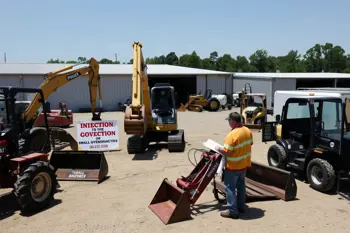
General government surplus is a broader and often more consistent category. Agencies sell equipment because of age, fleet standardization, budget timing, changing project requirements, or repair costs. Typical inventories can include skid steers, backhoes, wheel loaders, excavators, dozers, trenchers, forklifts, dump trucks, air compressors, generators, and attachments such as buckets, forks, breakers, snowplows, brush cutters, and pavement equipment. 10
Evaluating a machinery listing
Most government and police auction listings require an as-is assessment. The description and photographs should be compared with the machine's identification plate, serial number, hour meter, attachments, visible hydraulic components, tires or tracks, controls, and signs of storage damage. Inspection arrangements vary, and some sales combine online bidding with an in-person preview. A short inspection window makes advance questions about operating condition, keys, batteries, and access especially important. 9 10
Ownership documentation deserves separate review. The listing should identify whether the item is seized, forfeited, abandoned, unclaimed, or surplus, and should state what title, bill of sale, lien information, or registration documents are supplied. A seized asset may require different paperwork from a retired municipal machine. If the description does not resolve ownership or transfer questions, the uncertainty should be treated as a material bidding risk rather than inferred away from photographs. 9 12 13
Payment, transportation, and ongoing risk
The winning bid is not necessarily the complete acquisition cost. Each marketplace or selling agency sets its own buyer premium, taxes, payment deadline, accepted payment methods, storage rules, and pickup requirements. Public-auction guidance emphasizes reading the sale terms before bidding. Heavy equipment frequently requires specialized hauling, loading arrangements, permits, fuel planning, or a transport contractor, and the buyer is commonly responsible for removal from the stated location. 1 10
Maintenance risk continues after collection. A machine that appears complete may need batteries, fluids, tires, tracks, hydraulic repairs, electrical work, safety equipment, or manufacturer-specific parts. Public-agency service can involve extensive idle time, hard use, or equipment removal, while long-term impound storage can create separate deterioration concerns. Heavy-equipment specialists such as IronPlanet and Ritchie Bros. provide machinery-focused auction channels, but a public-agency listing should still be verified by its actual seller and pickup site. 7 8 9
Sources
- USA.gov, Government auctions of seized and surplus property
- GSA Auctions
- GovDeals
- Public Surplus
- Municibid
- PropertyRoom
- IronPlanet
- Ritchie Bros.
- Government Auctions Blog, Police Auctions: How to Buy Without Guesswork
- Government Auctions Blog, Surplus Construction Equipment Auctions Explained
- Frugal Info, Police Impound Tractors: Auction Opportunities
- U.S. Marshals Service, Asset Forfeiture
- U.S. Department of the Treasury, Treasury Auctions
- Texas Department of Public Safety, Surplus Property
- New York State Office of General Services, State Surplus Property
Authored by MyTrendSpot team