HVAC Technician pay rates by state: A comprehensive analysis of national compensation trends for 2026
The landscape of compensation for Heating, Air Conditioning, and Refrigeration Mechanics and Installers in 2026 is defined by a wide spectrum of earnings, with a national median annual wage of $61,010 1. As industries face a shortage of qualified personnel, estimating fair market compensation requires an analysis of regional economic factors, state-specific licensing requirements, and the technical specializations held by individual workers 5, 6. This report provides an overview of current wage benchmarks, utilizing data from the Bureau of Labor Statistics (BLS) Occupational Employment and Wage Statistics (OEWS) program to illustrate how geography and experience correlate with pay 2, 7.
National Wage Distribution and Percentile Benchmarks
Understanding the median salary is only the starting point for evaluating the financial reality of the trade. While the national median sits at $61,010, the distribution of wages is notably right-skewed, meaning that top-tier technicians often command significantly higher pay than the national midpoint 1, 9. Data indicates that the bottom 10 percent of the workforce earns approximately $40,050 annually, typically reflecting entry-level apprentices and helpers 4, 9. Conversely, the top 10 percent of earners, often comprising control specialists and refrigeration experts, exceed $95,210 per year 4, 9.
| Percentile | Annual Salary |
|---|---|
| 10th Percentile | $40,050 |
| 25th Percentile | $48,360 |
| Median (50th) | $61,010 |
| 75th Percentile | $77,060 |
| 90th Percentile | $95,210 |
This wide salary range, spanning over $55,000 between the lowest and highest deciles, highlights the significant influence of experience and specialization 6, 7. Compensation is rarely static, with hourly rates having shown a consistent upward trend since 2019, driven by high demand for maintenance in both commercial and residential sectors 8. The mean annual wage currently sits at $64,780, suggesting that advanced roles and overtime opportunities contribute substantially to the higher end of the pay scale 9.
Regional Disparities in Technician Pay
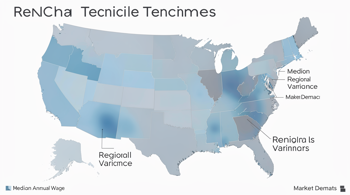
Geography acts as one of the most powerful variables in determining HVAC technician pay. The spread between the highest-paying states and the national median often reflects the local cost of living and the intensity of labor demand in that specific climate 2, 6. Jurisdictions such as the District of Columbia and Alaska consistently report median annual wages well above the $80,000 mark, significantly outpacing the national average 1, 6. States in the Northeast and Pacific Northwest also feature prominently in the upper tier of compensation rankings 1, 5.
For instance, states such as Massachusetts, Illinois, and Connecticut frequently report median salaries exceeding $76,000, benefitting from rigorous state licensing standards and higher concentration of commercial, climate-controlled infrastructure 1, 4. Conversely, states with lower costs of living may exhibit median salaries closer to the $45,000 to $50,000 range 2. This divergence underscores the necessity of analyzing regional market data rather than relying solely on national averages when assessing vocational earning potential 1.
Impact of Certification on Earning Potential
Beyond geographical location, professional credentials represent a primary driver for wage advancement. The industry recognizes several certifications that correlate with higher compensation, including the EPA 608 Universal certification, NATE (North American Technician Excellence) credentials, and HVAC Excellence master-level designations 4, 6. These qualifications signal to employers that a technician possesses the specialized knowledge required to handle complex industrial systems, thereby justifying a higher base pay 4.
- Entry-Level Installers: Typically command the lowest base rate while gaining foundational skills.
- EPA 608 Certified Technicians: Often see an immediate bump in earnings, with historical data suggesting an potential increase of roughly $18,000 over entry-level wages 4.
- NATE Senior/Master Technicians: These professionals often reach the upper echelon of the salary spectrum, frequently clearing $79,800 or more annually 4.
The financial return on these certifications remains high relative to the cost of testing, which often remains under $150 per examination 4. Employers place significant value on these documents as they mitigate risk and ensure compliance with federal and state environmental standards 4.
Specialization as a Financial Lever
The type of equipment and systems an HVAC technician specializes in plays a crucial role in wage determination. Technicians who focus on residential HVAC installation often face a different pay structure than those performing maintenance on complex Building Management Systems (BMS) or data center cooling infrastructure 6, 8. Controls and BMS specialists, in particular, frequently see earnings in the $85,000 to $90,000 range due to the sophisticated technical requirements of their role 6.
Specialized fields require ongoing training and familiarity with automated digital systems, which are increasingly replacing traditional mechanical configurations 8. As the industry pivots toward energy efficiency and smart building technologies, the demand for techs capable of programming and maintaining these systems has created a sub-market of labor where compensation is driven by technical proficiency rather than simple seniority 8.
Workplace Environment and Labor Trends
The nature of the workplace also influences pay, with commercial and industrial environments typically offering higher base salaries than residential service roles 2, 8. Commercial work frequently involves large-scale refrigeration or central plant maintenance, which requires a broader range of diagnostic tools and safety training 8. Furthermore, the current labor shortage of approximately 110,000 technicians across the U.S. has prompted many employers to incorporate retention bonuses and competitive pay adjustments to maintain their workforce 6.
This tight labor market has particularly impacted metropolitan areas, where the competition for skilled labor is fierce. In these high-demand markets, employers are frequently forced to exceed local median salary benchmarks to attract and retain talent 1. The aging demographic of the current workforce ensures that this trend toward higher starting and mid-career wages is likely to persist as veteran technicians retire and the influx of new, qualified entrants remains constrained 6.
Risk and Regulatory Considerations
While the salary ceiling for the industry is high, prospective technicians must also consider the realities of the field, including the physical nature of the work, the requirement for travel, and the necessity of maintaining updated certifications 2. Regulatory oversight, such as state-mandated licensing, can create barriers to entry that influence the local supply of labor and, consequently, local pay rates 5, 10. Furthermore, the cyclical nature of HVAC services means that technicians in certain climates may experience seasonal fluctuations in their hours, impacting total annual compensation unless they are employed by firms that focus on year-round commercial maintenance 8.
Sources
- HireAligned: HVAC technician salary by state (2026)
- Housecall Pro: HVAC Technician Salary Guide
- World Population Review: HVAC Salary by State 2026
- GlobalCybers: HVAC Technician Salary 2026, By State & Certification
- HVACJobs.IO: HVAC Technician Salary by State (2026)
- PathScorer: Heating, Air Conditioning, and Refrigeration Mechanics and Installer Salary (2026)
- SalaryByState.com: HVAC Technician Salary 2026
- HVACTechSalary.com: HVAC Technician Hourly Pay (2026)
- SubcontractorHub: HVAC Technician Salary in 2026
- CloseCrew: HVAC Technician Salary Guide for 2026
Authored by MyTrendSpot team