How to Perform CPR Safely: A Comprehensive Clinical Overview of Emergency Life-Saving Procedures
Understanding the Mechanics of Cardiac Arrest
Cardiac arrest is an abrupt, often warning-free medical emergency where the heart ceases its effective pumping action, leading to a sudden loss of responsiveness and breathing 2. Approximately 350,000 cardiac arrests occur outside of hospitals annually in the United States, yet the survival rate remains near 10% 2. When a heart stops, blood circulation to vital organs, particularly the brain, is interrupted, necessitating immediate intervention 1. Cardiopulmonary resuscitation (CPR) serves as a vital bridge, manually sustaining a baseline level of blood flow until professional emergency responders arrive 3.
Witnesses of a collapse may observe an individual who has become unconscious or is only gasping for air intermittently 3. Experts emphasize that hesitation often stems from fear or uncertainty regarding the appropriate response, yet the threshold for initiating CPR is intentionally low 2. Research indicates that early bystander intervention can effectively double or even triple an individual's survival chances 3. Despite this, only about 42% of out-of-hospital cardiac arrest victims receive bystander CPR, a statistic that underscores the importance of public awareness and education 6.
Initial Site Assessment and Safety Protocols
Before any physical intervention, the rescuer must conduct a brief but critical assessment of the immediate environment to ensure personal safety 3. This involves scanning for hazards such as active traffic, fire, or unstable structures that could pose a risk to both the rescuer and the patient 3. Once the area is deemed secure, the focus shifts to checking the patient for responsiveness by tapping their shoulders firmly and shouting, "Are you OK?" 3. This "shout-tap-shout" method is a standard technique for identifying unresponsiveness without delaying emergency assistance 9.
If the person does not respond and is either not breathing or exhibiting only occasional gasping, they require immediate help 3. The next mandatory step is to call 911 (or local emergency services) or direct a specific bystander to do so and secure an automated external defibrillator (AED) if one is available 3. If a bystander is present, assigning them the task of fetching an AED is vital, as these devices provide specific audio or visual prompts that guide the user through the resuscitation process 4.
Hands-Only CPR: Technique for Untrained Rescuers
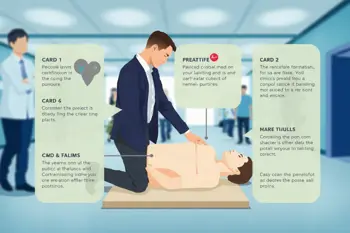
For individuals without formal certification, Hands-Only CPR is the recommended approach for teens and adults in cardiac arrest 1. This method removes the complexity of rescue breaths, focusing entirely on high-quality chest compressions to maintain cardiac output 7. The rescuer should place the person on their back on a firm, flat surface and position themselves directly over the chest 8. The proper hand placement involves placing the heel of one hand in the center of the chest, then placing the other hand on top, interlocking the fingers 4.
Effective compressions require the rescuer to push hard and fast, reaching a depth of at least 2 inches (5 cm) but generally no more than 2.4 inches 8. The cadence for these compressions should be 100 to 120 per minute, which is the necessary rate to simulate cardiac activity 1. Critically, the rescuer must allow the chest to fully return to its normal position after each push to permit heart refilling, avoiding the common mistake of leaning on the chest between compressions 8. This consistent application of force is the cornerstone of effective Hands-Only CPR 5.
Advanced Procedures: Integration of Rescue Breaths
Trained rescuers may opt to include rescue breaths in the resuscitation sequence to provide additional oxygenation, especially in cases of drowning or breathing-related emergencies 4. The standard ratio for trained individuals is 30 chest compressions followed by 2 rescue breaths 3. To perform rescue breaths correctly, the rescuer must open the airway using a head-tilt, chin-lift maneuver, pinch the nose, and deliver a breath just sufficient to make the chest rise, avoiding excessive ventilation which could push air into the stomach 4.
If a rescuer is not trained in rescue breaths, or if they are uncomfortable providing them, they should continue with continuous, uninterrupted chest compressions 4. The focus remains on minimizing interruptions, as every pause in compressions decreases blood flow to the brain 4. Minimizing switch-over time between rescuers to less than 10 seconds is essential for maintaining a high quality of care until paramedics arrive 10.
Utilization of Automated External Defibrillators
An AED should be deployed as quickly as possible if one is accessible within the immediate vicinity 5. These devices are designed to analyze the heart's rhythm and determine if an electrical shock is required to reset a chaotic rhythm 4. Once the device is turned on, it provides explicit voice prompts that dictate every step, making it highly effective even for those with minimal training 4. The AED may instruct the user to pause compressions during rhythm analysis or shock delivery, but otherwise, manual CPR must continue 5.
It is important to note that CPR itself does not restore a normal heart rhythm, but it keeps the heart in a more receptive state for the electrical intervention provided by the AED 7. Bystanders should not fear using an AED; the technology is designed to be fail-safe, preventing the delivery of a shock if the patient's heart rhythm does not require it 5.
Ongoing Maintenance and Termination Criteria
The commitment to perform CPR is significant, as it should be maintained until specific indicators suggest the rescuer can stop 5. These conditions include the patient showing clear signs of life, such as regular breathing or purposeful movement, the arrival of professional emergency medical personnel who take over, or the arrival of an AED that interrupts for rhythm analysis 5. Rescuers may also cease efforts if they are physically unable to continue due to extreme exhaustion 5.
| Indicator | Action |
|---|---|
| Scene Safety | Verify before approach |
| Responsiveness | Shout-tap-shout method |
| Emergency Alert | Call 911 immediately |
| Compression Rate | 100–120 per minute |
| Compression Depth | At least 2 inches |
It is crucial for bystanders to understand that their efforts are often the only lifeline available in the minutes before paramedics arrive. While the prospect of performing these procedures can be daunting, evidence indicates that any attempt at life-saving action is superior to inaction 7. By focusing on the fundamentals-safety, calling for help, and effective chest compressions-untrained rescuers can play a decisive role in increasing out-of-hospital survival rates 4.
Sources
- Cleveland Clinic (my.clevelandclinic.org)
- American Heart Association (heart.org)
- Medical News Today (medicalnewstoday.com)
- Resuscitation Council UK (resus.org.uk)
- Acibadem Hospitals Group (acibademinternational.com)
- Harvard Health Publishing (health.harvard.edu)
- Heart Foundation Australia (heartfoundation.org.au)
- MedlinePlus (medlineplus.gov)
- Franciscan Health (franciscanhealth.org)
- Safety Training Pros (safetytrainingpros.com)
Authored by MyTrendSpot team