Ways to manage joint stiffness at home: An evidence-informed practical guide
Managing joint stiffness at home commonly involves gentle movement, practical comfort measures, and adjustments that reduce strain during daily activities. Research-based guidance supports low-impact exercise and range-of-motion work, while persistent swelling, redness, loss of function, or prolonged morning stiffness can require medical evaluation. 1
Begin with gentle movement
Regular movement can help maintain joint function and reduce discomfort, particularly after long periods of sitting or inactivity. Low-impact activities such as walking, swimming, cycling, and controlled mobility exercises are generally described as joint-friendly because they keep the body active without placing the same stress on joints as high-impact activity. Strengthening muscles around a joint can also improve support, balance, and everyday function, but activity should be increased gradually rather than forced. 2
A short home routine can focus on comfortable, active motion. Healthline describes a beginner-friendly, low-impact sequence lasting about 15 minutes and using a chair for support. Options include cat-cow movements for spinal mobility, knees-to-chest movements for the hips and lower back, lunges for hip flexibility, seated knee extensions for the knees, and trunk rotation. Movements should be slow and controlled, stopping if sharp pain develops. 3
Use range-of-motion exercises
Range-of-motion exercises move a joint through its available movement and may help preserve flexibility when arthritis or inactivity causes stiffness. Harvard Health describes gentle hand, shoulder, knee, and hip exercises that can be performed at home, including repeated finger bends, thumb movements, slow arm raises, seated leg extensions, and controlled hip motion. The purpose is not to force a joint beyond its capacity, but to maintain usable movement through regular, careful practice. 4
Morning stiffness or stiffness after sitting may respond to a gradual sequence rather than an intensive stretch. The Arthritis Foundation notes that holding a joint still to protect it can make movement more difficult over time, while slow range-of-motion work can help prevent loss of motion. Active mobility may be preferable to aggressive stretching when movement is limited, because forcing an uncomfortable position can increase guarding and discomfort. 5
Choose heat or cold based on symptoms
Heat and cold serve different purposes in home symptom management. Warm baths, warm compresses, or a heating pad may relax surrounding muscles and make a stiff joint easier to move, especially when stiffness is associated with inactivity. Cold packs are generally used when swelling or inflammation becomes more prominent, including after activity or during a flare. A cloth barrier can protect the skin, and treatment should remain comfortable rather than extreme. 6
The pattern of symptoms helps determine which approach is more appropriate. A joint that feels tight and improves with light movement may respond better to warmth followed by mobility work. A joint that is hot, swollen, or more irritated after activity may require reduced loading and cooling instead. Home measures address symptoms but do not identify the cause. Inflammatory diseases such as rheumatoid arthritis may require systemic treatment to prevent joint damage, so repeated flares should not be managed indefinitely without clinical advice. 7
Reduce mechanical stress at home
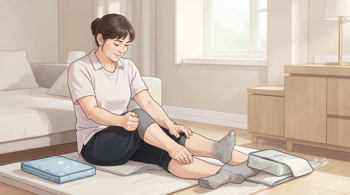
Joint protection involves changing how tasks are performed so that painful joints carry less force. Ergonomic tools, shoe inserts, splints, and other assistive devices may reduce mechanical stress, depending on the joint and the activity. Practical adjustments can include using larger handles, distributing loads between both hands, avoiding prolonged gripping, and taking short movement breaks during desk work. These changes are intended to preserve function while reducing repeated irritation. 8
Weight management is another consideration when stiffness affects weight-bearing joints such as the knees or hips. Guidance from the Mayo Clinic and CDC identifies maintaining a healthy weight as a way to reduce pressure on these joints and support arthritis management. This is a longer-term factor rather than an immediate remedy, and it should be considered alongside movement, muscle support, sleep, and treatment of any underlying condition. 9
Support joint health through daily habits
Hydration is commonly included in joint-care guidance because synovial fluid helps joints move smoothly. AARP describes synovial fluid as a gel-like substance that lubricates the space between bones, while maintaining adequate fluid intake is presented as one part of general joint health. Hydration alone does not correct arthritis or an injury, but regular drinking habits can complement movement and other measures. Dietary patterns emphasizing fruits, vegetables, whole grains, and sources of omega-3 fatty acids are also discussed in relation to inflammation and joint health. 10
Mind-body activities such as yoga and Tai Chi may combine gentle mobility, balance, and muscle control. Harvard Health identifies Tai Chi as an activity associated with improved balance and joint range of motion, while gentle yoga routines may help address stiffness through stretching. These activities still require modification when balance is limited, a joint is acutely swollen, or a position causes pain. Consistency is generally more useful than intensity, and unsupported poses should be avoided when stability is uncertain. 11
Know the limits of self-care
Stiffness has many possible causes, including osteoarthritis, injury, overuse, gout, bursitis, rheumatoid arthritis, and other conditions. The timing and pattern of symptoms can provide clues, but they cannot establish a diagnosis at home. Stiffness that persists, repeatedly interferes with daily activities, or is accompanied by swelling, redness, heat, or reduced function deserves assessment by a healthcare professional. Morning stiffness lasting more than around 30 minutes can also warrant discussion, particularly when it is persistent. 12
Exercise should be stopped or modified when it produces sharp pain, increasing swelling, instability, or symptoms that last beyond the activity. A clinician or physical therapist can help match exercises, splints, topical treatments, or over-the-counter pain relievers to the affected joint and medical history. Capsaicin or menthol products may provide temporary topical relief for some people, but they do not treat the underlying cause and may not be appropriate for every skin or health condition. 13
Sources
- Healthline, “Stretches for Joint Relief: Simple Exercises to Ease Stiffness”
- Acibadem Hospitals Group, “Can Exercise Help Stiff Joints? Safe Ways to Improve Mobility”
- Healthline, “Stretches for Joint Relief: Simple Exercises to Ease Stiffness”
- Harvard Health, “Range-of-motion exercises for arthritis”
- Arthritis Foundation, “Tips to Ease Joint Pain”
- Cleveland Clinic, “Should You Use Ice or Heat for Pain Relief?”
- Arthritis Foundation, “Tips to Ease Joint Pain”
- Johns Hopkins Medicine, “Arthritis Joint Protection Techniques”
- Mayo Clinic and CDC, osteoarthritis and arthritis management guidance
- AARP, “7 Ways to Keep Your Joints Lubricated as You Age”
- Harvard Health, “The Health Benefits of Tai Chi”
- Zoom Health, “Joint Pain and Stiffness: Tips for Natural Relief”
- Medical News Today, “Natural Remedies for Joint Pain”
Authored by MyTrendSpot team