7-day Ireland self-drive vacation packages: A practical research guide
7-day Ireland self-drive vacation packages typically combine a rental car, arranged accommodation, and a planned route through selected regions rather than the entire island. A one-week journey commonly links Dublin with Galway, the Cliffs of Moher, Killarney, the Ring of Kerry, or other southern and western destinations, while leaving travelers independent on the road. 1
What a seven-day package usually contains
Self-drive packages are designed to provide the independence of a private road trip alongside structured planning. Common components include car rental, prebooked accommodation, route instructions, maps, and access to a tour helpline or virtual guide. Providers may arrange stays in guesthouses, hotels, historic inns, boutique properties, or castle accommodations, with the exact category depending on the selected itinerary and travel preferences. 1
Customization is a defining feature of this travel format. Itineraries may be adjusted around accommodation standards, car type, activities, route preferences, and the number of nights spent in each location. Some providers describe their arrangements as tailored independent vacations, while others present fixed route themes such as coast-to-coast travel, greenways, or scenic regional circuits. 2
How seven days affects route planning
A week is generally long enough for a focused introduction to Ireland, but it is not well suited to covering every major region. One published seven-day route begins and ends in Dublin and concentrates on the southern half of the Republic of Ireland, including Glendalough, Cork, Killarney, the Ring of Kerry, the Dingle Peninsula, and the Cliffs of Moher. 3
Another commonly described route moves from Dublin through Cashel, Blarney, Kinsale, West Cork, Kerry, Clare, Galway, and Connemara. This is characterized as a fast-paced trip, while slower versions use fewer bases and allow more time in each area. The hub-and-spoke approach, with two or three accommodation bases, can reduce repeated packing and limit the pressure created by long daily transfers. 4
Regional itineraries and principal sights
Southern and western circuits are particularly common because they combine historic sites, coastal scenery, and established visitor towns within a single week. Possible stops include Dublin’s museums and historic areas, the Rock of Cashel, Cork or Kinsale, Killarney National Park, the Ring of Kerry, the Dingle Peninsula, Galway, and the Cliffs of Moher. These routes emphasize variety without attempting a complete island tour. 3
The Wild Atlantic Way can also form the basis of a self-drive package, although its full coastal route extends about 2,500 kilometers from Donegal to West Cork. A seven-day version therefore represents a selected section, not a comprehensive drive of the entire route. Northern extensions may add Sligo, Donegal, the Causeway Coastal Route, Belfast, and Brú na Bóinne, but those locations are more commonly associated with longer itineraries. 5
Driving conditions and travel time
Ireland drives on the left, a factor that can require adjustment for visitors accustomed to right-hand traffic. Rural driving may involve narrow lanes, winding roads, stone walls, roundabouts, and limited passing opportunities. Scenic routes often take longer than their map distance suggests, so a package itinerary should be assessed by realistic driving time rather than by kilometers alone. 6
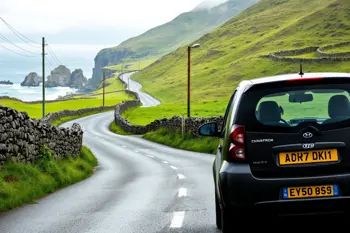
The road itself is part of the experience, but it can also create logistical friction. Coastal viewpoints, villages, beaches, ruins, and local recommendations may encourage unplanned stops, making tightly scheduled days difficult to maintain. A route that appears geographically compact can still feel demanding when it combines slow rural roads with multiple attractions, especially around peninsulas and mountain areas. 5
Rental eligibility and toll responsibilities
Rental arrangements generally require a valid driving license, passport, payment card, and compliance with the rental company’s minimum-age, insurance, and documentation conditions. Travelers should examine whether the vehicle has manual or automatic transmission and should clarify the treatment of insurance excess, additional drivers, fuel, parking, attraction tickets, and optional excursions before evaluating the overall package cost. 8
Ireland has toll roads, including the barrier-free M50 toll near Dublin. Because the M50 does not operate like a conventional toll plaza, the driver should confirm whether the rental company registers and bills the charge or whether another payment process applies. Toll arrangements, insurance conditions, and vehicle collection procedures can materially affect the practical cost and administration of a self-drive trip. 7
Seasonality, accommodation, and package comparison
Published package schedules commonly show April through October as the operating period for several Ireland self-drive itineraries. Examples include eight-day Scenic Ireland, ten-day Classic Ireland, fourteen-day Complete Ireland, and seventeen-day Grand Tour programs. These examples indicate that seven days is one point within a wider range of route lengths, rather than the standard duration for every provider or region. 1
Accommodation can range from three-star retreats and traditional guesthouses to four-star hotels, boutique properties, manors, and castle stays. Comparison should focus on the number of nights, location of each base, rental-car insurance, transmission, mileage conditions, airport arrangements, and excluded expenses. Flights may also be separate, and Shannon Airport can be more geographically convenient than Dublin for itineraries focused on Galway, Clare, Kerry, or the west coast. 2
What to verify before selecting an itinerary
The main trade-off is flexibility versus advance coordination. A planned package can reduce the burden of researching routes and arranging accommodation, but fixed reservations may make it harder to remain longer in a town or change direction because of weather. Travelers should check cancellation terms, support availability, driving distances, check-in times, and whether the itinerary assumes arrival early enough to complete the first day’s activities. 2
A suitable seven-day plan should prioritize a coherent region and protect time for driving conditions, meals, walking, and unexpected stops. The most useful comparison is not simply the number of attractions listed, but how the route distributes overnight stays and whether the package reflects the traveler’s driving confidence. Official guidance and rental documentation should be reviewed alongside the itinerary because road rules, toll handling, insurance, and eligibility remain the traveler’s responsibility. 6
Sources
- Nordic Visitor, Ireland self-drive tours, https://www.nordicvisitor.com/ireland/self-drive-tours/
- Overland Ireland Tours, Ireland self-drive tours and road trips, https://overlandirelandtours.com/self-drive-tours/
- Avrex Travel, Ireland self-drive tour itinerary, https://avrextravel.com/ireland-road-trip-itinerary/
- The Irish Road Trip, seven days in Ireland itinerary, https://www.theirishroadtrip.com/one-week-in-ireland/
- My Ireland Tour, seven days in Ireland travel guide, https://www.myirelandtour.com/travelguide/advice/7-days-in-ireland.php
- Tourism Ireland, driving in Ireland, https://www.ireland.com/en-us/plan-your-trip/travel-information/driving-in-ireland/
- Transport Infrastructure Ireland, tolling information, https://www.tii.ie/en/roads-tolling/tolling-information/
- Lynott Tours, customized independent Ireland vacations, https://www.lynotttours.com/ireland/self-drive.html
Authored by MyTrendSpot team