Ways to manage arthritis at home: An evidence-based guide to daily symptom control
Start with movement that the joints can tolerate
Regular physical activity is among the most consistently supported approaches for arthritis management. It can strengthen muscles supporting the joints, improve flexibility, balance and mood, and reduce pain and fatigue. Common low-impact options include walking, cycling, swimming, water aerobics and yoga. The Arthritis Foundation cites weekly guidance of 150 to 300 minutes of moderate aerobic activity plus two strength-training sessions, although people who are new to exercise may need a slower progression. 19
Starting gradually is important because pain and reduced muscle strength can make activity difficult. The Arthritis Foundation advises small increases in intensity or duration rather than pushing too hard too soon, and notes that fitness gains may take six to eight weeks to become noticeable. A physical therapist can adapt exercises when stiffness or pain limits movement. Gentle range-of-motion work can also help preserve mobility in the hands, shoulders and knees when performed within a comfortable range. 96
Use heat, cold and planned recovery
Heat and cold serve different purposes in home symptom management. Moist heat can relax muscles and ease stiffness, while cold can numb sharper pain and reduce swelling or inflammation. The Arthritis Foundation identifies these approaches as nondrug options, but the appropriate choice depends on the symptom pattern and the individual joint. Applying either method for a limited period and protecting the skin from direct extreme temperatures are practical safety considerations when using packs at home. 31
Rest does not necessarily mean keeping a painful joint completely still. Arthritis guidance recommends balancing activity with active recovery, because prolonged avoidance can make movement more difficult over time. Pacing involves alternating demanding or repetitive tasks with lighter activities and taking breaks before fatigue becomes overwhelming. This approach can conserve energy while reducing repeated stress on weakened or painful joints. Persistent flares, pain that remains difficult to control, or symptoms linked to inflammatory arthritis warrant discussion with a clinician rather than relying only on home measures. 135
Protect joints during ordinary household tasks
Joint protection changes how a task is performed instead of requiring complete avoidance of activity. Arthritis Society Canada recommends positioning joints to reduce strain, keeping heavy items near waist height, and avoiding repeated lifting up and down stairs when possible. Raising seat levels can reduce stress on the hips and knees. These modifications matter because painful movement in one joint can alter posture or walking mechanics and place additional stress on nearby areas. 53
Assistive tools can reduce force on the hands, hips and knees during daily routines. Examples identified in arthritis self-management guidance include jar and tap openers, enlarged utensil grips, carts for carrying objects, reachers and canes. Long-handled tools may reduce bending, while a physical or occupational therapist can help determine whether an aid is being used correctly. A device should support safer movement, not replace medical assessment when pain, weakness or loss of function is progressing. 52
Support joint health through food and weight management
A mostly plant-based eating pattern, including Mediterranean, vegetarian or vegan approaches, has been associated with reductions in chronic pain in a 2021 meta-analysis of seven randomized controlled trials summarized by the Arthritis Foundation. Results were not uniformly positive for every dietary pattern or every person, so diet should be viewed as one part of a broader management plan. Foods commonly emphasized in the supplied research include fruits, vegetables, lean proteins, fish, nuts and other sources of omega-3 fatty acids. 12
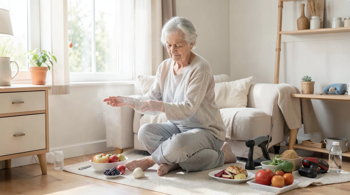
Weight management is particularly relevant when osteoarthritis affects weight-bearing joints. The Arthritis Foundation reports that each pound lost results in four pounds less pressure on the knees and other weight-bearing joints, and cites research in which losing 10% to 20% of body weight improved pain, function and quality of life among older adults with obesity and osteoarthritis. These findings apply most directly to osteoarthritis and should not be generalized to every arthritis type. 7
Address stiffness, sleep and pain perception
Gentle range-of-motion exercises can be performed at home to maintain flexibility. Harvard Health describes hand movements that repeatedly open and close the fingers, shoulder movements that slowly raise an arm overhead, and seated knee movements. The exercises should be gentle, and the supplied guidance states they can be performed even when joints are painful as long as movement remains controlled. Sudden force, repeated aggravation or worsening symptoms are reasons to seek professional exercise instruction. 6
Sleep and mental wellness are also part of self-management because persistent pain can affect mood, activity and daily function. The Arthritis Foundation describes meditation and other complementary approaches as options that may help people manage pain without making pain the central focus of life. Arthritis Society Canada likewise includes sleep habits and mental wellness among daily self-management areas. Tai chi and similar mind-body activities may combine gentle movement, balance practice and stress management, but they do not replace treatment for active inflammatory disease. 159
Match home care to the type of arthritis
Arthritis is not a single condition, and home strategies do not have identical roles across diagnoses. Osteoarthritis involves degenerative joint changes, while rheumatoid arthritis and other inflammatory diseases require systemic treatment to control inflammation that can damage or destroy joints. Home exercise, pacing and symptom relief may complement prescribed care, but they should not be treated as substitutes for disease-modifying management when inflammation is the underlying problem. Diagnosis is therefore important before building a long-term routine. 32
Topical products, over-the-counter pain relievers, splints and therapeutic exercises may be considered for some forms of joint pain, but each has limitations and potential risks. Topical options can contain ingredients such as capsaicin, menthol, camphor, lidocaine or topical nonsteroidal anti-inflammatory drugs, and their effects differ depending on whether pain is inflammatory, superficial or nerve-related. Medication safety depends on health history and other medicines. Professional advice is appropriate when pain is persistent, a flare repeatedly interrupts daily activity, or home measures no longer maintain function. 43
Sources
- Arthritis Foundation, Natural Relief for Arthritis Pain
- Cleveland Clinic, Osteoarthritis Self-Care Tips
- Arthritis Foundation, Tips to Ease Joint Pain
- Arthritis Foundation, Fight Arthritis Pain Without Pills
- Arthritis Society Canada, Inflammatory Arthritis Self-Management
- Harvard Health, Range-of-Motion Exercises for Arthritis
- Arthritis Foundation, Treatments for Osteoarthritis
- Arthritis New Zealand, Top 10 Tips for Managing Osteoarthritis
- Arthritis Foundation, Exercise and Strength Training With Arthritis
Authored by MyTrendSpot team