How to run with plantar fasciitis safely: A clinical guide to load management and recovery
Recognizing the injury pattern
Plantar fasciitis, also called plantar fasciopathy or plantar heel pain, involves the thick band of connective tissue extending from the heel bone to the bases of the toes. The fascia supports the arch, absorbs load, and helps propel the body during running. The most characteristic symptom is sharp pain during the first steps after waking or after sitting, followed by temporary easing as the tissue warms. 1
Symptoms that improve during a run but return afterward should not automatically be interpreted as recovery. The fascia may feel better while moving and then become more painful after the session or the next morning. This pattern is considered a load-capacity problem, meaning repeated stress can exceed the tissue's ability to adapt. Monitoring first-step pain from week to week provides a practical measure of whether overall loading is improving or worsening. 2
Deciding whether running is appropriate
Running can sometimes continue in mild cases when pain remains low, the stride stays normal, and symptoms settle within 24 hours. A conversational pace, reduced distance, and avoidance of hills or speed work reduce the demands placed on the plantar fascia. A commonly cited modification is cutting normal distance by approximately 20% to 50%, although the appropriate reduction depends on symptoms and recent training load. 3
Running should stop when pain becomes sharp, reaches approximately 6 out of 10, causes limping, or changes foot placement and stride. Persistent pain lasting beyond the following day is also a warning that the session exceeded current tissue tolerance. Continuing to run through altered mechanics can shift stress to other areas of the foot, ankle, knee, or hip, creating a second injury while the original heel problem remains unresolved. 4
- Lower-risk signs include mild pain, a normal gait, and no meaningful next-morning increase.
- Higher-risk signs include limping, sharp pain on uneven ground, and worsening symptoms after each session.
- When running is paused, cycling, swimming, pool running, and elliptical exercise can maintain aerobic conditioning with less direct plantar loading. 1
Using surfaces, pace, and footwear strategically
Softer surfaces such as grass, synthetic tracks, or groomed trails may reduce impact forces compared with concrete. Surface changes should still be introduced cautiously because uneven ground can provoke sharp pain or encourage compensatory movement. Flat routes are generally more manageable during recovery than steep hills, while speed sessions and other high-intensity work should be deferred until ordinary running is tolerated without a delayed flare-up. 5
Running shoes with adequate cushioning and arch support can distribute pressure more evenly across the foot. Worn footwear may provide less structural support and shock absorption, so shoe condition should be considered when symptoms begin after a mileage increase. Research guidance cited for runners commonly places replacement somewhere between 300 and 500 miles, but visible compression, loss of comfort, and changed running mechanics are also relevant indicators. 6
Building capacity with rehabilitation
Stretching can address calf and plantar fascia stiffness, particularly before the first steps in the morning. Gentle foot and calf stretches before getting out of bed may reduce the abrupt stress placed on a stiff fascia. Stretching can also be performed before and after running, but aggressive or painful stretching is not a substitute for progressive strengthening. The condition is often described as degenerative tissue overload rather than simple inflammation, which helps explain why passive relief alone may be incomplete. 7
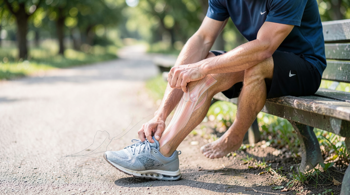
Strengthening the calf, intrinsic foot muscles, and supporting posterior-chain muscles increases the amount of load the foot can tolerate. Eccentric calf work, such as controlled single-leg heel drops, is included in runner rehabilitation recommendations, while hip and lower-limb strength may help control gait forces. A rehabilitation plan should progress gradually and should not produce a substantial increase in first-step pain the next morning. 8
- Use gentle plantar fascia and calf stretching around periods of inactivity.
- Progress calf and foot strengthening instead of relying only on ice, rolling, or temporary pain relief.
- Track morning stiffness, post-run soreness, and walking comfort as well as pain during the run.
Returning through a run-walk progression
A run-walk schedule limits continuous loading and gives symptoms time to be assessed between sessions. One published progression begins with six repetitions of one minute running and four minutes walking, performed three times per week on alternate days. Later stages increase running intervals to two, three, and five minutes before introducing continuous 20-minute running. The progression is contingent on low pain during exercise and minimal or absent symptoms the following morning. 9
After continuous running is tolerated, the same framework advances toward 25 to 30 minutes and then increases weekly volume by about 10%, with a fourth running day added only when symptoms remain controlled. The cited plan targets roughly 50% to 60% of pre-injury volume by weeks seven and eight. These figures are a framework rather than a diagnosis, and a physiotherapist or podiatrist can adjust them when pain is persistent, recurrent, or difficult to classify. 9
| Stage | Example session | Reported symptom guide |
|---|---|---|
| Early | 1 minute run, 4 minutes walk, repeated six times | No more than 3/10 during exercise and minimal next-morning pain |
| Middle | 3 to 5 minute running intervals | No limp and no progressive flare-up |
| Later | 20 to 30 minutes continuous running | About 2/10 or less and settled symptoms within 24 hours |
Managing risk and knowing when to seek care
Complete rest is not always necessary, but relative rest is important when running repeatedly aggravates symptoms. A sudden mileage spike, hard surfaces, weak supporting muscles, tight calves, and inadequate footwear can all increase the tensile demand on the fascia. Reducing training load while maintaining conditioning through lower-impact exercise can preserve fitness without repeatedly stressing the painful tissue. Most runners improve within approximately six to 12 weeks when load management, stretching, footwear, and rehabilitation are coordinated. 1
Professional assessment is appropriate when pain does not improve after several weeks, returns whenever mileage rises, or interferes with ordinary walking. A clinician can evaluate whether the pain pattern is consistent with plantar fasciitis and consider options such as taping, prefabricated or custom orthotics, night splints, or shockwave therapy when conservative care stalls. Cortisone injections should not be treated as an automatic first step because reducing pain temporarily does not necessarily restore tissue capacity. 10
- Do not use pain reduction during a run as the only return-to-running test.
- Reduce frequency or intensity when next-morning stiffness is clearly worse.
- Seek assessment for severe, unexplained, or persistent heel pain rather than assuming every symptom is plantar fasciitis.
- After recovery, maintain calf and foot strengthening, monitor mileage increases, and reconsider footwear when support or cushioning declines. 9
Sources
- NaplesPodiatrist, “Plantar Fasciitis Treatment for Runners”
- The Science Runner, “Plantar Fasciitis in Runners: Science-Based Rehab”
- Free Thy Feet, “Running With Plantar Fasciitis: When It’s OK and When to Stop”
- TheStartingPace, “Can You Run With Plantar Fasciitis?”
- Fleet Feet, guidance on running with plantar fasciitis
- WebMD, guidance on plantar fasciitis and running shoes
- Runner’s World, “Plantar Fasciitis Relief: 7 Proven Exercises for Runners”
- Cleveland Clinic, guidance on plantar fasciitis recovery
- Michigan Foot Doctors, return-to-running progression after plantar fasciitis
- Hospital for Special Surgery, guidance on plantar fasciitis taping and support
Authored by MyTrendSpot team