Lifelong learning institutes for seniors: Examining the Growth, Models, and Cognitive Impact of Academic Programs in Later Life
The Emergence of Academic Initiatives for Older Adults
In modern adult education, structured programs targeting retired individuals have expanded significantly to support cognitive vitality and social integration. The concept that educational engagement serves as a core benefit of retirement learning has led to a nationwide surge in formal initiatives 1. Older adults are seeking non-credit environments where they can engage with complex topics such as liberal arts, science, and history without the stress of traditional academic benchmarks like exams, grades, or mandatory homework 2. These organizations focus on providing structured environments that facilitate intellectual inquiry.
Academic institutions are responding to this demand by establishing specialized environments that bridge community access with formal university resources. For example, programs like the Harvard Institute for Learning in Retirement offer localized, campus-based engagement designed specifically for retired professionals 1. The emergence of these hubs highlights a systemic shift in how society approaches intellectual aging, transforming traditional university campuses into intergenerational spaces that welcome adult learners of all educational backgrounds 3.
Structural and Curricular Models of Retirement Learning
Educational opportunities for older adults are generally organized under two primary academic formats: university-developed curricula and peer-led learning structures. In peer-led models, program participants contribute to classroom environments by designing, developing, and instructing the coursework themselves 1 4. This participant-driven approach allows retired professionals to leverage their diverse career backgrounds, enhancing deep group discussions 1. Many programs, such as those at the Fielden Institute, rely heavily on this peer-led model to foster collaborative environments 4.
Alternatively, many programs feature structured lectures delivered by university faculty, historians, and regional specialists 5 6. At organizations like LIFE@TU, courses are curated by a dedicated committee that integrates member survey data to select highly relevant historical, scientific, and cultural subjects 5. These structured approaches ensure that senior learners have access to high-quality academic discussions overseen by experienced subject-matter experts 5 7.
Academic Diversity and Technical Training Programs
The scope of subjects offered within lifelong learning programs is highly diverse, ranging from classical music and historical studies to advanced technologies. While humanities and social sciences remain highly popular, there is a growing focus on modern technology and digital literacy to help older adults navigate contemporary digital platforms 8. Specialized coursework in computer fundamentals, cybersecurity, and artificial intelligence has become increasingly common across community college systems 8 9.
| Provider | Session Topic | Academic Format |
|---|---|---|
| Tiffin University | Underground Railroad History | Faculty Lecture 5 |
| Harvard Institute | Participant-Led Liberal Arts | Peer Discussion 1 |
| Blue Ridge Community College | Appalachian History and Art | Hybrid Campus and Zoom 10 |
| Cumberland Village | Digital Literacy and AI | Structured Training Course 8 |
Geographic Accessibility and Delivery Modalities
Access to educational facilities is critical in determining senior participation rates, prompting many institutes to adopt multi-campus or hybrid learning models. Programs such as the Blue Ridge Center for Lifelong Learning deliver classes on-campus during weekdays, while simultaneously offering virtual access via online platforms like Zoom to accommodate individuals with mobility limitations 10. This flexibility expands educational access to individuals who may face geographical barriers or transport limitations in regional areas.
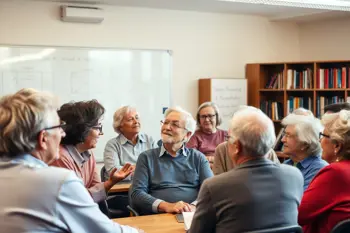
In addition to traditional campuses, some programs integrate educational access directly into residential retirement communities. Rice University Glasscock School of Continuing Studies pioneered virtual learning partnerships to broadcast interactive classes directly to senior living facilities nationwide 11. Similarly, partnerships like the Tufts University Osher Lifelong Learning Institute at The Commons in Lincoln deliver specialized non-credit courses directly to residents on-site, combining educational engagement with daily residential life 12.
Membership Structures and Administrative Realities
The financial and administrative governance of lifelong learning programs varies significantly depending on the host institution. Many organizations operate on a membership model, requiring participants to pay flat semester or annual fees that grant access to multiple courses 3 13. For example, Midwestern State University offers individual memberships for $100 per semester or $150 per year 3. In contrast, programs like Quincy University’s POLIS charge a minimal membership fee of $15 per semester, with additional nominal fees of $5 per class session 6.
Beyond coursework, membership often yields secondary institutional privileges. Participants in programs like Harvard’s HILR gain access to university library systems, specialized speaker events, and eligibility for non-credit courses at associated extension schools 13. However, enrollment in these highly structured communities often requires formal application processes, commitments to long-term community participation, and adherence to specific semester schedules, which may present barriers for transient learners 1 13.
Cognitive, Social, and Wellness Outcomes
Participation in structured adult education has been documented to support overall cognitive and psychological health. Engaging with new concepts, such as scientific exploration or music, creates cognitive stimulation that promotes mental agility and challenges long-held personal frameworks 14. Academies like the Glenridge Academy emphasize that continuous learning introduces fresh information that shifts set perspectives and supports intellectual wellness 14.
Furthermore, these institutes serve as vital networks for social interaction, helping to combat isolation among older populations. By gathering in welcoming, academic settings to discuss intellectual topics, seniors build connections and lasting friendships with like-minded peers 4 3. These social networks, combined with extracurricular events and group travel initiatives, contribute to a holistic approach to senior wellness that integrates physical, intellectual, and social health 15 16 17.
Sources
- Harvard Institute for Learning in Retirement
- New Adventures in Learning
- Midwestern State University Lifelong Learning Center
- Fielden Institute at Indian River State College
- Tiffin University
- Quincy University
- James Madison University Lifelong Learning Institute
- Cumberland Village / University of South Carolina Aiken
- York College
- Blue Ridge Community College
- Rice University
- Tufts University Osher Lifelong Learning Institute at The Commons in Lincoln
- Harvard Institute for Learning in Retirement - Join Our Community
- Glenridge Academy
- La Roche University
- Western Kentucky University Society for Lifelong Learning
- Florida Gulf Coast University Academy
Authored by MyTrendSpot team