Lightweight Medical Beds for Home Use: An Analytical Assessment of Modern Homecare Designs, Structural Engineering, and Patient Safety Metrics
An objective evaluation of lightweight medical beds for home use reveals how advanced materials and modern robotics have transformed residential clinical environments. These specialized platforms bridge the gap between hospital-grade therapeutic support and home environments, offering improved ergonomics for both patients and caregivers. Understanding the structural designs, electrical mechanisms, and safety regulations associated with these beds is essential for executing a successful homecare strategy.
Structural Engineering and Materials of Lightweight Medical Beds
The evolution of lightweight medical beds for home use has greatly simplified residential patient care logistics. While traditional hospital beds featured heavy steel frames requiring multi-person installation, modern engineering introduces split-spring structures allowing a single caregiver to transport and assemble the platform 1. By manufacturing frames from high-strength carbon steel, zinc-coated spring decks, or aluminum, developers reduce physical weight while retaining robust durability 1.
Advancements in design have further minimized structural bulk. Lightweight medical beds are frequently designed with tool-free assembly protocols to enable rapid setup by a single individual 3. This is achieved by utilizing modular components and removable motor systems. For instance, bariatric models feature frames up to 100 pounds lighter than conventional bariatric options, significantly easing transit and decreasing caregiver strain during initial setup without compromising working load limits 3.
Electric versus Semi-Electric Power Systems
Homecare medical beds are broadly categorized by mechanical operation into semi-electric and full-electric models. Semi-electric designs, such as the standard 15030 series, utilize electric motors to adjust head and foot angles, while requiring a manual hand crank to alter overall deck height 2. This hybrid setup offers a lighter, quieter alternative to multi-motor beds, incorporating integrated battery backups for power failure scenarios 2.
Conversely, full-electric systems feature a comprehensive three-motor configuration that automates head, knee, and overall bed height adjustments via a hand pendant 1. Advanced full-electric configurations support low-bed adjustments, with pre-installed motors near the foot section to shift the deck between standard heights and ultra-low levels 4. To ensure hygiene protocols are met, modern designs feature fully removable electronic components and motors, allowing the structural frame to be completely sanitized without damaging electrical circuitry 1.
Weight Capacity Distinctions: SWL vs. MPW
Understanding weight limits is critical when selecting a homecare medical bed. Clinical guidelines emphasize the technical distinction between Safe Working Load (SWL) and Maximum Patient Weight (MPW) 9. The Safe Working Load denotes the absolute weight capacity that the structural frame and motors can support, including the patient, mattress, blankets, and auxiliary equipment such as IV poles or trapeze bars 9. In contrast, the Maximum Patient Weight is the specific limit assigned strictly to the individual occupant 9.
Standard lightweight beds typically present an SWL of 450 pounds alongside an MPW of 350 pounds 1. For patients requiring more substantial support, bariatric lightweight beds utilize reinforced steel slats to offer a safe working load of up to 750 pounds without necessitating excessively heavy solid-steel frames 3. Smaller, specialty platforms designed for petite individuals feature narrower mattress surfaces, providing a compact footprint with a weight capacity of approximately 180 kilograms 12.
Low-Height and Fall-Prevention Technologies
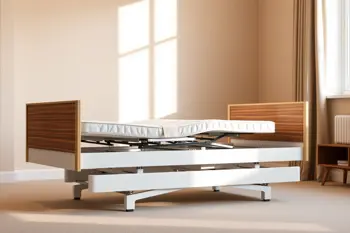
Accidental falls present a major risk for patients transitioning from clinical facilities to residential care. To address this risk, specialized floor-level medical beds lower to extreme minimum heights, reducing the impact force of accidental roll-outs. Standard floor-level frames can descend to a deck height of just 3.6 inches from the ground 5, while ultra-low alternative models lower even further to 2.7 inches 7. These positions are approximately equal to the width of a standard smartphone, creating a safe environment.
These low-profile beds achieve extreme elevation ranges through advanced scissor-lift mechanisms or telescoping legs 1. For instance, a typical ultra-low configuration provides an electric vertical travel span from a minimum height of 3.7 inches up to a maximum working height of 25 inches 8. The higher end of this range is essential for caregivers, as it raises the patient to an ergonomically safe working height for transfers, dressing, and physical therapy, thereby reducing physical strain and musculoskeletal injury risk 8.
Therapeutic Positioning Features
Beyond basic height and angular adjustments, modern lightweight medical beds integrate therapeutic positioning capabilities that mirror high-end ICU equipment. Advanced models incorporate features like One-Button Cardiac Chair positioning and Trendelenburg support 5. This position elevates the torso while lowering the lower extremities to optimize cardiopulmonary function, ease breathing, and allow social engagement. Trendelenburg and Reverse Trendelenburg modes are also essential for managing edema and promoting circulation.
To minimize physical shear and patient migration during head articulation, several manufacturers utilize automated contouring systems that shift the mattress deck dynamically as the head section rises 5. More advanced homecare designs employ rotating technology to automatically pivot the entire sleep surface into a vertical chair position facing the side of the bed 6. This stand-assist function enables individuals with severe mobility limitations to safely exit the bed. Additionally, retracting frames pull the upper portion of the bed backward toward the wall as the head rises 10.
Regulatory Standards, Safety Protocols, and Market Access
Lightweight medical beds must adhere to rigorous performance and safety standards before they can be deployed in homecare environments. Devices designed for residential medical support must meet international safety standards such as IEC 60601-2-52, which dictates structural requirements for medical beds, alongside electromagnetic compatibility standards like IEC 60601-1-2 3. Compliance with these protocols ensures that motorized components do not interfere with other home medical equipment, such as oxygen concentrators, and guarantees that the electrical grounding remains stable.
Accessing these medical beds often depends on clinical necessity and insurance guidelines. Medicare Part B covers certain adjustable and hospital-style beds as Durable Medical Equipment (DME) if they are prescribed by a physician and deemed medically necessary 11. However, navigating the procurement process requires careful planning, as private purchases of medical beds are frequently subject to significant commercial friction, including delivery fees and substantial restocking penalties ranging from 25% to 50% for returned frames 13.
Sources
- Cleveland HME
- Drive DeVilbiss Healthcare
- SonderCare Learning Center
- Human Care
- Medicare.gov
Authored by MyTrendSpot team