Bank-owned campers available in California: A Guide to Asset Liquidation Processes
When individuals look for bank-owned campers available in California, they are often exploring a sector of the market defined by asset repossession and financial liquidation. Unlike standard retail purchases, these units enter the marketplace through specialized channels utilized by lenders to recover losses on defaulted loans 1. This process is distinct from conventional consumer-to-consumer transactions or dealership sales, requiring a different approach to inventory discovery and transaction management 2.
Understanding the Repossession Auction Environment
Financial institutions typically do not manage the sale of repossessed campers through their local branch offices. Instead, these assets are diverted to specialized remarketing companies, industrial auction houses, and liquidation platforms that possess the infrastructure to host large-scale inventory for a broader buyer base 5. Because banks prioritize the rapid recovery of capital, they often utilize online auction sites that facilitate competitive bidding across state lines 2. These platforms include major networks like IronPlanet, GovDeals, and other industry-specific repossession hubs 1, 2.
For residents in California, navigating these listings involves familiarizing oneself with digital auction interfaces where units are categorized by condition, make, and year. While retail marketplaces like RVshare or RVezy offer contemporary, privately owned units-such as 2026 Winnebago Solis models or 2025 Heartland travel trailers-these are typically peer-to-peer rentals and not bank-owned assets for purchase 1, 6. Distinguishing between these rental ecosystems and the industrial liquidation sector is the first step in correctly identifying opportunities for acquiring repossessed equipment 2.
Regulatory Oversight and Title Status
The acquisition of bank-owned campers in California is subject to specific regulatory scrutiny, particularly concerning the legal status of the vehicle title. Repossessed units are often branded with an 'as-is' status, signifying that the lender provides no warranties regarding the mechanical or structural integrity of the camper 4, 7. California law requires that any vehicle operated on public roadways must meet rigorous safety and emission standards, meaning that units sold through salvage or repossession auctions may require significant administrative oversight or mechanical repairs to reach legal compliance 5.
Prospective purchasers must perform thorough due diligence by utilizing a Vehicle Identification Number (VIN) history report. This documentation provides insight into previous collision reports, flood damage, or unresolved liens that may complicate the registration process at the California Department of Motor Vehicles (DMV) 6, 7. Buyers should also be aware that the 'repossessed' branding on a title can influence the availability of financing from traditional banks and may affect the premium rates offered by insurance carriers in the state 4.
Navigating Market Dynamics and Inventory Access
Lenders frequently sell their inventory in bulk, which presents a significant barrier to individual buyers who may prefer to acquire a single unit. These bulk lots are often purchased by secondary dealers or scrap entities that specialize in refurbishing or dismantling campers for parts 5. While platforms like AutoTrader or RV Trader provide aggregated listings from various sources, it remains difficult to track down specific inventory that originated directly from a bank foreclosure, as the intermediary processes often obscure the original ownership history 4, 5.
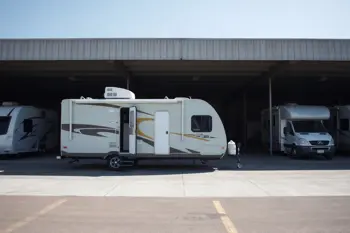
Credit unions sometimes list repossessed inventory directly on their official websites, offering a more transparent but highly localized path for potential buyers 6. These listings are rare and usually limited to the geographic footprint of the institution's membership base. Because of this, serious participants often maintain constant monitoring of specialized remarketing sites that act as centralized databases for financial institutions across the Western United States 5, 8.
The Role of Competitive Bidding and Licensure
Participating in major salvage and repossession auctions often necessitates more than just capital. Many of the larger auction houses, such as Copart, frequently require bidders to hold a valid dealer’s license to participate in certain high-value auctions 3. This ensures that only professionals, or those with significant experience in vehicle reconstruction, are accessing the primary liquidation pools. Individual buyers who lack these credentials may find themselves relegated to secondary consumer-facing auctions, which often carry higher price volatility 3.
Auction houses operate on rigid timelines and strict payment protocols. Once a winning bid is placed, the buyer is typically responsible for transport, storage, and the administrative costs associated with transferring a repossessed title. It is highly recommended that participants consult consumer protection guides, such as those provided by Consumer Reports or Bankrate, to fully understand the legal obligations and risks involved in entering into a contract that lacks standard consumer protections like return policies or mechanical performance guarantees 9, 10.
Risk Management for Potential Buyers
The primary risk when targeting bank-owned units is the 'as-is' condition of the inventory. Campers are complex vehicles containing integrated plumbing, electrical, and gas systems that are highly susceptible to damage during periods of abandonment or improper storage 7. A unit that has been sitting in a repo yard for months may suffer from water intrusion, rodent damage, or electrical corrosion-none of which are disclosed by the lending institution during the auction process 7. Prospective buyers should factor in a substantial contingency fund for potential repairs beyond the winning bid price.
Furthermore, the logistical costs of moving a large camper from a holding facility to a private residence in California can be substantial. Many units in these auctions are not roadworthy, requiring the use of professional flatbed towing services. Before placing a bid, the cost of transportation should be integrated into the overall valuation of the asset, as the remote location of some storage lots can significantly inflate the total acquisition cost 9.
Comparison Table: Market Access Points
| Resource | Primary Function | Buyer Requirement |
|---|---|---|
| IronPlanet | Industrial Auction Platform | Registration |
| GovDeals | Government/Institutional Asset Liquidation | Standard User Account |
| Copart | Salvage & Repossession Inventory | Often Requires Dealer License |
| CURealty | Credit Union Inventory Portal | Membership/Local Access |
| California DMV | Title & Registration Guidance | Official Documentation |
Sources
- IronPlanet
- GovDeals
- Copart
- AutoTrader
- RV Trader
- CURealty
- California DMV
- Bid4Assets
- Consumer Reports
- Bankrate
Authored by MyTrendSpot team