Single tooth replacement at home pricing: A Clinical Cost and Safety Review
“Single tooth replacement at home pricing” generally refers to temporary cosmetic appliances ordered remotely, not a complete dental implant or professionally fitted bridge. A permanent implant requires surgical placement of a titanium post, while bridges and custom partial dentures require clinical assessment, impressions, and bite evaluation. The available pricing therefore spans temporary devices costing several hundred dollars to professional implant treatment costing several thousand dollars, with safety and suitability determined by a dental professional. 1
What home replacement pricing actually covers
A home-ordered tooth replacement is usually a removable acrylic flipper or partial denture rather than a replacement root. One dentist-directed acrylic flipper listing reports a price of $389, while a flexible partial denture listing reports $479. These appliances are described as custom made, with tooth and gum shade selection, impression materials, and licensed-dentist review included in the stated process. 23
Those figures should not be interpreted as the total cost of restoring oral function permanently. A removable appliance may conceal a gap and assist appearance, but it does not replace the tooth root or provide the same bone-preservation function associated with an implant. Fit, speech, chewing comfort, durability, and the need for follow-up adjustments can affect the practical cost beyond the initial listed price. 13
Professional implant costs and components
Published estimates vary by source and by what is included in the quote. CareCredit reports a national average of $2,143 for a full-size single implant, with a stated range of $1,646 to $4,157, while other 2026 cost analyses place an all-in single-tooth implant commonly between $3,000 and $6,000. Differences may reflect whether the abutment, crown, imaging, extraction, and grafting are included. 14
A complete implant has three principal components: the implant fixture placed in the jaw, the abutment connecting the fixture to the crown, and the visible crown. One cost breakdown assigns approximately $1,500 to $2,000 to the post, $300 to $700 to the abutment, and $1,000 to $2,000 to the crown. Consultation, three-dimensional imaging, extraction, sedation, and bone grafting may be itemized separately. 5
| Replacement type | Reported price range | Clinical characteristic |
|---|---|---|
| Temporary flipper | $300 to $500 | Removable cosmetic appliance |
| Flexible partial denture | From $359, with one listing at $479 | Removable, dentist-directed appliance |
| Single implant | About $3,000 to $6,000 | Surgically placed root replacement and crown |
Why do-it-yourself devices have limitations
Over-the-counter tooth repair materials marketed for home use are generally temporary cosmetic stop-gaps rather than permanent dental replacements. Reported pharmacy pricing is approximately $20 to $50, but these materials do not establish whether the missing-tooth space is healthy, whether neighboring teeth are shifting, or whether the appliance interferes with the bite. Professional assessment remains necessary when infection, gum disease, or bone loss is possible. 7
Improperly fitted devices can create pressure points, irritate gum tissue, trap food, and contribute to tooth movement or periodontal damage. The research information also identifies possible infection, nerve injury, and airway obstruction if an appliance is swallowed. These risks make a home device unsuitable as a substitute for diagnosis, especially when pain, swelling, drainage, numbness, or difficulty swallowing is present. 7
Alternatives to an implant for one missing tooth
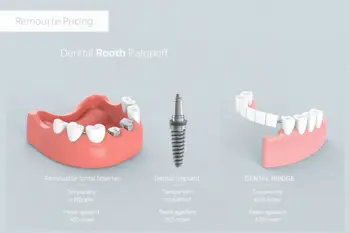
A fixed dental bridge replaces the visible tooth by attaching an artificial tooth to neighboring crowned teeth. Reported bridge pricing is approximately $1,500 to $3,000 per tooth in general cost guidance, while another 2026 comparison places bridges between $2,500 and $5,000. Bridges avoid implant surgery but require preparation of adjacent teeth and typically have a stated lifespan of about 10 to 15 years. 56
A removable partial denture or flipper is generally less invasive and less costly than an implant, but it can be less stable and may affect speech or comfort. A Maryland bridge, particularly for a front tooth, uses resin bonding and can involve less alteration of neighboring enamel. The appropriate option depends on tooth position, gum condition, available bone, bite forces, appearance requirements, and the health of adjacent teeth. 6
Eligibility, examination, and treatment timing
Implant candidacy depends on more than the presence of a gap. Reported criteria include sufficient bone, healthy gums, and the absence of uncontrolled diabetes or other conditions that could impair healing. A dentist may recommend imaging to evaluate bone volume and anatomy. If bone has deteriorated, grafting may be required, with published estimates ranging from $800 to $1,500 for minor grafting and $2,500 to $4,000 for a major sinus lift. 15
Missing teeth can allow neighboring teeth to drift, permit the opposing tooth to over-erupt, and contribute to shrinking bone beneath the space. One clinical comparison reports implant success rates near 95 percent and notes that a partial denture may last approximately five to seven years, although individual outcomes vary. A professional examination determines whether the gap can be restored immediately or whether disease control, extraction, grafting, or other preparation is needed. 6
Insurance, maintenance, and evaluating a quote
Dental insurance coverage for restorative care varies considerably. General guidance indicates that many plans cover a portion of major services, often around 50 percent after the deductible, while implants may have exclusions, waiting periods, annual limits, or separate coverage rules for crowns and surgery. A written estimate should identify the examination, imaging, extraction, implant fixture, abutment, crown, grafting, anesthesia, and follow-up visits rather than presenting only one unexplained total. 5
Maintenance also affects long-term value. Removable appliances require cleaning and periodic assessment for fit, while implants require routine professional monitoring of the crown, gums, and supporting bone. A quote that appears lower may exclude diagnostic imaging, temporary teeth, laboratory charges, or treatment of gum disease. The central distinction is that home-ordered appliances address appearance temporarily, whereas implants, bridges, and professionally fabricated partial dentures require clinical planning and ongoing care. 47
Sources
- CareCredit, “Single Tooth Dental Implants Cost and Procedure Guide,” carecredit.com
- Denture Rescue, “Flexible Partial Dentures,” denturerescue.com
- Denture Rescue, “1-2 Tooth Replacement Acrylic Partial,” denturerescue.com
- Toothcheck, “Dental Implant Cost in 2026: Full Breakdown,” toothcheck.io
- CostPrism, “Dental Implant Cost Calculator 2026,” costprism.com
- Xhaowen, “Single Tooth Implant Cost,” xhaowen.com
- American Dental Association and related clinical guidance summarized in the supplied research data, ada.org
Authored by MyTrendSpot team