Used Cabin Cruisers for Sale in the United States: Market Overview, Models, and Buying Considerations
The market for used cabin cruisers in the United States reflects substantial activity across multiple online platforms and regional dealers, with hundreds of vessels listed at any given time. Prospective buyers searching for overnight cruising capability, family-friendly accommodation, and extended water-based living find diverse options spanning decades of manufacturing and price points. This article provides an objective overview of what currently exists in the used cabin cruiser marketplace, what realistic pricing and specifications look like, and what criteria serious buyers typically evaluate.
Understanding Cabin Cruiser Categories and Layouts
Cabin cruisers represent a distinct vessel category engineered specifically for comfortable extended stays on the water, distinguishing them from open day boats or performance-focused speedboats. 1 The defining characteristic across all cabin cruiser designs is the presence of enclosed below-deck accommodation space featuring sleeping quarters, galley facilities, and head (bathroom) compartments. 2 This accommodation-first design philosophy allows families and groups to depart from shore and maintain reasonable comfort standards during multi-day or seasonal voyages without requiring resort facilities or land-based lodging.
Within the broader cabin cruiser category, several distinct layout subtypes have emerged over decades of production. Express cruisers prioritize open upper-deck social spaces with helm and cockpit areas flowing together, while maintaining full sleeping and sanitary facilities below. Aft-cabin motor yachts designate the largest stateroom to the rear of the vessel, creating a private master suite with direct transom access. Pilothouse designs envelope the helm station within an enclosed weatherproof salon, providing year-round piloting comfort in variable conditions. 3 Sport sedans blend multiple characteristics, featuring enclosed upper helms with expansive lower salons and flexible sleeping arrangements. Understanding these distinctions helps buyers immediately identify which layout aligns with their cruising patterns and family dynamics.
Representative Models and Current Market Listings
The used cabin cruiser marketplace demonstrates active inventory across multiple decades of production, with particularly strong representation from vessels manufactured during the 1990s through 2000s. A 1998 Carver 405 Aft Cabin Motor Yacht, designated "I Swear," is listed at $124,900 USD in Gibsonton, Florida, equipped with Cummins 6BTA diesel engines and noted as having completed the Great Loop recreational cruising circuit in 2026. 4 Similarly, a 1998 Carver 445 Aft Cabin Motor Yacht, "Summer Breeze," carries an asking price of $169,900 USD in Onekama, Michigan, featuring twin Cummins 450 horsepower diesels with documented engine hours of 2,206 and 2,211 respectively. 5
Pricing demonstrates considerable variance according to vessel size, age, engine condition, and installed systems. A 1995 Carver 325 Aft Cabin with freshwater-only history and under 800 engine hours is offered at $39,000 USD in Cheboygan, Michigan. 6 By contrast, a 2004 Grand Banks 49 Eastbay HX, "Bella Blue," commands $575,000 USD in Hilton Head Island, South Carolina, reflecting the premium pricing typical of larger displacement vessels and full offshore-capability platforms. 7 A 2004 Chaparral Signature 350 express cruiser lists for $88,995 USD in Stuart, Florida, representing the mid-range segment with twin Mercury Mercruiser gasoline engines delivering 425 horsepower each. 8 A 1996 Cruisers Yachts 3650 Aft Cabin, marketed as a "floating waterfront condo," carries a $99,000 USD price tag in San Diego, California. 9
Engine Types, Fuel Systems, and Mechanical Considerations
Used cabin cruisers feature markedly different propulsion architectures, each presenting distinct operational and maintenance realities that substantially impact total cost of ownership. Diesel inboard systems dominate larger production cruisers and express models designed for extended cruising, with manufacturers including Cummins, Caterpillar, and Volvo Penta supplying most factory installations. 10 Diesel engines deliver superior fuel efficiency relative to gasoline alternatives, reduced fire risk compared to volatile gasoline systems, and established service infrastructure across the United States. However, diesel engines require regular fuel polishing to remove water and particulates, periodic injector service, and specialized technician knowledge for major repairs, adding to ownership complexity and cost.
Gasoline inboard and sterndrive systems remain common on smaller cabin cruisers and express models, particularly those manufactured during the 1990s and early 2000s. 11 These engines offer simpler maintenance for basic service items and lower initial acquisition costs relative to diesel equivalents, but consume significantly more fuel during extended cruising and present greater fire hazard risks in enclosed cabin environments. Engine hours critically influence purchase decisions: units with documented hours under 500 command premium pricing, while cruisers with 2,000-3,000-plus hours require serious mechanical inspection and budgeting for major service or overhaul within 5 to 10 years of acquisition. Prospective buyers consistently request engine hour documentation and maintenance records as primary indicators of remaining service life and reliability.
Accommodation Layouts, Galley Facilities, and Living Space
Cabin cruiser accommodations range from compact single-stateroom designs suitable for couples to three-stateroom layouts accommodating extended families or chartering groups. Two-stateroom, two-head configurations represent the most common layout found in the 35-50 foot size range, providing a private aft master stateroom with ensuite head and separate shower, plus a forward guest cabin with access to a day head. 12 Salons typically feature convertible dinettes doubling as sleeping berths, L-shaped sofas with fold-out bed functions, and abundant storage cabinetry designed for extended liveaboard use. Modern cabin cruisers integrate marine-grade refrigerators, microwave ovens, gas or electric stovetops, and double sinks with freshwater pumping systems, enabling meal preparation comparable to small apartment kitchens.
Galley equipment represents a significant quality differentiator among used vessels. Recently updated galleys with newer refrigerator units, convection ovens, and modern plumbing command measurably higher prices than comparable hulls with original or failing equipment. 13 Head (bathroom) compartments in entry-level cabin cruisers typically feature marine-style compact toilets (either manual or electric macerating), shower stalls with limited water pressure, and limited ventilation, contrasting sharply with full-size residential bathroom fixtures found aboard larger or heavily upgraded examples. Freshwater tank capacity directly influences extended cruising range and liveaboard viability: entry-level cruisers may carry 75-100 gallons (limiting daily usage to 20-25 gallons), while larger models provide 250-400 gallon capacity enabling multi-week deployments between shore refueling. Holding tank capacity and macerator pump functionality prove critical for sanitary system reliability.
Exterior Decking, Weather Protection, and Structural Condition Assessment
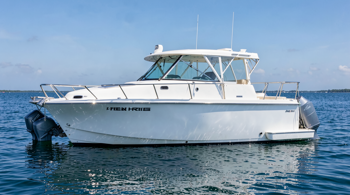
Used cabin cruiser exterior conditions vary dramatically based on storage history, maintenance protocols, and regional environmental exposure. Vessels kept under permanent cover or in freshwater systems consistently command pricing premiums of 15-25 percent over saltwater-exposed examples with identical hull ages and engine hours. 14 Hardtop structures covering helm and cockpit areas provide essential weather protection and directly influence year-round cruising comfort, while soft canvas bimini tops and full enclosures offer seasonal protection at lower cost. Recent bottom paint application and zinc anode replacement represent significant maintenance expenses: buyers should inquire about the timing of these services, as deferred bottom maintenance often signals broader deferred maintenance patterns.
Fiberglass hull integrity assessment requires professional marine survey evaluation, as cosmetic cracks and crazing may indicate stress fractures or osmotic blistering requiring expensive gelcoat repair or barrier coating systems. Teak decking and varnished toerails, common on higher-end models, demand consistent seasonal maintenance (stripping, sanding, and varnish application) to prevent rot and deterioration. Molded fiberglass nonskid surfaces and newer SeaDek non-skid coatings require only regular cleaning and occasional resealing. Walk-through windshields, integrated swim platforms with stainless steel railings, and radar arches represent common upgrades found on well-maintained examples. Prospective buyers should specifically examine window frames for stress cracks, hatch seals for leakage evidence, and transom structures for soft spots indicating delamination or water intrusion.
Electronics Systems, Navigation, and Modern Upgrades
Electronics integration represents a critical quality differentiator between recently upgraded cabin cruisers and vessels with original or obsolete equipment packages. Modern used cruisers increasingly feature integrated Garmin or Raymarine chartplotting systems combining GPS positioning, radar, sounder, and autopilot functions within unified touchscreen interfaces. 15 Older vessels equipped with standalone mechanical autopilots, paper-chart navigation, and separate VHF radios present operational limitations for serious cruisers and often see pricing discounts reflecting required upgrade costs. Recent upgrades including new gauge panels, LED cockpit and cabin lighting, upgraded stereo systems, and backup camera installations directly correlate with higher asking prices and faster sales timelines.
Generator systems warrant specific attention, as generator failure necessitates expensive at-sea service calls or forced early harbor return during extended voyages. Used cruisers should feature documented generator maintenance records, with hours typically tracked separately from main engine hours. Onan gasoline generators common on smaller vessels require regular run cycles and carburetor cleaning to prevent fuel system degradation, while Kohler and John Deere diesel generators demand periodic fuel polishing and filter replacement. Bow thruster systems dramatically enhance docking capability in confined spaces and represent desirable features on cruisers 40 feet and larger; however, thruster failures can require costly haul-outs and underwater specialist repairs. Battery banks, inverters, shore power systems, and water heaters undergo significant lifecycle costs during extended ownership, with replacement cycles typically ranging from 5-10 years depending on usage patterns and maintenance discipline.
Price Ranges, Regional Variation, and Acquisition Pathways
The used cabin cruiser market demonstrates distinct price stratification according to vessel length, age, engine type, and regional location within the United States. Entry-level cabin cruisers in the 28-35 foot range with gasoline engines and original equipment typically trade between $35,000-$75,000 USD, with particular concentration in freshwater lake regions. 16 Mid-range express and aft-cabin cruisers spanning 35-45 feet with diesel engines and moderate upgrades command pricing from $100,000-$250,000 USD. Premium examples exceeding 45 feet with recent major overhauls, modern electronics, and proven offshore capability regularly exceed $400,000 USD, with the finest Grand Banks and Hinckley examples reaching $600,000-$700,000 USD.
Geographic location substantially influences pricing for identical vessels: cruisers located on the Great Lakes and inland river systems typically command 10-20 percent premiums over similar vessels in southern saltwater regions, reflecting the perceived freshwater maintenance advantages and proven Great Loop cruising capability. 17 Acquisition pathways include direct private-seller transactions (requiring independent surveys and title verification), regional yacht brokers (typically charging 5-10 percent commissions), online auction platforms specializing in distressed or salvage vessels (presenting substantial uncertainty and repair cost risk), and dealership trade-in inventory (offering convenience and warranty protections at premium pricing). Serious buyers consistently commission professional marine surveys from accredited surveyors prior to commitment, with survey costs ranging from $800-$2,500 USD depending on vessel size and examination scope. Financing availability remains limited compared to residential real estate, with marine lenders requiring 15-20 percent down payments and charging interest rates 1-3 percentage points higher than standard mortgage rates.
Sources
- MarineMax - Cabin Cruiser Boats Educational Overview
- YachtBuyer - Cruiser Boats for Sale Category Description
- MarineMax - Cabin Cruiser Boats Blog Article
- Odysseys Marine & Yachts - 1998 Carver 405 Aft Cabin Motor Yacht Listing
- South Jersey Yacht Sales - 1998 Carver 445 Aft Cabin Motor Yacht Listing
- Walstrom Marine - 1995 Carver 325 Aft Cabin Motor Yacht Listing
- Palm Beach Motor Yachts - 2004 Grand Banks 49 Eastbay HX Listing
- South Jersey Yacht Sales - 2004 Chaparral Signature 350 Listing
- Infinity Yacht Sales - 1996 Cruisers Yachts 3650 Aft Cabin Listing
- Various Dealer Listings - Diesel and Gasoline Engine Specifications
- Chaparral and Four Winns Listings - Gasoline Inboard Systems Documentation
- Multiple Broker Listings - Two Stateroom, Two Head Layout Specifications
- Rhode River Boat Sales and Weber Yachts - Recent Upgrade Documentation
- Curtis Stokes Yacht Brokerage and Multiple Listings - Freshwater vs. Saltwater Pricing Differential
- Castaways Yacht Club and Irwin Yacht Sales - Modern Electronics Integration Examples
- Elite Boat Sales and My Boats for Sale - Entry-Level Cruiser Pricing Data
- Hinckley Brokerage and Palm Beach Motor Yachts - Great Lakes and Regional Premium Documentation
Authored by MyTrendSpot team