What to Look for in Orthopedic Sneakers for Long Walks: A Podiatrist-Informed Consumer Guide
Why the Term 'Orthopedic' Requires Scrutiny
The label 'orthopedic' is among the most misused terms in footwear marketing. A board-certified podiatric surgeon with over 15 years of clinical practice has noted that patients routinely arrive at orthopedic offices wearing shoes that are actively worsening their foot conditions, sometimes footwear that cost over $300. 1 According to Dr. Nicholas Butler, a podiatrist and board-certified foot and ankle surgeon, orthopedic shoes are not simply comfortable footwear; they are therapeutic, meaning they must create proper support through the feet to benefit the entire kinetic chain, including the ankles, knees, hips, and lower back. 2 For long walks specifically, that therapeutic function depends on a cluster of structural features working together, and the absence of even one can compromise the design's overall effectiveness.
Roughly 77% of adults report foot pain at some point in their lives, and certain populations such as seniors, women, and those with chronic conditions face disproportionate risk. 3 Approximately 30% of adults live with flat feet, a condition that places added strain on arch structures during extended walking. 4 These prevalence figures explain why understanding shoe construction at a functional level matters before making any purchase decision.
Arch Support: The Structural Baseline
Arch support is the most clinically cited feature in orthopedic walking footwear. The American Academy of Orthopaedic Surgeons recommends selecting shoes with proper arch support and cushioned insoles as a foundation of foot health. 5 According to podiatrists, a genuine orthopedic shoe must have a footbed that curves upward to meet and support the arch rather than lying flat. This medial arch support is the single most important feature for individuals with flat feet, fallen arches, or overpronation, because it prevents the inward rotation of the foot that places excessive strain on the knees and lower back. 6
Orthotic insoles achieve this by spreading weight across the foot to reduce pressure hot spots and pain during long wear. Many orthopedic sneakers now include removable insoles, which allow walkers to insert custom or prescribed orthotics for personalized support. 7 The American Podiatric Medical Association advises selecting shoes that fit well and provide this type of structural support to help reduce foot problems over time. 8
Heel Counter, Midsole Cushioning, and Rocker Soles
The heel counter is the rigid shell that wraps around the back of the heel. A firm heel counter prevents excessive pronation, which is the inward rolling motion that stresses the plantar fascia, Achilles tendon, and surrounding structures. 1 Podiatry specialists identify a stable heel counter as a non-negotiable element of proper walking footwear, because it controls rearfoot motion and supports better gait mechanics throughout the entire stride cycle. 9 Without adequate heel containment, even a well-cushioned shoe can permit the biomechanical deviations that lead to heel pain, shin splints, and knee soreness.
Midsole cushioning materials such as EVA foam and nitrogen-infused compounds absorb shock with each footfall, reducing joint strain in the knees and hips over long distances. 7 Rocker-bottom soles represent a separate but complementary design element: the curved sole geometry helps distribute pressure evenly across the foot and reduces stress on the forefoot and toes during the push-off phase of the gait cycle. 10 Orthopedic Surgeon Brandon Haghverdian of Hoag Orthopedic Institute specifically recommends flat or low-heeled shoes with good cushioning and a slight rocker sole for walking recovery. 11
Toe Box Geometry and Torsional Rigidity
The Cleveland Clinic identifies a wide toe box and proper fit as key factors in preventing foot pain during long walks. 12 A proper toe box allows all five toes to splay naturally during the push-off phase of the gait cycle. Narrow toe boxes are a primary driver of bunions, hammertoes, neuromas, and ingrown toenails. In clinical practice, narrow shoes account for the majority of forefoot complaints that podiatric surgeons treat. 1 For individuals already managing bunions or hammertoes, an anatomically shaped toe box is not optional but a clinical requirement.
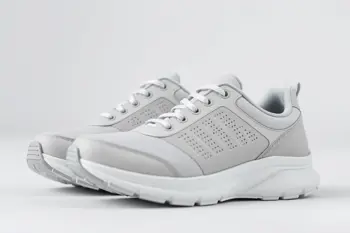
Torsional rigidity in the midfoot is a less-discussed but equally important structural criterion. Flexibility in a walking sneaker should be isolated to the forefoot area only; the midfoot section should resist twisting forces. 7 A simple field test involves holding the heel in one hand and the toe in the other and attempting to twist the shoe. A properly constructed orthopedic walking sneaker will resist this rotation, while a structurally deficient shoe will twist easily through the arch zone, undermining its support function entirely.
Upper Materials, Breathability, and Fit Precision
Breathable mesh or perforated uppers are consistently recommended for long-distance walking because they manage heat and moisture accumulation during extended wear. 7 Friction-related blisters and hot spots are among the most common complaints from walkers using footwear with non-breathable uppers, particularly during walks exceeding 10,000 steps. Stretch-knit constructions also accommodate mild foot swelling that naturally occurs during prolonged activity.
Fit precision encompasses several factors that go beyond the basic length measurement. Podiatrists note that most adults have one foot longer than the other, making bilateral measurement at the end of the day, when feet are at their largest, the clinical standard. 13 Width availability is equally important: brands including New Balance offer extended widths in 2E and 4E options, which are particularly relevant for individuals with wide feet, edema, or bunions. Heel slip during walking is a sign of inadequate heel fit and should be considered a disqualifying characteristic regardless of other positive features.
Recognizing Legitimacy: APMA Seals and Professional Oversight
The American Podiatric Medical Association grants a Seal of Acceptance to footwear that meets verified standards for foot health. Several models cited by podiatrists in 2026 carry this designation, including the Brooks Ghost Max 3, which has earned both APMA and diabetic shoe certification. 14 The Orthofeet Kita Slip-On Sneaker also holds an APMA Seal of Acceptance and carries a 4.2-star average across nearly 2,000 Amazon reviews, reflecting consistent real-world performance among people managing plantar fasciitis, overpronation, and neuropathy. 15
Despite brand reputations and third-party certifications, individual fit remains the primary variable. Orthopedic Doctor of Physical Therapy Ashley Katzenback has observed that overly padded and cushioned shoes can prevent walkers from feeling their toes push off, altering walking mechanics in ways that are counterproductive. 11 The Mayo Clinic emphasizes that comfortable, properly fitted, supportive shoes can reduce pain and improve walking comfort, particularly for individuals managing arthritis or other joint conditions. 16 For anyone with a diagnosed foot condition, consultation with a podiatrist or orthopedic specialist before selecting footwear remains the most reliable path to matching shoe features to specific anatomical needs.
Key Features Summary: What to Evaluate Before Selecting
| Feature | What to Look For | Why It Matters for Long Walks |
|---|---|---|
| Arch Support | Contoured medial footbed, not flat | Distributes weight evenly, reduces plantar fasciitis risk |
| Heel Counter | Rigid, deep shell around the heel | Controls rearfoot motion and prevents overpronation |
| Midsole Cushioning | EVA foam, nitrogen-infused compounds | Absorbs shock, reduces knee and hip strain |
| Rocker Sole | Curved sole geometry at forefoot | Reduces forefoot pressure during push-off phase |
| Toe Box | Wide, rounded, allows toe splay | Prevents bunions, neuromas, hammertoes |
| Torsional Rigidity | Midfoot resists twisting | Maintains arch integrity during stride |
| Upper Material | Breathable mesh or stretch-knit | Manages heat and moisture, reduces blister risk |
| Removable Insole | Extractable sock liner | Allows custom orthotics to be inserted |
| Width Options | Multiple width designations (D, 2E, 4E) | Accommodates diverse foot shapes |
| Certification | APMA Seal of Acceptance | Independent verification of foot health standards |
Sources
- michiganfootdoctors.com - Best Orthopedic Shoes 2026: Podiatrist Top Picks
- cnn.com - 14 Best Orthopedic Shoes for Foot Pain, per Podiatrists
- rosenberryrooms.com - 12 Best Orthopedic Shoes for Women (July 2026) In-Depth Reviews
- healthyseventy.com - Orthopedic Sneakers for Fallen Arches: A Senior's Guide to Pain-Free Mobility
- orthoinfo.aaos.org - Athletic Shoes (American Academy of Orthopaedic Surgeons)
- twilltees.com - Best Orthopedic Sneakers for Men 2026
- ifafs.blog - Orthopedic Sneakers: Comfort and Stability for Active Lifestyles
- apma.org - Shoes and Socks (American Podiatric Medical Association)
- podiatrytoday.com - How to Choose the Right Walking Shoe
- verywellhealth.com - How to Choose Walking Shoes
- eatingwell.com - The Best Walking Shoes According to Orthopedic Doctors
- health.clevelandclinic.org - How to Choose the Best Walking Shoes
- michiganfootdoctors.com - Best Walking Shoes 2026: Podiatrist MI Picks
- goinglikesixty.com - Best Sneakers for Long Distance Walking 2026 Reviews
- shoestoryteller.com - Orthofeet Women's Orthopedic Kita Sneaker Review
- mayoclinic.org - Arthritis Symptoms and Causes (Mayo Clinic)
Authored by MyTrendSpot team