Welding Training Schools: A Comprehensive Report on Technical Education and Career Preparation
The Landscape of Modern Welding Education
The pursuit of professional welding skills typically begins with identifying an educational environment that aligns with specific career objectives, whether those are focused on rapid workforce entry or long-term specialization in complex industrial applications 1. Welding training schools in the United States generally function as specialized technical centers, offering pathways that range from accelerated, weeks-long bootcamps to comprehensive, year-long diploma programs 2. These institutions prioritize hands-on experience, recognizing that the ability to handle equipment, interpret blueprints, and troubleshoot technical issues is essential for modern fabrication and construction roles 3. Prospective students must differentiate between these varied instructional models to ensure the chosen curriculum meets the physical and professional requirements of the industry 4.
Educational facilities are categorized by the depth and duration of their offerings. Private trade schools, such as those operated by Tulsa Welding School or Arclabs, often emphasize high-intensity, practical training designed to prepare graduates for entry-level positions in seven to nine months 5. Conversely, community college programs, like the individualized certificates offered by institutions such as Moraine Valley, provide a broader academic foundation integrated with technical instruction 6. Furthermore, specialized entities like Welder Corps or private, Christian-owned bootcamps offer compressed 30-day programs designed for immediate skill acquisition, illustrating the diversity of educational delivery currently available in the vocational sector 7.
Core Technical Competencies and Industry Processes
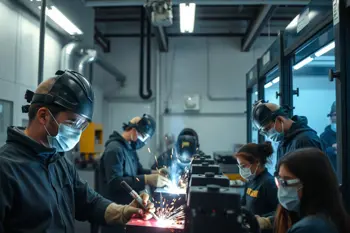
Rigorous welding training focuses on mastering the four primary industry processes: Shielded Metal Arc Welding (SMAW or Stick), Gas Metal Arc Welding (GMAW or MIG), Gas Tungsten Arc Welding (GTAW or TIG), and Flux-Cored Arc Welding (FCAW) 8. Programs are structured to immerse students in these techniques, often devoting 80% to 95% of instructional time to supervised workshop activity 9. By working in dedicated booths with modern equipment, students gain the muscle memory and precision necessary for structural and pipe welding applications 10. The goal is to develop a level of proficiency that allows for the safe and consistent execution of welds across various positions, including flat, vertical, and overhead orientations 11.
In addition to these foundational processes, advanced training often covers specialized material handling, such as aluminum and stainless steel, as well as complex pipe welding codes 12. Schools often integrate instruction on blueprint reading, schematic interpretation, and safety protocols, which are mandatory for functioning in industrial environments like shipyards, aerospace manufacturing, and energy infrastructure projects 13. Graduates are expected to understand the nuances of machine setup and basic maintenance, as these skills are highly valued by employers looking to minimize equipment downtime and ensure the structural integrity of fabricated components 14.
Certification Standards and Regulatory Oversight
Professional credibility in the welding industry is frequently linked to certifications granted by the American Welding Society (AWS) or the American Society of Mechanical Engineers (ASME) 15. Many accredited welding schools function as designated test centers, allowing students to complete their performance-based assessments on-site during their training period 16. Obtaining an AWS certification, such as a 6G pipe qualification, serves as a nationally recognized verification of a welder's ability to produce sound, code-compliant welds under specified test conditions 17. These certifications are not merely school-level accomplishments but rather industry-verified credentials that enhance employability across diverse sectors 18.
Regulatory frameworks also play a role in standardizing training. Institutions often align their curricula with the National Center for Construction Education and Research (NCCER), ensuring that the training provided meets standardized industry benchmarks for craft professionals 19. Prospective students should verify whether a school’s testing facility is accredited and if the curriculum includes preparation for these vital industry certifications, as the credentials achieved can significantly impact a graduate's ability to secure employment in highly regulated fields like defense or power generation 20.
Evaluating Potential Training Programs
When assessing a welding training school, individuals should consider several key metrics beyond simple course length. These include the availability of hands-on, instructor-led hours, the ratio of students to equipment, and the presence of career support services, such as resume building and direct employer outreach 21. While some programs advertise rapid completion times, it is important to investigate whether the duration is sufficient to reach the skill levels required by local industry employers 22. Transparency regarding the specific credentials a student will earn upon completion is a primary indicator of a program’s alignment with industry needs 23.
Financial considerations and scheduling flexibility are also critical components of the decision-making process. Schools serving adult learners often provide day, evening, or weekend classes to accommodate existing work or family commitments 24. Furthermore, because professional-grade welding equipment and safety materials are significant costs, students should verify if the school provides necessary gear or if additional investment is required 25. Investigating financing options, such as third-party lenders or local vocational grants, can clarify the feasibility of enrollment without assuming unrealistic financial expectations regarding potential future earnings 26.
Workforce Realities and Career Trajectories
The decision to enter a welding program is often driven by the reported industry demand for skilled technicians in sectors such as manufacturing, construction, and maritime infrastructure 27. According to broad labor market observations, there is a consistent requirement for trained professionals to fill roles involved in the repair and maintenance of critical national infrastructure 28. However, entry-level candidates should be aware that the transition from a training environment to a full-time career often involves additional on-the-job training, where skills are refined in the context of specific production or fabrication requirements 29.
While specialized training provides the foundational skills necessary to begin a career, professional advancement often depends on continuous learning and the acquisition of advanced certifications 30. Supervisory roles, for example, may require further academic or leadership training, such as the trades leadership programs that some technical schools offer as an extension to their core welding diplomas 31. Potential students should view these programs as the start of a professional trajectory that requires ongoing development rather than a final destination 32.
Risks and Considerations for Prospective Students
Every educational path carries potential risks that require careful evaluation. These include the risk of program completion without securing the desired certification or, conversely, obtaining certification but failing to secure employment due to local market saturation 33. Additionally, the physical demands of the welding profession-including exposure to extreme heat, fumes, and the requirement for repetitive, precise physical movements-may not be suitable for all individuals 34. It is essential for students to prioritize safety training during their instruction to mitigate the long-term health risks associated with the trade 35.
Ultimately, the effectiveness of a welding school is defined by its ability to prepare students for the realities of the field, rather than just the classroom environment 36. Before committing to a program, prospective students are encouraged to visit facilities during an open house or a demo session to observe the instructional quality and equipment standards firsthand 37. By conducting thorough research and understanding both the benefits and the inherent challenges of the welding profession, students can make informed decisions about their vocational future 38.
Sources
- U.S. Bureau of Labor Statistics, Welders, Cutters, Solderers, and Brazers Overview.
- American Welding Society, Education and Training Resources.
- Tulsa Welding School, Program Curriculum and Industry Objectives.
- Arclabs Welding School, Program Structure and Hands-on Requirements.
- Tulsa Welding School, Career Preparation Guidelines.
- Moraine Valley Community College, Individualized Welding Certificate Details.
- WeldCore, Accelerated Training Models and Industry Standards.
- American Welding Society, Process Knowledge and Standards.
- Arclabs Welding School, Workshop and Shop Hour Requirements.
- ATI, Maritime Welding Technology and Shop Instruction.
- United Welding School, Practical Training and Joint Positions.
- Arclabs Welding School, Specialty Metal and Pipe Welding.
- ATI, Blueprint and Schematic Literacy.
- Norris Mechanical Welding School, Professional Training and Equipment Maintenance.
- American Welding Society, Certified Welder Program Criteria.
- United Welding School, On-Site Testing Facilities.
- Norris Mechanical Welding School, AWS and ASME Certification Protocols.
- United Welding School, Industry Recognition and Qualifications.
- NCCER, Workforce Development and Craft Professional Curriculum.
- Welder Corps, Industry-Relevant Credentials.
- Sun City Welding Academy, Career Support and Instruction.
- CareerOneStop, Training Search and Program Metrics.
- Universal Technical Institute, Welding Programs and Career Development.
- Sun City Welding Academy, Schedule Flexibility.
- ATI, Equipment Access and Materials.
- United Welding School, Financing and Economic Considerations.
- U.S. Bureau of Labor Statistics, Industry Demand Statistics.
- Moraine Valley Community College, Infrastructure and Maintenance Roles.
- U.S. Department of Labor, Registered Apprenticeship and On-the-Job Training.
- Lincoln Electric, Education and Ongoing Skill Development.
- ATI, Trades Leadership and Associate Degree Programs.
- Hobart Institute of Welding Technology, Advanced Training Pathways.
- National Center for Education Statistics, Classification of Instructional Programs.
- U.S. Bureau of Labor Statistics, Working Environment and Occupational Hazards.
- Sun City Welding Academy, Safety Training Standards.
- American Welding Society, Educational Assessment and Industry Readiness.
- WeldCore, Open House and Practical Demonstration Standards.
- CareerOneStop, Vocational Education Decision-Making Tools.
Authored by MyTrendSpot team