Luxury Baby Clothing Sets: A Report on Materials, Design, and Gift-Set Structure
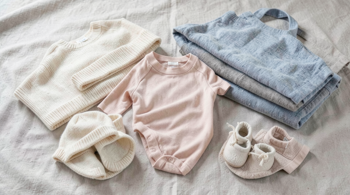
Luxury Baby Clothing Sets generally combine coordinated garments or accessories with premium materials, decorative details, and presentation intended for newborn gifting. Documented examples range from a three-piece cotton knit ensemble to larger sets containing sleepwear, bibs, hats, blankets, toys, or rattles, showing that the category covers both clothing-focused outfits and broader newborn layettes.
What Typically Defines a Luxury Set
A luxury baby set is usually distinguished by material selection, coordinated design, construction quality, and presentation rather than by one universal item count. The documented Pepa London set contains a top, footed bottoms, and bonnet, while MIKI HOUSE lists a coverall, kimono-style bodysuit, beanie, and mittens. These formats show how the term can describe either a formal outfit or a practical group of newborn layers. 1 3
- Common components include onesies, bodysuits, rompers, bonnets, hats, booties, mittens, bibs, and blankets.
- Larger gift formats may add loveys, rattles, or decorative packaging.
- Neutral colors and gender-neutral prints appear alongside traditional pink, blue, and ivory palettes.
Materials and Skin Comfort
Natural fibers are central to the documented luxury segment. Pepa London specifies 100% cotton for its European-made knitted set, MIKI HOUSE identifies cotton knit gauze and cotton jersey, and Willow & Cole describes a bonnet and booties set made from 100% cashmere. DaisySilk identifies 19 momme mulberry silk, while Solly Baby uses 94% certified TENCEL Modal blended with spandex. 1 3 6 8 9
- Cotton is represented as breathable, washable, and suitable for repeated daily use.
- Cashmere emphasizes softness, warmth, and a lightweight hand feel.
- Silk emphasizes smoothness and breathability but requires more careful washing.
- TENCEL Modal blends softness, stretch, and lightweight wearability.
Construction, Fit, and Newborn Function
Practical construction remains important even when appearance is formal. The MIKI HOUSE hadagi is described as a light kimono-style bodysuit intended to form a protective layer for newborn skin, while DaisySilk uses bottom snaps to simplify diaper changes. Solly Baby describes a pull-on two-piece design and selected sizes with convertible hand and foot covers. Estella specifies snap closures on its organic whale romper. 3 8 4 9
| Consideration | Documented example |
|---|---|
| Newborn layering | Kimono-style hadagi bodysuit |
| Diaper access | Bottom snaps or pull-on construction |
| Coverage | Attached feet, mittens, or convertible covers |
| Fit range | Preemie through 18 or 24 months in selected collections |
Design Language and Heirloom Appeal
Luxury baby clothing often uses coordinated visual language to create a complete presentation. Pepa London uses a diamond openwork knit and matching bonnet, while Pink Chicken pairs a floral cotton-voile top with a lined diaper cover, purlstitch trim, and satin bow. Maisonette’s Atelier Choux set uses Carousel Blue and Zodiac Blue prints across carrés and reversible bibs, with additional newborn pieces in a Hot Air Balloons design. 1 7 2
- Openwork knitting and embroidery create texture without relying on large graphics.
- Matching prints can extend across blankets, bibs, rompers, and accessories.
- Decorative trims include lace, satin bows, golden snaps, and embroidered motifs.
- Miniature versions of established fashion-house patterns are a recognized luxury-market direction, according to the supplied market research.
Pricing and Market Position
Documented prices span a wide range within the luxury and premium category. The Pepa London three-piece set is listed at $190, the MIKI HOUSE Polka Dot Gift Set at $200, Estella’s five-piece Whale Luxury Set at $218, and Maisonette’s Atelier Choux Luxury Gift Set at a regular price of $395. Other examples occupy lower price points, including a $99.99 silk onesie and a £70 cashmere bonnet and booties set. 1 3 4 2 8 6
These figures should not be treated as a standardized valuation system. Brand reputation, fiber, country of manufacture, item count, customization, packaging, and distribution channel all affect the amount attached to a set. The supplied market research places luxury designer newborn sets broadly from $200 to more than $800, while also identifying Gucci, Burberry, Bonpoint, Moncler, and Dior Baby as prominent designer names. 11
Presentation, Personalization, and Gifting
Presentation is a recurring part of the category’s value proposition. Maisonette describes an oversized Hotel Gift Box and offers monogramming with additional processing time, while Willow & Cole places its cashmere set in a signature gift box. MIKI HOUSE describes complimentary gift wrapping and notes that its set has a stated $240 value. Such details can make a set function as a ceremonial present, although they do not change the garment’s fiber, fit, or care requirements. 2 6 3
- Personalization can introduce longer preparation periods.
- Gift packaging may increase storage needs and does not substitute for garment durability.
- Monogrammed, bespoke, or christening-related items may have narrower return conditions.
Care, Sustainability, and Market Friction
Maintenance requirements vary materially. MIKI HOUSE specifies cold machine washing and line drying, Pink Chicken recommends a gentle cold cycle and hanging to dry, and DaisySilk advises cool washing, no bleach or softener, flat drying, and use of a mesh wash bag. Solly Baby identifies sustainably sourced and biodegradable TENCEL Modal, while Maisonette’s description identifies GOTS Certified Organic Cotton made in France for its carrés and bibs. 3 7 8 2
Market friction includes rapid infant growth, delicate-fiber care, stock variation, and restrictions on returns or exchanges. The supplied examples include newborn through toddler sizing, but sizes are not interchangeable across brands, and Estella provides separate measurements for several garment types. Luxury buyers should also distinguish fiber claims, certification claims, origin statements, and personalization policies, because each addresses a different aspect of product evaluation. 4
Resale and Evaluation Considerations
The supplied market research identifies resale platforms such as The RealReal and Vestiaire Collective as channels for authenticated pre-owned luxury children’s apparel, with durability and brand recognition contributing to resale interest. Authentication, condition, provenance, stains, alterations, and the completeness of a coordinated set can influence secondhand assessment. These factors make documentation and careful storage relevant, but no fixed resale return or value can be assumed. 12 13
- Check the fiber composition and care label rather than relying only on the word luxury.
- Compare garment measurements with the child’s current size needs.
- Review return, personalization, and final-sale conditions before ordering.
- Assess whether the set’s accessories will be used, stored, or retained as keepsakes.
Sources
- Pepa London, Diamond Openwork Three Piece Knitted Set
- Maisonette, Atelier Choux Luxury Gift Set
- MIKI HOUSE USA, Polka Dot Gift Set
- Estella, Whale Luxury Set
- Perfect Little Thing, Luxury Blue Teddy Bear Baby Two Piece and Bib Gift Set
- Willow & Cole, Cashmere Bonnet and Booties Set
- Pink Chicken, Baby Girls Jaipur 2-PC Set
- DaisySilk, Sleeveless Baby Silk Onesies
- Solly Baby, Pomegranate Baby Sleep Set
- Solly Baby, Thistle Block Baby Sleep Set
- Supplied luxury baby market research, including Gucci, Burberry, Bonpoint, Moncler, and Dior Baby references
- The RealReal, Kids and Baby category
- Vestiaire Collective, Baby category
Authored by MyTrendSpot team