Meal Prep Delivery Services: A Consumer Analysis of Formats, Nutrition, and Logistics
Meal prep delivery services generally describe two distinct arrangements: ingredient kits supplied with recipes for home cooking, and fully prepared meals intended to be reheated. The difference affects preparation time, kitchen work, storage requirements, portion control, and the type of nutrition information a customer receives.
Two core service formats
Meal kits deliver measured ingredients and cooking instructions rather than finished dishes. Green Chef describes pre-measured produce, proteins, sauces, spices, and dressings, with more than 80 weekly menu options across categories such as Keto, Plant Based, High Protein, Gluten-Free, Mediterranean, and Calorie Smart. 1 Gousto describes a similar cook-ahead model, with more than 175 weekly dishes, pre-portioned ingredients, and batch-cooking recipes. 6
| Format | What arrives | Main practical requirement |
|---|---|---|
| Ingredient meal kit | Measured ingredients, sauces, and recipes | Cooking, portioning, and cleanup at home |
| Prepared meal service | Cooked, portion-controlled dishes | Refrigeration and reheating |
Prepared services remove most of the chopping and cooking. BOZU states that its meals arrive chilled, fully cooked, macro-balanced, and ready to heat in two to three minutes. 4 Enzo Nutrition similarly reports microwave preparation in two to three minutes and delivers meals in two batches each week. 5 These services suit different routines, so the label “meal prep” alone does not identify the actual workload.
Menu design and dietary categories
Menus commonly organize meals around dietary patterns, calorie targets, or performance goals. Green Chef lists Keto, High Protein, Plant Based, Gluten-Free, Gut and Brain Health, Mediterranean, and Calorie Smart plans, with the latter described as meals containing 650 calories or less. 1 EveryPlate presents meal options for individuals, families, plant-based eating, and calorie-conscious planning. 2
- Diet-pattern categories may include keto, plant-based, vegetarian, vegan, Mediterranean, or gluten-free choices.
- Performance-oriented menus emphasize protein and macro balance.
- Calorie-controlled plans use stated calorie ranges or limits.
- Chef-prepared services may rotate dishes weekly or provide a larger selectable menu.
Some services present nutrition as a central planning tool. Z.E.N. Foods describes weight-loss plans at 1,200 to 1,500 calories daily and muscle-building plans at 2,000 to 2,500 calories with approximately 140 grams of protein per day. 3 Nutrition Solutions lists example meals averaging either 400 calories and 35 grams of protein or 571 calories and 56 grams of protein, depending on the plan. 7 Such figures are plan descriptions, not universal nutritional outcomes.
Prepared meals versus cooking kits
The main tradeoff is control versus convenience. Ingredient kits allow customers to cook meals at home, adjust seasoning, alter portions, and choose when preparation occurs. Gousto describes a model in which customers select recipes, receive measured ingredients, and cook ahead for the week. 6 The same structure still requires time, equipment, food handling, and cleanup, even when ingredients are organized in advance.
| Consideration | Meal kits | Prepared meals |
|---|---|---|
| Cooking effort | Required | Usually limited to reheating |
| Portion consistency | Depends on home preparation | Typically built into the package |
| Menu flexibility | Recipe selection and customization | Selection from prepared dishes |
| Storage | Raw ingredients need handling | Chilled or frozen storage may be required |
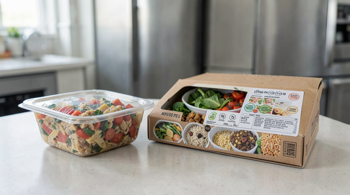
Prepared meals can make routine eating more predictable, but they reduce the role of the customer in cooking and may offer less control over final ingredients or serving size. BOZU specifically contrasts prepared meals with meal kits by emphasizing that customers do not need to shop, chop, or cook. 4 Enzo’s two-batch delivery structure illustrates another operational compromise: fewer delivery events than daily service, while meals remain organized around freshness. 5
Delivery models and logistics
Delivery schedules vary substantially. Enzo Nutrition describes twice-weekly deliveries on Sundays or Mondays for businesses and Wednesdays. 5 The Nutrition Chefs describes South-East England service that can be scheduled daily or as one-off support, with personal and performance plans. 8 Z.E.N. Foods describes fresh daily delivery in Southern California, while BOZU describes chilled delivery across the United Kingdom. 3 Location therefore determines which service structures are relevant.
- Daily delivery can reduce the amount stored at once but may involve more delivery coordination.
- Twice-weekly delivery concentrates logistics into defined batches.
- Chilled delivery requires the recipient to manage refrigeration after arrival.
- Meal kits involve raw ingredients, while prepared meals are generally ready for heating.
Delivery descriptions also reveal differences in geographic scope and packaging expectations. Allcook Kitchen states that it delivers across Switzerland, uses Swiss Post, and starts dishes at CHF 16.40. 9 The Nutrition Chefs lists daily delivery from £150 and five-day plans from £300. 8 These figures are examples from specific providers and should not be interpreted as a market-wide price range, especially because serving counts, delivery areas, and plan composition differ.
Nutrition claims and eligibility questions
Nutrition claims require careful interpretation. Terms such as “high protein,” “macro-balanced,” “organic,” “calorie-controlled,” and “dietitian approved” appear in the supplied service descriptions, but they do not all describe the same measurement. BOZU identifies high-protein, macro-balanced meals with labelled nutrition. 4 Z.E.N. Foods describes organic ingredients and dietitian-designed plans. 3 A consumer comparing services needs the actual calories, protein, carbohydrate, fat, allergens, and serving size.
Eligibility is often determined by dietary needs, location, household size, and preparation capacity rather than by a formal application process. Green Chef lists meal kits for singles, couples, and families, as well as multiple diet categories. 10 EveryPlate similarly describes options for one person and family feeding. 2 The supplied research does not establish medical eligibility rules, clinical supervision, or regulatory approval for any plan. People with allergies, diagnosed conditions, or prescribed dietary requirements should therefore treat marketing categories as starting descriptions, not medical certification.
Costs, maintenance, and consumer friction
Reported prices range from per-dish figures to multi-meal plans. Allcook lists dishes from CHF 16.40, Z.E.N. Foods lists plans from $33.45 per day, and Nutrition Solutions lists package examples from $162 for 12 meals to $276 for 28 meals under one displayed set of plans. 9 3 7 Direct comparison is difficult because currencies, meal counts, snacks, delivery inclusion, and nutrition targets are not standardized.
- Confirm whether delivery is included in the stated figure.
- Check the number of meals, snacks, and daily calories in each plan.
- Review delivery territory and the required refrigeration window.
- Assess whether skipping, pausing, or cancelling is permitted and how changes are managed.
- Inspect ingredient, allergen, and nutrition labels rather than relying only on category names.
Ongoing maintenance is part of the service experience. Green Chef describes app-based order customization, delivery tracking, and recipe management, while both Green Chef and EveryPlate state that plans can be paused or cancelled. 1 2 The research does not specify universal rules for refunds, missed deliveries, shelf life, packaging disposal, or food-safety oversight. Those omissions are practical friction points that should be resolved through each provider’s written terms before a plan is evaluated.
Sources
- Green Chef
- EveryPlate
- Z.E.N. Foods
- BOZU
- Enzo Nutrition
- Gousto
- Nutrition Solutions
- The Nutrition Chefs
- Allcook Kitchen
- Green Chef Meal Kit Delivery Options
Authored by MyTrendSpot team